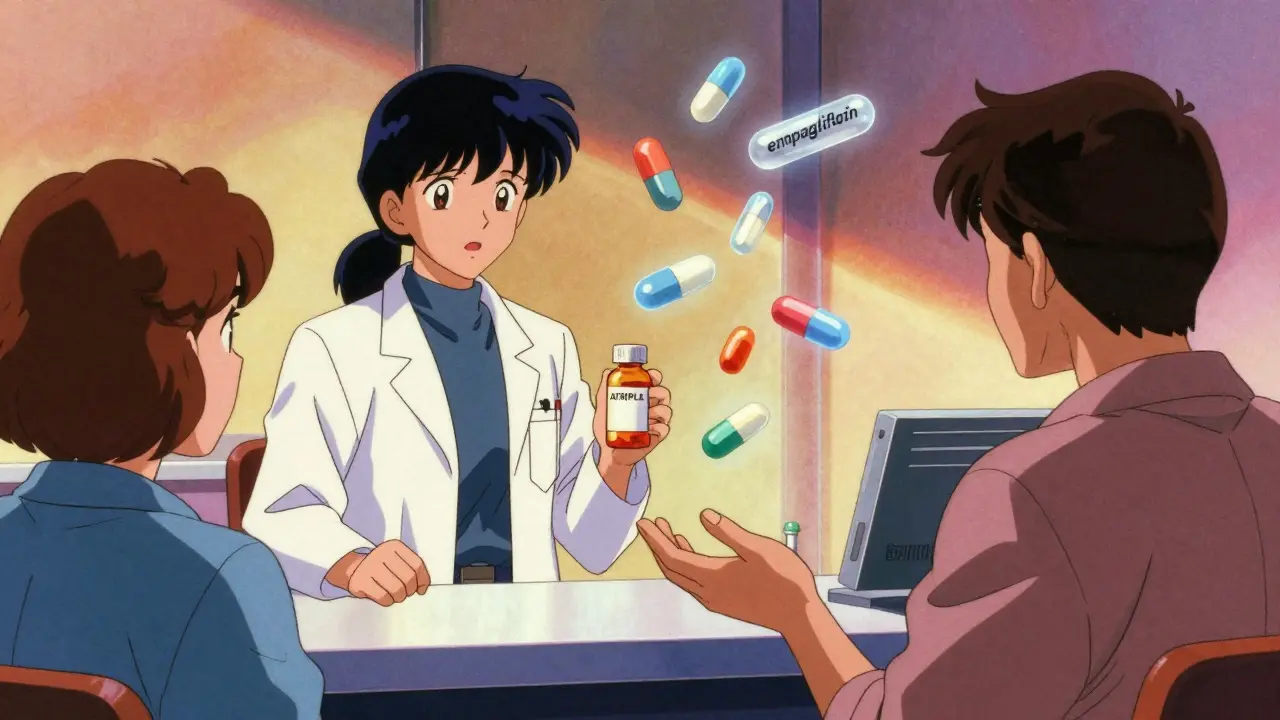
When a doctor prescribes a medication, they’re not just picking a drug-they’re picking a combination. Think of it like a recipe: two, three, or even four active ingredients mixed into one pill to treat a single condition. These are called fixed-dose combinations (FDCs), and they’re everywhere now-from HIV treatment to heart disease and diabetes. But here’s the problem: when pharmacies try to swap one combination drug for another, things get messy. Fast. Legal. Dangerous. And no one’s fully ready for it.
What Exactly Is a Combination Drug?
A combination drug isn’t just two pills in one blister pack. It’s a single dosage form-tablet, capsule, injection-with two or more active ingredients chemically combined. ATRIPLA, for example, packs efavirenz, emtricitabine, and tenofovir into one pill for HIV. That’s three separate drugs, each with its own dosing schedule, side effect profile, and metabolic pathway, now locked together. The idea? Reduce pill burden. Improve adherence. Cut costs. But here’s what most people don’t realize: this isn’t just a medical decision. It’s a regulatory one. The FDA defines these as combination products-blends of drugs, biologics, or even devices. And once you mix regulated components, the rules change. You can’t just swap them like you would a single generic drug.Why Generic Substitution Rules Don’t Work Here
Most states have laws allowing pharmacists to substitute a brand-name drug with a generic version if it’s deemed “therapeutically equivalent.” That means same active ingredient, same strength, same form. Simple. Clean. But with combination drugs, “equivalent” gets blurry. Take a prescription for metformin 500mg. A pharmacist can swap it for any generic metformin. But if the doctor prescribed metformin + sitagliptin (a common combo for type 2 diabetes), can the pharmacist swap it for metformin + empagliflozin? Legally? Probably not. Clinically? Maybe. But that’s not the pharmacist’s call. The problem? State substitution laws were written for single-entity drugs. They assume one active ingredient. One bioequivalence study. One manufacturer. Combination products break all those assumptions. Two drugs? Three? Each with different release profiles, absorption rates, or interactions? There’s no standardized way to prove they’re interchangeable.The Legal Tightrope: Prescribing vs. Substituting
Pharmacists aren’t doctors. They can’t rewrite prescriptions. That’s the law. But in practice, they’re being pushed to do just that. Alberta’s College of Pharmacy makes it clear: substituting a single drug with a combination product counts as initiating therapy. That requires prescribing authority. So if a patient has a prescription for lisinopril, and the pharmacy only has lisinopril + hydrochlorothiazide in stock, the pharmacist can’t just give it to them-even if it’s clinically better. They’d need a new prescription. And it goes the other way too. If a doctor prescribes a combo, can the pharmacist split it and give two separate generics? No. That’s not allowed either. The combination product is treated as a single unit. Even if the ingredients are available separately, the FDA and most state boards consider the combo as a distinct product. This creates a nightmare for patients on fixed incomes. They get a prescription for a branded combo drug like KEYTRUDA + LENVIMA (approved for kidney cancer in 2021). It costs $15,000 a month. The individual components? Much cheaper. But the pharmacist can’t substitute them. The patient pays the full price-or goes without.State Laws Are a Patchwork
There’s no national standard. Texas, California, New York-all have different rules. Some allow substitution if the combo contains only FDA-approved components. Others require the exact same formulation. Some require prescriber consent. Others don’t even mention combination products in their statutes. A 2022 survey by the National Community Pharmacists Association found 68% of independent pharmacists faced a combination substitution dilemma at least once a month. Over 40% refused to substitute because they weren’t sure if it was legal. That’s not confidence. That’s fear. And when patients move across state lines? Forget it. A substitution that’s legal in Georgia might be illegal in Minnesota. Pharmacies don’t have time to check 50 sets of rules. So they play it safe. And patients suffer.
Cost Savings vs. Patient Risk
The push for substitution isn’t just bureaucratic. It’s economic. Generic drugs make up 90% of prescriptions in the U.S. but only 23% of drug spending. Combination products? They’re expensive. The global market hit $184 billion in 2022. Insurance companies want to cut costs. Medicaid and Medicare Part D are pushing therapeutic substitution hard. Dr. Jane Chen from ICER estimates substitution could save 15-25% on chronic disease meds. That’s billions. But Dr. John Smith from the FDA warned Congress in 2022: “The current patchwork creates confusion-and safety risks.” Why? Because some combos have narrow therapeutic windows. Too much or too little of one component? You could trigger arrhythmias, kidney failure, or liver toxicity. The European Medicines Agency specifically warns against substituting these without physician oversight. And the American Heart Association says inappropriate substitution in cardiovascular combos could lead to adverse events in up to 8% of elderly patients. That’s not a small number. That’s thousands of people every year.What’s Being Done? New Rules on the Horizon
The FDA released draft guidance in September 2022 on how to prove therapeutic equivalence for fixed-dose combinations. That’s a start. The National Association of Boards of Pharmacy proposed a tiered system in March 2023: simple combos (two old, well-known drugs) vs. complex ones (novel mechanisms, narrow index). Only the simple ones might be eligible for pharmacist substitution. The European Commission made harmonizing substitution rules a priority in its 2023 Pharmaceutical Strategy. The UK’s NHS already has strict protocols for cardiovascular combos-and saved £280 million a year since 2019. Germany? Still requires a doctor’s signature for every switch. And courts are stepping in. In Smith v. CVS Caremark (2022), the 9th Circuit ruled that pharmacists can’t substitute a combo product that includes extra active ingredients not prescribed. Even if those ingredients are safe. Even if they’re clinically beneficial. The law says: stick to the prescription.What Should Patients and Pharmacists Do?
If you’re a patient: always ask. “Is this the exact combo my doctor prescribed? Can I get the individual drugs cheaper?” Don’t assume substitution is safe. Ask for a copy of the prescription label. Compare ingredients. If something’s changed, call your doctor. If you’re a pharmacist: document everything. If you’re unsure, don’t substitute. Contact the prescriber. Use the FDA’s Drug Database to check if the combo is listed as a single entity. Know your state’s rules. And never assume a combo is interchangeable just because the ingredients match. The truth? Combination drugs are the future. By 2025, nearly one in three new drug approvals will be combos. But our laws? They’re stuck in 2005. We need clear, national standards. We need training for pharmacists. We need systems that flag high-risk combos before substitution. And most of all, we need to stop treating complex medical treatments like simple commodity swaps. Cost savings matter. But not if it costs someone their life.
What Happens If a Pharmacist Substitutes Without Permission?
If a pharmacist substitutes a combination drug without legal authority, they’re not just breaking pharmacy rules-they’re breaking the law. The consequences vary by state but can include fines, suspension of license, or even civil liability if a patient is harmed. In one case in 2021, a pharmacist in Ohio swapped a patient’s prescribed amlodipine + valsartan combo for amlodipine + hydrochlorothiazide, thinking the diuretic was a safer alternative. The patient developed acute kidney injury and had to be hospitalized. The pharmacist was sued. The pharmacy lost its license. Even if the substitution seems harmless, the legal system doesn’t care. The prescription is the law. Anything else is an unauthorized change.Can a Doctor Prescribe Individual Components Instead of a Combo?
Yes. And many do-especially if cost is a concern. A doctor can write separate prescriptions for each drug in a combination. That gives the pharmacy flexibility to source generics, adjust doses, or switch components independently. But there’s a catch. It increases pill burden. A patient might have to take four pills instead of one. That reduces adherence. Studies show patients on multi-pill regimens are 30% less likely to stick with their treatment. So it’s a trade-off: control vs. convenience. Doctors have to weigh clinical need, cost, and patient behavior. Pharmacists can’t make that call. That’s why substitution rules exist-to protect patients from well-intentioned but unauthorized changes.Are Biosimilars or Generic Combos Allowed to Be Substituted?
Biosimilars are excluded from most substitution rules-even for single-entity drugs. For combination products? Even more so. A biosimilar combo (like a biologic + small molecule) hasn’t been studied for interchangeability. No FDA designation exists yet. As for generic combos: yes, they exist. But they’re rare. Only 37 combination drug products were approved between 2015 and 2022, compared to over 1,200 single-entity drugs. Why? Because proving bioequivalence for multiple active ingredients is technically hard, expensive, and legally risky. So if you see a “generic combo,” it’s likely a brand-name product with no direct generic alternative. Don’t assume it’s interchangeable. Always check the active ingredients and manufacturer.What’s the Future of Combination Drug Substitution?
The trend is clear: more combos. More complexity. More pressure to cut costs. But the system isn’t ready. The best path forward? A federal framework that:- Classifies combos into tiers: simple (two old, stable drugs) vs. complex (novel, narrow index)
- Requires prescriber consent for complex combos
- Allows pharmacist substitution only for simple combos with FDA-approved equivalence data
- Creates a national database of approved interchangeable combos
- Trains pharmacists on combo-specific risks
Can a pharmacist substitute a combination drug without a doctor’s approval?
Generally, no. Most state laws treat combination drugs as single units. Substituting one combo for another-even if the ingredients seem similar-is considered initiating new therapy, which requires prescribing authority. Pharmacists can only swap single-entity generics, not combination products, unless their state has specific rules allowing it and the combo is listed as interchangeable.
Why can’t I just get the individual drugs in a combo instead of the pill?
You can, and sometimes it’s cheaper. But taking multiple pills increases the chance you’ll miss a dose. Combination drugs were designed to simplify treatment. If you split them, you lose that benefit. Your doctor may prefer the combo for adherence reasons, especially for chronic conditions like HIV or hypertension.
Are all combination drugs the same in terms of substitution rules?
No. Simple combos-like two well-known drugs (e.g., metformin + sitagliptin)-are more likely to have approved generic equivalents. Complex combos-like a new biologic paired with a small molecule (e.g., pembrolizumab + lenvatinib)-have no interchangeable versions. Regulatory agencies treat them differently, and so should you.
What should I do if my pharmacy gives me a different combo than prescribed?
Stop taking it. Check the label. Compare the active ingredients to your prescription. If there’s any difference-even one extra ingredient-call your doctor and the pharmacy immediately. Never assume it’s safe. Unauthorized substitution can lead to serious side effects or drug interactions.
Is there a list of approved interchangeable combination drugs?
Not yet. The FDA doesn’t maintain a public list of interchangeable combination products like it does for single-entity generics (the Orange Book). Some states have internal databases, but there’s no national standard. Always verify with your pharmacist or prescriber before assuming substitution is allowed.





Elizabeth Ganak
28 December, 2025 17:48 PMWow, this hit home. I’m a pharmacist in Delhi, and we get this all the time-patients come in with a combo script, but only one of the generics is in stock. We’re stuck between helping them afford meds and breaking the law. No one trains us for this. I’ve had to call doctors at 10 PM just to ask if it’s okay to swap. It’s exhausting.
Elizabeth Alvarez
29 December, 2025 21:49 PMLet me tell you what they don’t want you to know: Big Pharma doesn’t want generics for combos because they make WAY more money off the branded versions. They lobby state boards to keep the rules confusing. That’s why there’s no national database. That’s why pharmacists are scared. It’s not about safety-it’s about profit. The FDA? They’re asleep at the wheel. You think this is an accident? Nah. It’s engineered. And they’re counting on you to just take whatever they give you.
Todd Scott
31 December, 2025 10:24 AMThere’s a real gap here between regulatory theory and clinical reality. In the U.S., we treat combination drugs like Lego blocks-snap them together, call it a product-but the pharmacokinetics don’t work that way. Two drugs in one pill aren’t just additive; they can alter absorption, metabolism, even gut flora. The EMA’s approach is smarter: tiered classification based on risk. Simple combos like metformin + sitagliptin? Fine for pharmacist substitution with clear labeling. Complex ones like pembrolizumab + lenvatinib? Absolutely not. We need a U.S. equivalent-standardized, evidence-based, and updated every 18 months. Until then, we’re playing Russian roulette with chronic disease patients.
Andrew Gurung
31 December, 2025 11:43 AMOMG. 😱 So you’re telling me some pharmacist in Ohio swapped a combo and someone got kidney failure? And they’re STILL letting this happen?! This is why America’s healthcare is a dumpster fire. 🗑️🔥 I mean, if I can’t even trust my pharmacist not to play doctor, who CAN I trust? My dog? My TikTok therapist? Someone needs to sue the entire pharmacy industry into oblivion. This is not healthcare. This is a horror movie with bad lighting.
Paula Alencar
31 December, 2025 13:29 PMIt is imperative that we recognize, with the utmost gravity, that the current regulatory framework governing fixed-dose combination products is not merely outdated-it is fundamentally incompatible with the evolving paradigm of personalized, patient-centered care. The fragmentation of state-level statutes creates a patchwork of legal ambiguity that places undue burdens upon both healthcare practitioners and vulnerable populations. A federal standard, grounded in pharmacovigilance data, therapeutic equivalence metrics, and patient adherence outcomes, is not merely advisable-it is an ethical imperative. We must elevate this issue from a logistical inconvenience to a civil rights concern: the right to safe, affordable, and predictable pharmaceutical care.
Nikki Thames
1 January, 2026 23:46 PMLet’s be honest: the real issue isn’t the law-it’s the patient’s failure to take responsibility. Why are people so dependent on pharmacies to make medical decisions? If you can’t manage four pills, maybe you’re not ready for chronic disease management. This isn’t about cost-it’s about personal discipline. And don’t get me started on the idea that ‘adherence’ justifies combining drugs without oversight. That’s medical paternalism dressed up as convenience. Patients need to be educated, not coddled. The system isn’t broken-it’s being abused by people who want everything to be easy.
Chris Garcia
3 January, 2026 05:11 AMIn Nigeria, we face a different kind of chaos-no regulation at all. Pharmacies sell combination drugs like candy. One man came in asking for his HIV combo, but the shopkeeper gave him three separate pills and said, ‘Same thing, brother.’ I stood there, stunned. No one checks bioequivalence. No one knows the FDA. But we still save lives. Maybe the answer isn’t more rules-it’s more training. More community pharmacists who understand the science, not just the price tag. We don’t need Washington to fix this. We need local champions with white coats and courage.
James Bowers
3 January, 2026 11:24 AMThe notion that pharmacists should be allowed to substitute combination products under any circumstances is a dangerous fallacy. The legal and clinical boundaries are not blurred-they are clearly delineated by decades of jurisprudence and pharmacological science. Any deviation from the prescriber’s exact specification constitutes an unauthorized practice of medicine. The fact that some states permit exceptions does not render the principle invalid; it renders those states negligent. The only acceptable path forward is strict adherence to the prescription as written. Period.
Olivia Goolsby
5 January, 2026 02:36 AMWait-wait-WAIT. 😳 So you’re telling me that the FDA, which approved these combo drugs in the first place, doesn’t even have a public list of which ones are interchangeable?! And you’re telling me this isn’t a conspiracy?! They’re hiding it! They’re hiding it because if people knew how many of these combos are NOT interchangeable, they’d riot! And the insurance companies? They’re pushing this so they can deny coverage for the real drugs and force people into unsafe swaps! This is a cover-up! Someone needs to file a FOIA request-NOW! And leak the internal emails! This is worse than the opioid crisis!
Alex Lopez
5 January, 2026 16:29 PMSo let me get this straight: we have a $184B market for combination drugs, no national standard for substitution, pharmacists terrified of lawsuits, and patients paying $15K/month for a pill that could be $300 if split… and the solution is… more paperwork? 😅 The irony is beautiful. We’re so afraid of a pharmacist swapping a pill that we’re letting people go bankrupt. Maybe the real problem isn’t substitution-it’s that we treat medicine like a spreadsheet instead of a human experience. Just let pharmacists swap simple combos with clear labeling. Add a 10-second warning on the receipt: ‘This isn’t your original script-call your doctor if unsure.’ Done. Problem solved. Why is this so hard?