
You take your morning pill. You take your afternoon supplement. You take your evening prescription. It feels routine, safe even. But what if the way those drugs interact isn't just about chemistry? What if it’s about your DNA?
For decades, doctors treated drug interactions as a numbers game based on averages. If Drug A slows down the liver enzyme that processes Drug B, then Drug B builds up in your system. Simple math. But this model ignores one massive variable: you. Your genetics determine how fast or slow your body metabolizes medications. When you combine standard drug-drug interaction risks with your unique genetic profile, the risk landscape changes completely.
This is where Pharmacogenomics (PGx) comes in. It’s not just a buzzword; it’s a clinical tool that reveals why two people can take the exact same combination of pills and have wildly different outcomes. One person gets relief; the other ends up in the emergency room. Understanding how PGx influences drug interaction risk is no longer optional for modern healthcare-it’s essential for survival.
The Hidden Third Player in Drug Interactions
Traditional drug interaction checkers look at two things: the perpetrator drug and the victim drug. They ask, "Does Drug X inhibit the enzyme that breaks down Drug Y?" If yes, flag a warning. This is useful, but incomplete.
Enter the third player: your genes. Specifically, the genes that code for enzymes like CYP2D6 and CYP2C19. These enzymes are the body’s primary machinery for breaking down medications. Here is the problem: your genetic makeup determines whether these enzymes work at full speed, half speed, or not at all.
Imagine a scenario where you are genetically a "poor metabolizer" of a certain drug because your CYP2D6 gene has a mutation that renders it inactive. Now, imagine you start taking a new medication that also inhibits CYP2D6. In a typical patient, this might cause a mild increase in drug levels. In you, it creates a perfect storm. The drug cannot be processed by your broken enzyme, and the new drug blocks whatever residual activity you might have. The result? Toxicity.
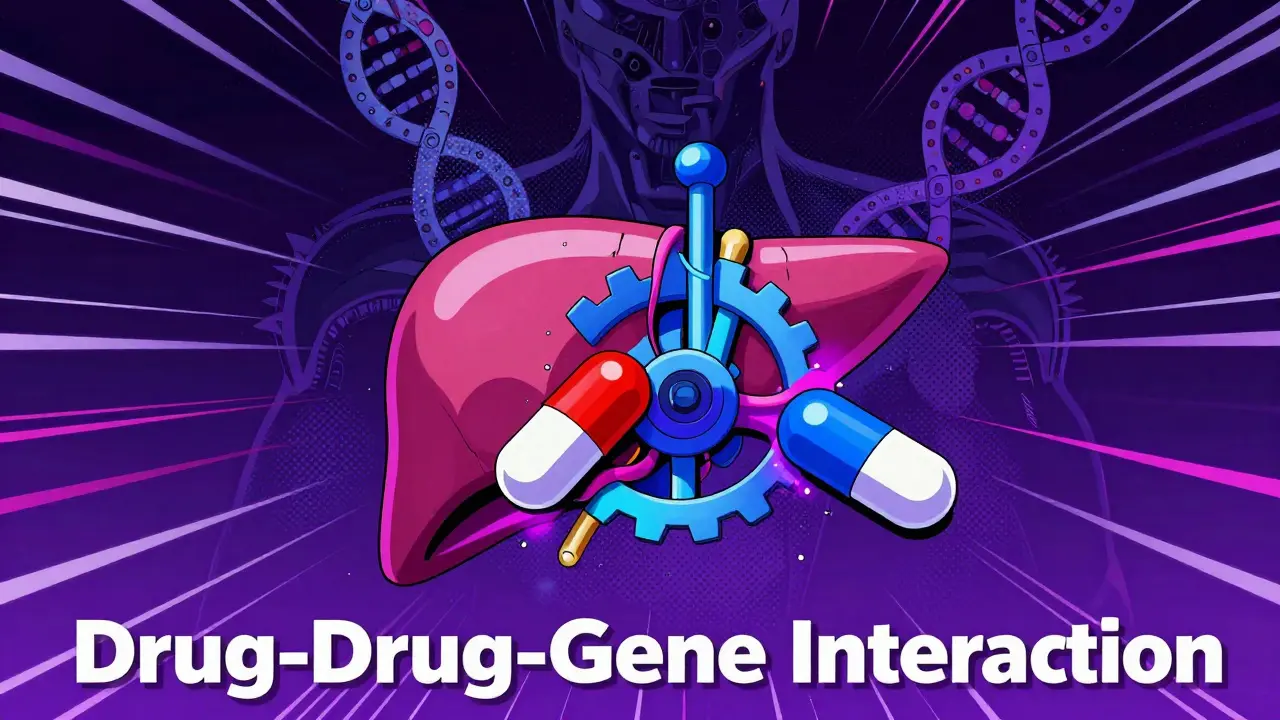
This phenomenon is called a Drug-Drug-Gene Interaction (DDGI). Research published in the American Journal of Managed Care found that when genetic polymorphisms were considered, the estimated probability of any interaction impact increased by nearly 91%. That is not a small margin. It means traditional screening misses almost half of the dangerous combinations lurking in your prescription list.
Three Ways Genetics Mess With Drug Chemistry
To understand the risk, you need to know the mechanics. DDGIs operate through three distinct mechanisms. Knowing which one applies to you helps explain why a doctor might suddenly change your dosage or switch your medication entirely.
- Inhibitory Interactions: This is the classic blockage. A "perpetrator" drug reduces the activity of an enzyme. If you already have low enzyme activity due to genetics, this inhibitor pushes your metabolism into overdrive-or rather, under-drive-causing drug concentrations to spike dangerously high.
- Induction Interactions: Here, a drug speeds up enzyme production. If you are genetically prone to slow metabolism, induction might actually help clear the drug faster. However, if you are a "rapid metabolizer," induction can clear the drug so quickly that it becomes ineffective before it can do its job.
- Phenoconversion: This is the trickiest one. Phenoconversion happens when a drug temporarily alters your metabolic phenotype. For example, you might have a genetic variant that makes you a "ultra-rapid metabolizer." But if you take a strong inhibitor, that inhibitor overrides your genetics, turning you into a "poor metabolizer" for the duration of the treatment. Your genotype stays the same, but your functional phenotype changes, leading to unexpected toxicity.
The European Medicines Agency notes that pharmacokinetic interactions (how the body handles the drug) account for about 60% of clinically significant PGx interactions. The remaining 40% are pharmacodynamic (how the drug affects the body), such as when two drugs target the same receptor pathway, amplified by genetic sensitivity.
Why Polypharmacy Makes Genetics Matter More
If you take one or two medications, the odds of a severe genetic interaction are lower. But if you are like 13% of U.S. adults who take five or more medications daily-a condition known as polypharmacy-the risk multiplies exponentially.
Dr. Julie Johnson, Editor-in-Chief of Clinical Pharmacology & Therapeutics, noted that preemptive PGx testing could reduce clinically relevant drug interactions by up to 30% in patients taking multiple drugs. Why? Because each additional drug adds another layer of complexity to your metabolic pathways. With five drugs, you aren’t just managing five separate effects; you are managing potentially dozens of cross-interactions, all filtered through your unique genetic lens.
Consider antidepressants and painkillers. Both classes heavily rely on the CYP2D6 enzyme. If you are on an SSRI (which often inhibits CYP2D6) and a codeine-based painkiller (which requires CYP2D6 to activate), and you happen to be a poor metabolizer, you get zero pain relief from the codeine. Worse, if you are an ultra-rapid metabolizer, you convert codeine to morphine too quickly, risking respiratory depression. Add a second inhibitor to the mix, and the risk skyrockets.
| Feature | Traditional DDI Checker | PGx-Informed Assessment |
|---|---|---|
| Data Source | Population averages | Individual genetic variants + population data |
| Interaction Detection | Drug-Drug only | Drug-Drug-Gene (DDGI) |
| Risk Accuracy | High false positives/negatives | Personalized risk stratification |
| Clinical Impact | Generic warnings | Dosage adjustments or drug switches |
| Missed Risks | ~34% of major impacts missed | Significantly reduced blind spots |
Real-World Examples: When Genes Save Lives
Theory is fine, but let’s talk about real consequences. Two drugs illustrate the power of PGx perfectly: Warfarin and Carbamazepine.
Warfarin (Blood Thinner): Warfarin is notoriously difficult to dose. Its effectiveness depends on two main genes: CYP2C9 (metabolism) and VKORC1 (target sensitivity). Dr. Alan H. Shuldiner from NIH noted that PGx-guided dosing reduces time in therapeutic range by 27% and major bleeding events by 31% compared to standard dosing. If you take another drug that interacts with CYP2C9, and you don’t know your genetic baseline, you are guessing. Guessing with blood thinners can lead to strokes or fatal bleeds.
Carbamazepine (Seizure/Mood Stabilizer): This drug carries a black box warning for patients with the HLA-B*15:02 allele. People with this genetic marker have a 50-100 times higher risk of developing Stevens-Johnson Syndrome, a life-threatening skin reaction. If a patient with this allele takes carbamazepine along with other drugs that stress the immune system, the outcome can be catastrophic. Genetic testing before prescribing eliminates this risk entirely.
At Mayo Clinic’s Center for Individualized Medicine, they implemented preemptive PGx testing years ago. Their data shows that 89% of patients had at least one actionable PGx variant. By integrating this data into their electronic health records, they reduced inappropriate prescribing by 45%. That is a tangible, measurable improvement in patient safety.

The Barrier to Entry: Why Isn’t Everyone Doing This?
If PGx is so effective, why isn’t it standard practice everywhere? The answer lies in infrastructure, education, and equity.
First, there is a knowledge gap. A 2023 survey found that only 28% of community pharmacists felt adequately trained to interpret PGx results. Doctors are busy; they don’t have time to decode complex allele tables (*1 = normal function, *3 = no function, etc.) during a 15-minute appointment. Without integrated clinical decision support systems that automatically flag DDGIs based on stored genetic data, the test sits unused in the file.
Second, there is the issue of diversity. Current PGx guidelines are heavily skewed toward populations of European ancestry. A 2023 study in Cell Genomics reported that only 2% of PGx research participants represented African ancestry populations. Genetic variants differ significantly across ethnic groups. A guideline built on white male data may not accurately predict risks for women or people of color. This creates a disparity where some patients benefit from precision medicine while others face higher uncertainty.
Finally, cost and reimbursement remain hurdles. While the global PGx market is growing rapidly, reaching $7.2 billion in 2022, insurance coverage varies. Many payors still view genetic testing as experimental for general polypharmacy, covering it only for specific drugs like warfarin or clopidogrel. This forces patients to choose between paying out-of-pocket or sticking with trial-and-error prescribing.
What You Can Do Today
You don’t need to be a geneticist to advocate for safer medication management. Here are practical steps to protect yourself:
- Audit Your Meds: List every prescription, over-the-counter drug, and supplement you take. Share this complete list with your pharmacist. Ask specifically: "Do any of these interact with my liver enzymes?"
- Ask About Testing: If you are starting a high-risk medication (like psychotropics, blood thinners, or chemotherapy), ask your doctor if pharmacogenomic testing is appropriate. Mention CPIC guidelines-they are the gold standard for evidence-based recommendations.
- Understand Your Phenotype: If you get tested, don’t just accept a raw data report. Ask for a clinical interpretation. Do you have a "poor metabolizer" status for CYP2D6? Does that mean you need a lower dose of Codeine? Get the translation from gene to action.
- Monitor for Side Effects: Be vigilant. If a new drug causes unexpected fatigue, dizziness, or nausea, it might not be a side effect of the drug itself, but an interaction amplified by your genetics. Report it immediately.
The future of medicine is not one-size-fits-all. It is precise, personalized, and predictive. Pharmacogenomics is the key that unlocks this potential, turning drug interactions from a gamble into a calculated risk. By understanding how your genes influence your meds, you take control of your health narrative. Don’t leave your safety to chance. Know your genes, know your drugs, and live safer.
What is a Drug-Drug-Gene Interaction (DDGI)?
A DDGI occurs when a patient's genetic makeup affects how their body processes a combination of drugs. Unlike standard drug-drug interactions, which assume average metabolism, DDGIs account for individual variations in enzymes like CYP2D6. This can lead to unexpected toxicity or lack of efficacy when multiple drugs interact with a genetically compromised metabolic pathway.
Who should consider pharmacogenomic testing?
Testing is most beneficial for patients on polypharmacy (taking 5+ medications), those who experience frequent adverse drug reactions, or individuals starting high-risk medications like antidepressants, anticoagulants, or chemotherapies. It is also crucial for patients with a history of treatment failure where genetic resistance might be the cause.
Can pharmacogenomics replace traditional drug interaction checkers?
No, it complements them. Traditional checkers identify chemical incompatibilities between drugs. Pharmacogenomics identifies biological incompatibilities between the patient and the drugs. Using both provides a comprehensive safety net, reducing missed risks by up to 34% compared to using traditional checkers alone.
What is phenoconversion in pharmacogenomics?
Phenoconversion is when a drug temporarily alters a patient's metabolic phenotype, overriding their genetic predisposition. For example, a patient with a fast-metabolizing genotype might become a slow metabolizer if they take a strong enzyme inhibitor. This mismatch can lead to sudden toxicity despite a "safe" genetic profile.
Are pharmacogenomic tests covered by insurance?
Coverage varies widely. Some insurers cover specific tests for drugs like warfarin or clopidogrel. Broad preemptive panels are less consistently covered. Patients should check with their provider and insurer, and look for tests backed by CPIC guidelines, which often have stronger reimbursement support.





Peter Sverla
3 July, 2026 20:43 PMI've been reading up on this because my dad has been on a cocktail of meds for his heart and depression. It's wild to think that the standard interaction checkers are basically guessing games if they don't account for your specific CYP enzymes. I'm curious, does anyone here know if these tests are actually covered by insurance for general polypharmacy or is it still mostly out-of-pocket? The article mentions CPIC guidelines but my local pharmacy just shrugged when I asked.
Sydney Jarrett
5 July, 2026 11:13 AMLet's be real, the average person doesn't have the cognitive bandwidth to understand allele frequencies or pharmacokinetic half-lives. This entire discourse is essentially medical gaslighting wrapped in expensive testing fees. You're telling people their 'routine' pills are a gamble, which induces unnecessary health anxiety. The FDA approves drugs based on population averages for a reason-statistical significance matters more than your unique genetic quirk. Most of you will never encounter a DDGI severe enough to warrant a $200 test, yet here we are, hyperventilating over phenoconversion. It's classic fear-mongering disguised as precision medicine. Stop trying to monetize basic biology.
Lorena Suarez
6 July, 2026 09:35 AMi get where sydney is coming from with the cost thing but honestly knowing my body better feels like a win not a scam. i had this weird reaction to an antibiotic once and turned out i was a poor metabolizer for something related. it was scary at first but now i just tell my doc before they prescribe anything new. its kinda cool how science is catching up to the fact that we are all different. no need to be so mean about it though
Ben Murphy
7 July, 2026 07:24 AMThe ethical implications of relying on such fragmented data are profound. When you introduce pharmacogenomic variables into clinical decision-making without standardized protocols, you create a tiered healthcare system where only those with the means can access safety. This is not progress; it is negligence masked as innovation. The lack of diversity in the underlying datasets, as noted in the post, means that minority populations are systematically excluded from these 'safety nets.' We are effectively gambling with lives based on incomplete models derived from Eurocentric biases. It is morally indefensible to promote this as a solution when the foundational data is so skewed.
Fred Stone
7 July, 2026 21:42 PMlook i work in a hospital lab and yeah ben has a point about the diversity gap but its getting better slowly. most places still use old algorithms. but for us techies who take 5+ meds its worth it. i got tested last year and found out i process blood thinners super slow. saved me a trip to the er probably. dont listen to the haters just ask your doc if its right for u. simple as that. no big deal really just another blood draw
Brett Aungst
8 July, 2026 14:13 PMFred, you're oversimplifying the clinical utility. While anecdotal evidence supports PGx, the widespread adoption is hindered by the lack of integrated clinical decision support (CDS) systems. Most EHRs do not automatically flag DDGIs based on stored genetic data, meaning the test results often sit unused in patient files. Furthermore, the interpretation of variants like CYP2D6 *1/*4 requires specialized training that most community pharmacists lack. Until we see better infrastructure, pushing patients toward self-advocacy places an unfair burden on them to navigate complex pharmacological landscapes.
Isis Fleming
8 July, 2026 20:44 PMIt is quite fascinating to observe the varying perspectives on this matter. As a pharmacist, I can attest that while the technology is promising, the implementation challenges are significant. We must ensure that equitable access is prioritized alongside technological advancement. The disparity in research participation across ethnic groups is indeed a critical concern that needs immediate attention from regulatory bodies. Perhaps collaborative efforts between healthcare providers and researchers could help bridge this gap more effectively in the near future.
Vinay Bairagi
10 July, 2026 07:12 AMThis western obsession with individual genetics ignores the holistic approach we have practiced for centuries. In India, we understand that diet, lifestyle, and environment play a far greater role in drug metabolism than some isolated gene variant. Your reliance on expensive tests is a symptom of a broken healthcare system that fails to treat the root cause. Instead of spending billions on these gimmicks, focus on preventive care and natural remedies that do not require a DNA sequence to be effective. The arrogance of assuming one-size-fits-all Western medicine is superior is laughable.