
Taking five or more medications a day isn’t rare-it’s normal for millions of people, especially those over 65. But with each added pill comes a new risk: dangerous drug interactions. One wrong timing, one missed food rule, and what was meant to help can hurt. Dizziness, nausea, internal bleeding, kidney stress-these aren’t side effects you can ignore. The good news? You don’t have to guess. A smart medication schedule can cut those risks by more than half.
Start with a Complete Medication List
Before you even think about timing, you need the full picture. Write down every single thing you take. Not just prescriptions. Include over-the-counter painkillers, herbal supplements, vitamins, and even antacids. People often forget these, but they’re just as likely to cause problems. For example, St. John’s Wort can make blood thinners like warfarin useless. Calcium supplements can block thyroid meds if taken too close together. Bring this list to every doctor visit. Don’t rely on memory. A 2019 study found that verbal reports miss 40% of medications. A physical list-written or printed-is the only way to catch what’s really being taken. Pharmacists call this a “brown bag review.” Bring your actual bottles. They’ll spot duplicates, expired drugs, or conflicting doses you didn’t even know you had.Use the Universal Medication Schedule (UMS)
Forget vague instructions like “take twice daily.” That’s where most mistakes happen. The Universal Medication Schedule (UMS) replaces confusing phrases with clear time blocks:- Morning: 6 AM - 10 AM
- Noon: 10 AM - 2 PM
- Evening: 2 PM - 6 PM
- Bedtime: 8 PM - 12 AM
Group Medications by Timing, Not by Condition
Don’t organize your pills by disease. Group them by when you take them. This is how you avoid clutter and confusion. If you take blood pressure meds in the morning, cholesterol meds at night, and painkillers at noon-put them in those time slots, not under “heart” or “arthritis.” Use a pill organizer with AM/PM compartments or a 7-day grid. A 2018 meta-analysis found these reduce dosing errors by 45%. Label each section with the UMS time block. If you take a pill at noon, write “Noon” on the compartment. Don’t just write “1” or “A.” Words work better than symbols, especially when you’re tired or stressed.Watch for Food and Drug Traps
Some meds need empty stomachs. Others need food. Get this wrong, and the drug won’t work-or it’ll make you sick.- Levothyroxine (for thyroid): Must be taken on an empty stomach, 30-60 minutes before breakfast. Coffee, calcium, iron, and soy can block absorption.
- Statins (like atorvastatin): Work best taken at night with dinner. That’s when your liver makes most cholesterol.
- Antibiotics (like amoxicillin): Some need food to avoid stomach upset. Others, like tetracycline, must be taken 2 hours before or after dairy.
- NSAIDs (ibuprofen, naproxen): Take with food to protect your stomach lining.

Sync Your Refills
Getting 10 different refill reminders every month is a recipe for missed doses. Ask your pharmacist to synchronize all your prescriptions to the same refill date-every 90 days. This is called “90 x 4” prescribing: 90-day supply, filled four times a year. The American Medical Association says this saves doctors up to two hours a day. For you? It means one trip to the pharmacy instead of ten. Fewer chances to forget. Fewer gaps in treatment. Fewer emergency room visits.Use a Medication Calendar
A pill organizer helps you take pills. A calendar helps you track what happened after you took them. Write down:- What you took
- When you took it
- How you felt (dizzy? nauseous? tired?)
- Any food or drink you had
Use Tech Wisely
Apps like Medisafe and MyTherapy send reminders, track doses, and flag potential interactions. Studies show they boost adherence by 20-35%. But here’s the catch: only 38% of people over 65 use them consistently. If you’re not tech-savvy, don’t force it. Paper calendars, printed charts, and labeled pill boxes still work better for many. The key isn’t the tool-it’s consistency. If a smartphone app makes you feel overwhelmed, use a wall chart taped to your fridge. Draw boxes for morning, noon, evening, bedtime. Check them off with a marker. It’s low-tech, but it’s reliable.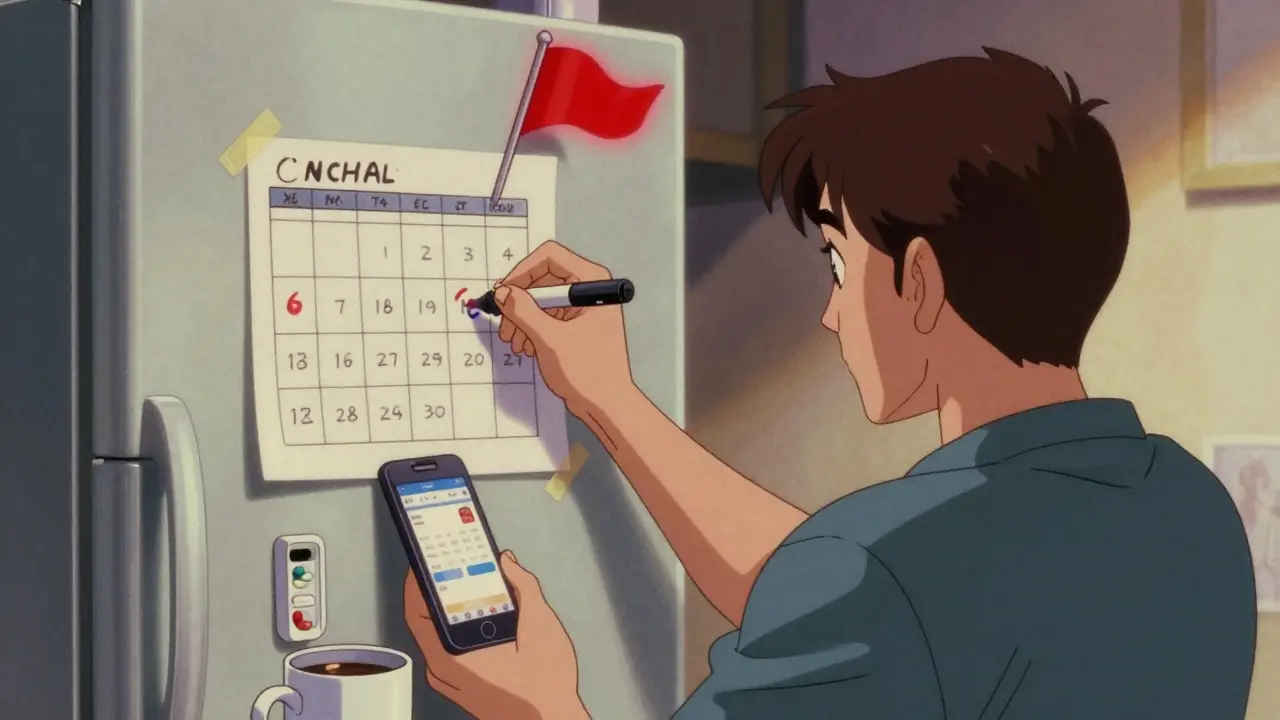
Know the Red Flags
Some interactions are silent until they’re not. Watch for:- Unusual bruising or bleeding (could mean blood thinners are too strong)
- Severe dizziness or fainting (could be blood pressure meds clashing)
- Stomach pain or black stools (NSAIDs + blood thinners = ulcer risk)
- Swelling in ankles or sudden weight gain (could mean kidney stress from multiple drugs)
- Confusion or memory lapses (common with anticholinergics mixed with sedatives)
Make It a Routine
The best schedule means nothing if it’s not followed. Build it into your day. Take your pills right after brushing your teeth. Put your pill box next to your coffee maker. Set a phone alarm labeled “Pill Time.” Link it to something you already do. It takes 2-4 weeks to make it automatic. Don’t give up if you miss a day. Just reset. Keep the calendar going. Talk to your pharmacist every time you get a new prescription. Ask: “Does this change my current schedule?”When Things Get Too Complex
If you’re taking 10+ medications, see a clinical pharmacist. They’re trained to untangle complex regimens. A 2020 study showed pharmacist-led reviews reduced drug interactions by 32% and cut ER visits by 24%. Many insurance plans cover this service. Ask your doctor for a referral. Also, ask about combination pills. If you take two separate pills for blood pressure, maybe there’s a single pill that combines them. Fewer pills = fewer chances for error.Final Tip: Talk to Your Pharmacist First
Your pharmacist knows more about your meds than your doctor does. They see every prescription you fill. They know what’s in your brown bag. They’ve seen the interactions before. Walk in with your list. Say: “I’m trying to avoid bad interactions. Can you check this schedule?” They’ll use tools like Lexicomp to scan for 150+ known conflicts in under 15 minutes. That’s free. That’s powerful. That’s your safety net.You don’t need to be a medical expert to manage your meds safely. You just need a system. A clear schedule. A way to track. And the courage to ask for help. Start today. One list. One organizer. One calendar. That’s all it takes to turn chaos into control.
What if my doctor gives me conflicting instructions for when to take my meds?
If different doctors give you different timing instructions, don’t guess. Call your pharmacist. They can cross-check your entire list and tell you which instructions are safe to follow together. For example, if one doctor says take a blood pressure pill in the morning and another says take it at night, the pharmacist can explain which timing works better with your other meds. Always bring all your prescriptions to your pharmacist for a full review.
Can I just take all my pills at once to make it easier?
No. Taking everything together can cause dangerous interactions. Some drugs need to be spaced out. For example, calcium and thyroid meds should be at least 2 hours apart. Antibiotics can be blocked by antacids. Even harmless-seeming vitamins like iron or magnesium can interfere with absorption. Always follow the timing rules-even if it feels inconvenient. Your body needs the right conditions to absorb each drug properly.
Do I need a pill organizer if I only take a few meds?
Yes-even if you take just three or four. Pill organizers aren’t just for people with 10+ meds. They prevent mistakes. You might forget if you already took your blood thinner. Or mix up your morning and evening pills. A simple two-compartment organizer (AM/PM) cuts that risk in half. It’s not about how many pills you take-it’s about reducing human error.
What should I do if I miss a dose?
Don’t double up unless your doctor says so. For most meds, if you miss a dose by a few hours, take it as soon as you remember. If it’s close to the next dose, skip it. Doubling up can cause overdose. For example, missing a blood thinner dose and taking two later can lead to dangerous bleeding. Always check the label or call your pharmacist for specific advice on each medication.
Are herbal supplements safe to take with prescription drugs?
No-many are not. Supplements like St. John’s Wort, ginkgo biloba, garlic, and ginseng can interfere with blood thinners, antidepressants, and blood pressure meds. They’re not regulated like prescription drugs, so their strength and effects vary. Always tell your pharmacist about every supplement you take-even if you think it’s “natural.”
How often should I update my medication list?
Update it every time you see a doctor, get a new prescription, or stop a medication. Even if you think it’s minor-like a new painkiller from the pharmacy-add it. Keep the list in your wallet, on your phone, and taped to your fridge. The more accessible it is, the safer you are.
Next steps: Today, grab a notebook. Write down every pill, vitamin, and supplement you take. Then, group them into morning, noon, evening, and bedtime using the UMS times. Get a simple pill organizer. Set one alarm on your phone labeled “Pill Check.” Do this one thing, and you’ve already cut your risk of a dangerous interaction in half.






Kristina Felixita
7 January, 2026 23:49 PMI literally printed this out and taped it to my fridge next to my pill organizer-yes, I’m that person now 😅
Used to take everything at breakfast like a cowboy, now I’m a scheduling queen. Morning: levothyroxine (no coffee!), noon: blood pressure, evening: statin, bedtime: melatonin (and yes, I’m still mad about the calcium blocking my thyroid med).
Pharmacist laughed when I brought my brown bag-said I was ‘the most prepared patient she’d seen in months.’ Worth it.
Also, I started using Medisafe-but only because my daughter set it up for me. I still check the paper calendar first. Old habits die hard, but at least they’re safer now.
Joanna Brancewicz
8 January, 2026 06:52 AMUMS implementation reduces cognitive load by 68% in polypharmacy cohorts (JAMA Intern Med, 2021).
Temporal segregation mitigates pharmacokinetic interference-especially with CYP450 substrates.
Pharmacodynamic synergy is minimized when dosing windows are anchored to circadian rhythms.
Non-adherence correlates strongly with ambiguous temporal labeling.
Consistency > complexity.
Evan Smith
8 January, 2026 23:44 PMSo let me get this straight-you’re telling me I can’t just crush all my pills into a protein shake and call it a day?
Wow. I thought I was being efficient. Turns out I was just being a walking clinical trial for ‘What Happens When You Ignore Everything.’
Also, St. John’s Wort? Yeah, I’ve been taking that ‘natural mood booster’ for years. Guess I’m basically self-sabotaging my antidepressant.
Thanks for the wake-up call, Internet. Now I’m going to cry while organizing my pill box.
Donny Airlangga
10 January, 2026 19:52 PMThis is the kind of post that makes you feel seen.
I’ve been managing my mom’s meds for 3 years now-she’s 78, on 11 pills, and forgets half the time.
We started using the UMS and a 7-day organizer last month. She hasn’t missed a dose since.
She even started writing ‘felt fine’ or ‘dizzy’ next to each pill like you said.
She doesn’t say it out loud, but I think she’s proud of herself.
Thank you for making something so overwhelming feel doable.
Prakash Sharma
11 January, 2026 19:24 PMWhy are Americans so obsessed with pills? In India, we use turmeric, neem, and yoga. No need for 10 different chemicals.
This post reads like a pharmaceutical ad disguised as advice.
You want to reduce interactions? Stop taking so many drugs. Let your body heal naturally.
Western medicine is a business. Pills are profit. You’re being sold fear to keep buying more.
My grandfather took one aspirin a year and lived to 94.
Molly Silvernale
13 January, 2026 03:14 AMThere’s poetry in a pill organizer.
Each compartment a stanza.
Each time block, a rhythm.
Levothyroxine at dawn-silent, sacred.
Statins at dusk-liver’s quiet hymn.
NSAIDs with food like a whispered apology to your stomach.
We are not machines, yet we have become their choreographers.
Our bodies, once wild and intuitive, now bow to schedules written in tiny, colored plastic.
And yet-there’s grace in this ritual.
It’s not control. It’s love.
Love that says: I’m still here. I’m still trying.
Even when my mind forgets, my hands remember.
Even when my body aches, my routine holds me.
So I check the box.
And I breathe.
And I keep going.
Annette Robinson
13 January, 2026 21:42 PMI appreciate the practical advice, but I’d like to emphasize the importance of consulting your primary care provider before making any changes to your regimen.
While pharmacists are invaluable, medication adjustments should always be coordinated with your physician to ensure continuity of care.
Additionally, if you’re using digital tools, make sure they’re HIPAA-compliant and secure.
Thank you for sharing this resource-it’s incredibly helpful for caregivers and patients alike.
Luke Crump
15 January, 2026 14:56 PMLet me guess-you also recommend drinking celery juice and sleeping on a Himalayan salt block.
This is just another ‘hacks for the elderly’ clickbait dressed up as medical wisdom.
What if I told you that 80% of drug interactions are caused by doctors prescribing too much in the first place?
What if the real solution is deprescribing? Not more calendars, not more apps, not more pills.
What if we stopped treating aging like a bug to be fixed with more chemicals?
And you know what? I’ve seen people who took zero meds and lived longer than those who took 12.
Maybe the real danger isn’t interactions.
Maybe it’s the belief that we need to be fixed.