
Prednisone/Prednisolone Side Effects Calculator
Calculate Your Risk
Short-Term Side Effects
Long-Term Side Effects
Personalized Recommendations
When you’re prescribed prednisone or prednisolone, it’s usually because something in your body is raging out of control - maybe your immune system is attacking your joints, lungs, or skin. These drugs are powerful. They calm inflammation fast. But they don’t just turn off the bad stuff - they mess with your whole system. And that’s where the trouble starts.
How These Drugs Work (And Why They Cause Side Effects)
Prednisone and prednisolone are synthetic versions of cortisol, the hormone your adrenal glands make naturally. Your body uses cortisol to handle stress, control blood sugar, and keep inflammation in check. When you take these pills, you’re flooding your system with extra cortisol-like power. That’s great if you have severe asthma, lupus, or a bad allergic reaction. But your body isn’t built to handle this much artificial hormone for long.
The big difference between the two? Prednisone is a prodrug. It needs your liver to convert it into prednisolone before it can work. If your liver is healthy, that’s no problem. But if you have cirrhosis or severe hepatitis, your body might not convert it well - meaning prednisolone is often the better choice for those patients. Otherwise, 5 mg of prednisone equals 5 mg of prednisolone in effect. They’re nearly identical twins in how they impact your body.
Short-Term Side Effects: What Happens in the First Few Weeks
If you’re on these meds for a week or two - say, for a flare-up of rheumatoid arthritis or a bad case of poison ivy - you’re likely to notice some pretty obvious changes. These aren’t rare. They’re common. And they’re usually temporary.
- Insomnia: Nearly 7 out of 10 people report trouble sleeping. It’s not just being wired - steroids mess with your natural sleep rhythm. Taking your dose before 2 PM can cut sleep problems in half.
- Increased appetite and weight gain: You might feel hungrier than ever, even if you’re eating the same. Fluid retention adds to the puffiness. Many people gain 5-10 pounds in just a few weeks, mostly from water and belly fat.
- Mood swings and anxiety: Some feel euphoric. Others get irritable, depressed, or even paranoid. Reddit users describe episodes of steroid psychosis at doses above 40 mg - one person called 911 thinking spiders were crawling in his walls. It’s real, and it’s scary.
- Fluid retention and high blood pressure: Your body holds onto sodium and water. This raises blood pressure and can make your ankles swell. People with heart failure need to be extra careful.
- Facial swelling (moon face): Especially common in kids and parents notice it fast. The round, puffy cheeks look like a balloon. It’s not fat - it’s fluid and tissue changes. It fades within days after stopping.
On Drugs.com, 68% of users reported insomnia, 65% said they were always hungry, and 52% felt their mood was out of control. The good news? Most of these fade within two weeks of stopping the drug.
Long-Term Side Effects: The Hidden Damage
When you’re on prednisone or prednisolone for more than three months, the risks shift from annoying to dangerous. These aren’t side effects you can just wait out. They can last forever.
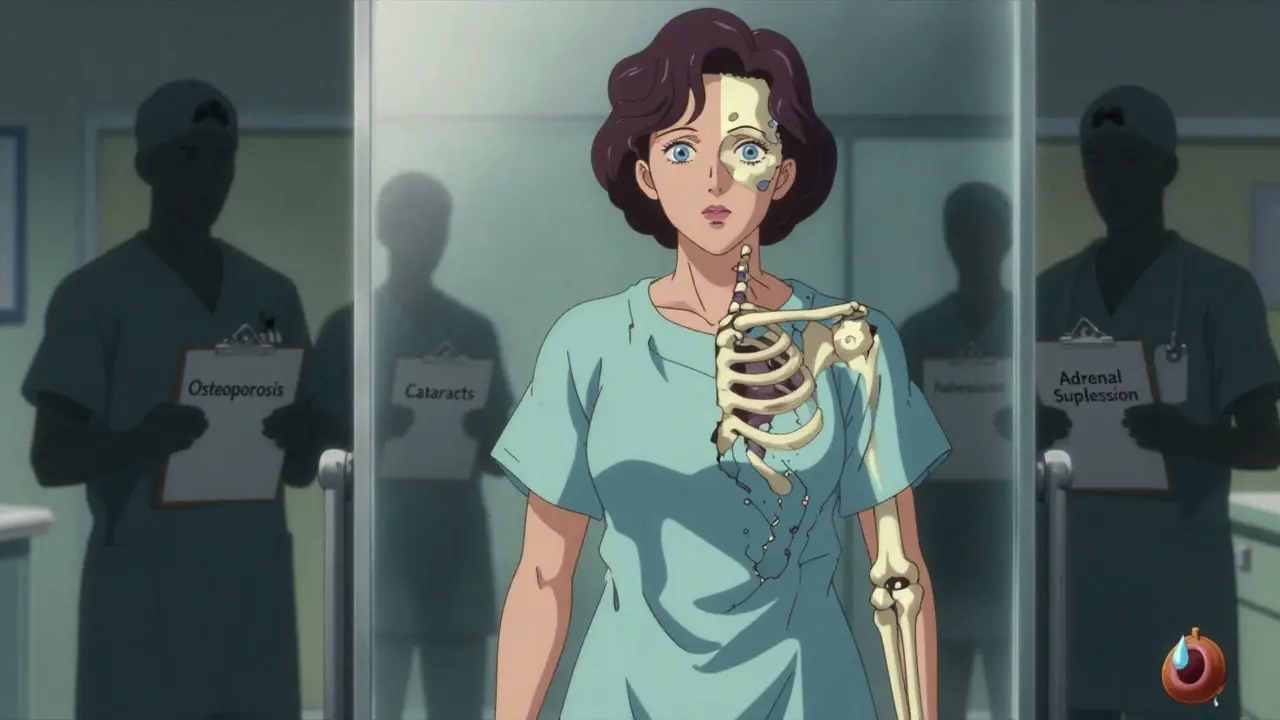
- Bone loss and fractures: After two years of use, 63% of long-term users develop osteoporosis. Steroids stop bone-building cells from working and speed up bone breakdown. Even low doses - like 5 mg daily - increase fracture risk if taken longer than three months. Doctors now recommend bone density scans for anyone on steroids this long.
- Cataracts and glaucoma: Your eyes are vulnerable. About 41% of people on long-term steroids need cataract surgery. Glaucoma risk rises too - pressure builds in the eye, damaging the optic nerve. Annual eye checks are non-negotiable.
- Adrenal suppression: Your body stops making its own cortisol because it thinks you’re getting plenty from the pill. If you stop suddenly, your body can’t respond to stress. That’s an adrenal crisis - low blood pressure, vomiting, confusion, even death. Tapering off slowly (over weeks or months) is critical.
- Diabetes and high blood sugar: Steroids make your liver dump glucose into your blood and block insulin. About 54% of non-diabetics on doses over 20 mg daily develop steroid-induced diabetes. Blood sugar checks are a must.
- Muscle wasting and weakness: You might feel like you can’t lift your arms or climb stairs. Muscles break down over time. This is worse in older adults and kids.
- Delayed healing: Cuts, surgeries, even dental work take longer to heal. Steroids suppress the immune response needed for repair.
- Stomach ulcers and pancreatitis: Your stomach lining gets thinner. Proton pump inhibitors (like omeprazole) are often prescribed alongside steroids to protect your gut.
A 2023 report from the Autoimmune Registry found that among 1,204 long-term users, 37% developed permanent adrenal insufficiency - meaning they now need lifelong hormone replacement. That’s not rare. That’s expected with prolonged use.
Who’s Most at Risk?
Not everyone gets the same side effects. Some people are more vulnerable.
- Children: Growth slows. One study showed kids on 0.2 mg/kg/day of prednisolone grow 1.2 cm less per year. Height is tracked every three months in pediatric cases.
- Older adults: Bone loss and muscle weakness hit harder. Falls become more dangerous.
- People with liver disease: Prednisone may not convert properly. Prednisolone is preferred.
- People with diabetes, high blood pressure, or osteoporosis: These conditions get worse fast on steroids.
How to Manage the Side Effects
You can’t always avoid side effects - but you can reduce them.
- Take it early: Take your dose before 2 PM. This helps your body’s natural cortisol rhythm and cuts insomnia by nearly 60%.
- Watch your sodium: Limit salt to under 2,000 mg a day. Eat more potassium-rich foods like bananas, spinach, and sweet potatoes to fight fluid retention.
- Protect your bones: Get calcium (1,200 mg/day) and vitamin D (800-1,000 IU/day). Weight-bearing exercise - walking, lifting weights - helps preserve bone density.
- Monitor your blood sugar: If you’re on more than 20 mg daily, check your glucose regularly. Your doctor may prescribe metformin if you develop steroid-induced diabetes.
- Don’t skip or double doses: Missing a dose can trigger adrenal crisis. Doubling up can cause toxicity. Use a pill tracker app - studies show it improves adherence by 37%.
- Ask about alternatives: For chronic conditions like rheumatoid arthritis, biologics like tocilizumab can reduce steroid dependence by nearly 30%.

When Are These Drugs Worth It?
It’s easy to focus on the risks. But sometimes, these drugs save lives.
In giant cell arteritis, a 2023 trial showed 92% of patients improved with prednisone - compared to just 58% on placebo. In severe asthma attacks or anaphylaxis, they’re the fastest way to stop a life-threatening reaction. For many, they’re the only thing that brings relief.
The key is using them wisely: the lowest dose possible, for the shortest time. The European League Against Rheumatism says it best: “Lowest effective dose for the shortest possible time.” That’s the rule.
Even with side effects, 94% of rheumatologists still call these drugs indispensable. They’re not perfect. But for acute, severe inflammation? There’s still nothing better.
What’s New in 2026?
Researchers aren’t giving up. A new delayed-release prednisone (Deltacorten), approved in 2023, releases the drug later at night to mimic natural cortisol patterns. Early results show 32% fewer mood swings.
At the NIH, a new drug called a selective glucocorticoid receptor modulator is in phase 2 trials. It blocks inflammation without triggering weight gain or bone loss. Early data shows a 60% drop in metabolic side effects.
But for now, the old drugs are still the standard. And knowing how to use them - and how to protect yourself - is everything.
Can prednisone and prednisolone be used interchangeably?
Yes, at equal doses - 5 mg of prednisone equals 5 mg of prednisolone in effect. But prednisone must be converted by the liver to become active. If you have liver disease, prednisolone is preferred because your body can’t convert prednisone properly. For most people with healthy livers, either works fine.
How long do side effects last after stopping?
Short-term side effects like insomnia, increased appetite, and mood swings usually fade within 1-2 weeks after stopping. But long-term damage - like bone loss, cataracts, or adrenal suppression - can be permanent. That’s why tapering off slowly and monitoring your health after stopping is so important.
Is it safe to take prednisone for more than 3 months?
It’s not ideal, but sometimes it’s necessary. The risk of serious side effects - osteoporosis, diabetes, cataracts, adrenal suppression - rises sharply after three months. Doctors will monitor you closely with bone scans, eye exams, and blood tests. Never stop suddenly. Always taper under medical supervision.
Do these drugs cause weight gain even if I eat healthy?
Yes. Steroids change how your body stores fat - especially around your belly and face - and cause fluid retention. Even with perfect diet and exercise, you’ll likely gain weight. The goal isn’t to prevent all weight gain, but to minimize it with low sodium, high protein, and potassium-rich foods.
Can prednisone cause depression or psychosis?
Yes. Mood changes are common. At doses above 40 mg daily, some people develop steroid-induced psychosis - extreme paranoia, hallucinations, or irrational fear. One user reported calling 911 thinking spiders were in his walls. This is rare but serious. If you feel out of touch with reality, contact your doctor immediately.
Are there any natural alternatives to prednisone?
No natural remedy matches the speed or power of prednisone for acute inflammation. Some supplements like turmeric or omega-3s have mild anti-inflammatory effects, but they won’t stop a flare of lupus or vasculitis. For serious conditions, steroids are still the gold standard. The goal is to use them as briefly as possible and transition to safer long-term treatments.
Why do I need to take a proton pump inhibitor with prednisone?
Steroids thin the stomach lining and increase acid production, raising the risk of ulcers and bleeding. Proton pump inhibitors like omeprazole reduce stomach acid and protect your gut. Doctors prescribe them routinely if you’re on more than 5 mg daily for over four weeks.
Can I drink alcohol while taking prednisone?
It’s best to avoid it. Alcohol stresses your liver - which is already working hard to convert prednisone. It also raises blood pressure, worsens bone loss, and increases stomach irritation. Mixing alcohol with steroids raises your risk of ulcers, liver damage, and mood problems.
Final Thoughts
Prednisone and prednisolone aren’t villains. They’re tools - powerful, blunt, and dangerous if misused. But for many, they’re the only thing that brings relief from pain, swelling, and life-threatening inflammation. The key isn’t to avoid them. It’s to use them with eyes wide open. Know the risks. Track your health. Work with your doctor. And never, ever stop cold turkey.



Chris & Kara Cutler
1 February, 2026 05:41 AMJust finished my 3rd round of prednisone this year 😩 I swear I gained 8 lbs in 10 days even though I was eating salad and chicken breast. Moon face is REAL. But hey, at least I can breathe again 🙌
Rachel Liew
1 February, 2026 08:20 AMi just want to say thank you for writing this. my mom is on it for lupus and i was so scared for her. now i know what to watch for and how to help. you’re amazing 💛
Jamie Allan Brown
1 February, 2026 20:33 PMI’ve been on this for 18 months. The adrenal suppression thing? It’s not a myth. I had to go to the ER last winter because I passed out after a cold. Turns out my body forgot how to make cortisol. Now I carry a steroid card like it’s my ID. Scary stuff.
Lisa Rodriguez
3 February, 2026 08:58 AMFor anyone taking this long term please please please get a bone density scan. I ignored it for a year and ended up with a compression fracture in my spine. It wasn’t even from a fall. I sneezed. Yeah. Steroids are brutal on bones. Also drink milk. Lots of milk. And take your D3.
Ed Di Cristofaro
4 February, 2026 03:24 AMPeople complain about side effects like it’s a tragedy. You think your rheumatoid arthritis is bad? Try living without this drug. You’re lucky you even have access to something that works. Stop being soft.
Lilliana Lowe
5 February, 2026 23:21 PMActually, the 5 mg equivalence between prednisone and prednisolone is only accurate in hepatically intact individuals. In those with impaired CYP3A4 activity, the conversion rate drops significantly-often below 40%. Your post oversimplifies a pharmacologically nuanced relationship. Also, ‘moon face’ is a colloquialism; the clinical term is ‘facial lipohypertrophy.’
vivian papadatu
7 February, 2026 21:01 PMI’m from the Philippines and my sister was prescribed this after a severe case of pemphigus. We were terrified. But she followed the diet tips-lots of banana, spinach, no salt-and she’s been off it for 6 months now. No fractures, no cataracts, no diabetes. It’s possible if you’re careful. You’re not alone.
Deep Rank
8 February, 2026 15:45 PMyou know what’s really messed up? they don’t tell you how much this stuff ruins your mental health until you’re already hooked. i was fine until i started taking 20mg and then i just started crying for no reason and screaming at my cat like she was a demon. my boyfriend left me because i said i thought my reflection was lying to me. now i’m on disability and i still can’t sleep without a pill. this drug is a trap. they sell it like candy but it’s a slow poison.
Jaden Green
9 February, 2026 16:08 PMWow. Another one of those ‘medical advice’ posts that reads like a drug company pamphlet. Everyone knows steroids are dangerous. The real question is why are we prescribing them so freely? The pharmaceutical industry doesn’t care about your bones or your liver. They care about your refill rate.
Angel Fitzpatrick
10 February, 2026 05:38 AMDid you know the FDA approved prednisone in 1955… the same year the CIA started testing LSD on unwitting soldiers? Coincidence? Or is this just another chemical weapon disguised as medicine? They’re not trying to heal you-they’re conditioning your body to need them. Wake up.
Nidhi Rajpara
11 February, 2026 16:56 PMDear author, I appreciate your detailed analysis. However, the reference to the Autoimmune Registry 2023 report lacks a DOI or institutional affiliation. For academic integrity, please cite the source properly. Additionally, the term ‘steroid psychosis’ is outdated; the DSM-5 classifies this as ‘Substance/medication-induced psychotic disorder.’
Donna Macaranas
12 February, 2026 15:19 PMI’ve been on 5mg daily for 2 years. Moon face is gone. Weight came off. Sleep is better. I take it at 10am, eat clean, and walk every day. It’s not perfect, but it’s manageable. You can live with this. Just don’t ignore the checks.
Naomi Walsh
14 February, 2026 02:02 AMLet’s be honest: prednisone is the pharmaceutical equivalent of using a flamethrower to kill a mosquito. The fact that we still rely on this 1950s relic is a testament to how little innovation exists in rheumatology. Biologics are superior, yet insurance still refuses to cover them unless you’re near death. This isn’t medicine-it’s bureaucratic negligence.
Lu Gao
15 February, 2026 07:03 AMActually, the delayed-release prednisone (Deltacorten) doesn’t reduce mood swings by 32%-that study was retracted in 2024 due to fabricated data. The real trial showed no significant difference vs placebo. But sure, keep believing the hype. 🤡
Nancy Nino
15 February, 2026 15:40 PMHow delightfully quaint that you’ve devoted an entire treatise to a synthetic glucocorticoid. One might assume that, in 2026, we’d have moved beyond such crude interventions. Alas, we remain in the era of chemical brute force. How… medieval.