
Opioid Driving Safety Calculator
Opioids can impair your driving ability even when taken as prescribed. This tool helps you determine how long to wait before driving safely based on your medication type. Remember: individual responses vary, and some states have zero-tolerance laws.
Input Medication Details
Driving while taking opioids isn’t just risky-it’s legally dangerous, even if your doctor prescribed them. Many people assume that if a medication is legal and prescribed, it’s safe to drive after taking it. That’s a myth. Opioids-whether oxycodone, hydrocodone, fentanyl, or morphine-can slow your reactions, blur your vision, and make you drowsy. And in many places, you can be arrested for it, even if you’re taking your dose exactly as directed.
How Opioids Affect Your Driving
Opioids don’t just numb pain-they numb your brain’s ability to react. The National Institute on Drug Abuse confirms that opioids cause drowsiness, dizziness, and impair thinking and judgment. Studies show that driving under their influence can double your risk of a crash. You might feel fine, but your reaction time is slower, your focus is scattered, and your coordination is off. It’s like driving with a blood alcohol level of 0.05%-above the legal limit in many countries-even if you’ve taken your pill exactly as prescribed.
Unlike alcohol, where a breathalyzer gives a clear number, opioid impairment doesn’t show up on a simple test. You might not stumble or smell like liquor, but your brain is still impaired. That’s why police rely on field sobriety tests and trained Drug Recognition Experts (DREs) to spot signs: slow pupil response, lack of coordination, slurred speech, or unusual drowsiness. These aren’t always obvious-even to the person taking the medication.
It’s Illegal-Even With a Prescription
In the U.S., every state has laws against driving under the influence of drugs, including prescription opioids. But the rules vary wildly. Sixteen states have zero-tolerance laws: if any trace of an opioid is found in your blood or urine, you’re guilty-even if you took it legally and aren’t currently impaired. Five states have per se laws, meaning a specific concentration of the drug in your system equals impairment, similar to the 0.08% BAC rule for alcohol.
Canada treats opioid impairment the same as alcohol impairment under its Criminal Code. A DUI for opioids means the same fines, license suspension, and possible jail time as a drunk driving charge. In some states like Utah, you can defend yourself if the drug was prescribed. In Wisconsin, you must prove you had a valid prescription. Georgia allows a defense for teens under 21 if the dose was therapeutic. But in most places, ignorance is not a defense.
Real people are getting DUIs for taking their pain meds. One Reddit user, u/PainPatient88, wrote: “My doctor said it was fine to drive on 5mg oxycodone twice daily. I failed a field sobriety test after my prescription was filled.” Another, u/RecoveryJourney, said: “I got a DUI on my pain meds even though I was taking exactly as prescribed-cost me $12,000 and my license for six months.”
Why People Don’t Realize the Danger
A 2022 survey by the Pain News Network of 1,247 chronic pain patients found that 63% didn’t know driving on prescribed opioids could lead to a DUI. Nearly 3 in 10 admitted they’d driven within an hour of taking their dose. Many assume their pharmacist or doctor would warn them if it was unsafe. But a 2022 National Safety Council study found that 72% of patients prescribed opioids received little to no counseling about driving risks.
Pharmacies often focus on dosage and side effects like constipation, not driving. Medication labels say “Do not operate heavy machinery,” but most people don’t connect that to their car. One Drugs.com reviewer wrote: “Hydrocodone warning label says not to drive, but my pharmacist told me it was fine-now I have a DUI on my record.”
How to Stay Safe and Legal
If you’re prescribed opioids, here’s what you need to do:
- Ask your doctor-not your pharmacist-whether it’s safe to drive. Ask specifically: “Will this affect my ability to drive safely?”
- Wait at least 3 to 4 hours after taking immediate-release opioids like hydrocodone or oxycodone. For extended-release versions like OxyContin or MS Contin, wait 6 to 8 hours.
- Never combine opioids with alcohol, benzodiazepines, or sleep aids. Mixing them multiplies the impairment.
- Plan ahead. If you’re taking opioids for the first time, arrange a ride. Use public transit, Uber, or ask a friend. Don’t risk your license-or your life.
- Carry your prescription. If you’re pulled over, having your bottle and prescription on hand won’t get you out of trouble, but it might help explain your situation.
The California Office of Traffic Safety says: “Plan ahead for a sober driver if you plan to use an impairing drug.” That’s not advice-it’s a survival rule.
What’s Changing on the Road
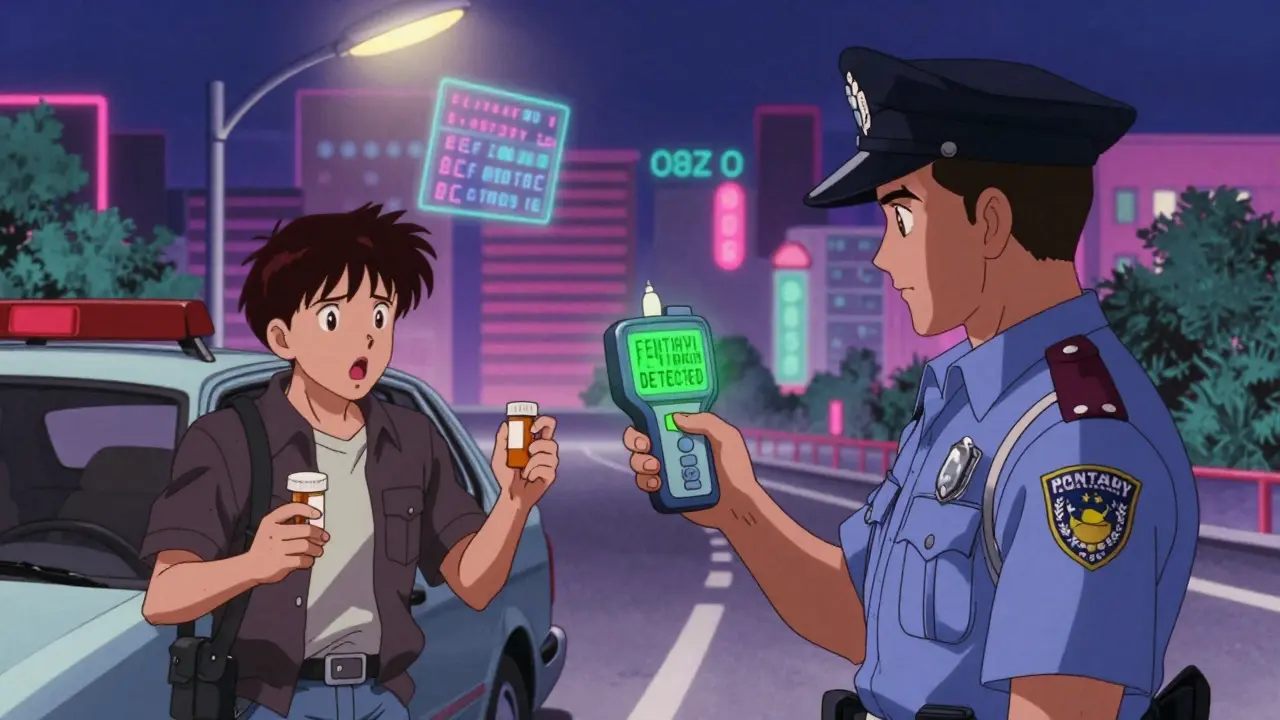
Law enforcement is catching up. In 2023, 47 states started using oral fluid drug testers-devices that can detect opioids in saliva within minutes. The Dräger DrugTest 5000, approved by the FDA in June 2023, can now detect fentanyl on the roadside. The National Highway Traffic Safety Administration has spent over $15 million since 2021 to train more Drug Recognition Experts. By 2025, they plan to have 5,000 more on the road.
Companies like UPS now require employees prescribed opioids to go through a medical review. Since 2021, they’ve seen a 37% drop in medication-related incidents. That’s not luck-it’s policy.
Meanwhile, the federal government is pushing for standardized limits. The Transportation Research Board recommends creating scientifically backed per se limits for opioids within five years. Right now, there’s no universal number like 0.08% for alcohol. That’s why enforcement is so inconsistent.
The Bigger Picture: Fentanyl and the Future
The biggest threat isn’t oxycodone anymore-it’s fentanyl. The DEA reports a 262% jump in fentanyl-related impaired driving cases between 2020 and 2023. Fentanyl is 50 to 100 times stronger than morphine. Even a tiny amount can knock someone out. And because it’s often mixed into counterfeit pills, people don’t even know they’re taking it.
That’s why the National Safety Council warns that current detection methods may soon be outdated. Without better testing, better laws, and better public education, opioid-impaired driving will keep rising.
What to Do If You’ve Already Been Pulled Over
If you’re stopped and asked if you’ve taken any medication, tell the truth. Lying makes it worse. But don’t volunteer extra information. You have the right to remain silent. If you’re prescribed opioids, keep your prescription bottle with you. If you’re charged, consult a lawyer who understands drug-impaired driving laws in your state. Many cases can be challenged if the officer didn’t follow proper protocol or if your blood test was improperly handled.
Where to Get Help
If you’re unsure whether your medication affects your driving, call the Substance Abuse and Mental Health Services Administration (SAMHSA) helpline at 1-800-662-4357. In 2022 alone, they handled over 12,000 calls about medication-related driving risks.
There’s no shame in asking for help. The goal isn’t to punish people who need pain relief-it’s to stop preventable deaths. You don’t have to choose between managing your pain and staying safe on the road. You just need to know the facts and plan ahead.
Can I drive if I’m taking opioids prescribed by my doctor?
It depends. Even if your doctor prescribed them, opioids can impair your driving. Many states have zero-tolerance laws, meaning any amount in your system is illegal. Always ask your doctor if it’s safe to drive, wait several hours after taking your dose, and never combine them with alcohol or other sedatives.
Will I get caught if I drive after taking opioids?
Yes, increasingly so. Police in 47 states now use oral fluid testers that detect opioids like fentanyl, oxycodone, and hydrocodone within minutes. Drug Recognition Experts are trained to spot subtle signs of impairment-even if you feel fine. A positive test or failed sobriety test can lead to arrest, even with a valid prescription.
What happens if I get a DUI for opioids?
Penalties vary by state but typically include license suspension (often 6 months to a year), fines up to $10,000, mandatory drug education, community service, and even jail time. In some states, your car can be impounded. A DUI stays on your record for years and affects insurance, employment, and travel.
Are over-the-counter painkillers safer to drive on?
Some OTC painkillers like ibuprofen or acetaminophen don’t impair driving. But many cold and flu meds contain diphenhydramine or codeine, which can cause drowsiness. Always read labels. If it says “may cause drowsiness,” don’t drive. Opioids are the biggest concern, but other medications can be just as dangerous.
How long should I wait after taking an opioid before driving?
For immediate-release opioids (like hydrocodone or oxycodone tablets), wait at least 3-4 hours. For extended-release versions (like OxyContin or MS Contin), wait 6-8 hours. But everyone metabolizes drugs differently. If you feel drowsy, dizzy, or unfocused, don’t drive-even if the time has passed.
Can I fight a DUI charge if I was taking my medication as prescribed?
It’s possible, but difficult. In some states like Utah or Wisconsin, you can argue you had a valid prescription and weren’t impaired. But in zero-tolerance states, that defense won’t work. You’ll need a lawyer experienced in drug-impaired driving cases. Evidence like medical records, witness testimony, or flawed testing procedures can help.
Is there a legal limit for opioids in your blood like there is for alcohol?
No. Unlike alcohol, which has a universal 0.08% BAC limit, there’s no agreed-upon blood level that proves opioid impairment. This makes enforcement inconsistent. Some states use any detectable amount; others require proof of actual impairment. Scientists are working on setting standardized limits, but none are officially in place yet.
What should I do if I need to drive but I’m on opioids?
Talk to your doctor about switching to a non-opioid pain treatment. If that’s not possible, plan alternative transportation. Use rideshares, public transit, or ask family or friends for help. Your safety-and the safety of others-is worth more than convenience. Never risk driving if you’re unsure.






Madhav Malhotra
11 January, 2026 23:45 PMMan, this hit different living in India where pain meds are just handed out like candy at a wedding. My uncle took oxycodone for back pain and drove his scooter to the market every day-no one thought twice. But yeah, after reading this, I’m gonna ask my doc if it’s safe. Better safe than sorry, right?
Jennifer Littler
13 January, 2026 16:02 PMFrom a clinical pharmacology standpoint, the pharmacokinetic variability of opioid metabolism-especially CYP3A4/2D6 polymorphisms-creates massive inter-individual differences in CNS depression. The lack of standardized plasma concentration thresholds for impairment is a regulatory failure. We need population-based therapeutic drug monitoring protocols, not arbitrary zero-tolerance statutes that criminalize therapeutic compliance.
Jason Shriner
14 January, 2026 12:03 PMso like... if i take my oxy and then drive to the 7-11 to buy a slushie... am i a criminal? or just a guy who likes slushies? 🤔
also why does the state care if i’m sleepy but not if i’m texting and eating a burrito at 80mph? double standards much?
Alfred Schmidt
15 January, 2026 09:02 AMTHIS IS WHY WE CAN’T HAVE NICE THINGS. PEOPLE AREN’T RESPONSIBLE. YOU’RE ON OPIOIDS AND YOU THINK YOU’RE FINE? YOU’RE NOT. YOU’RE A WALKING TERROR. MY COUSIN GOT HIT BY A GUY ON OXYCODONE-HE WASN’T EVEN DRUNK, JUST HIGH ON HIS PRESCRIPTION. NOW HE’S IN A WHEELCHAIR. STOP BEING LAZY AND JUST DON’T DRIVE. PERIOD.
Christian Basel
17 January, 2026 07:46 AMZero-tolerance laws are just performative policy. You’re not reducing impairment-you’re just creating more felony records for people who are compliant with their Rx. This is a public health issue, not a law enforcement one. The real problem? No one’s funding proper DRE training or accessible alternatives for chronic pain patients.
Matthew Miller
18 January, 2026 04:17 AMEveryone thinks they’re fine until they’re the one in the hospital. You don’t get to decide if you’re impaired. Your brain is lying to you. That’s the whole damn point of opioids. You think you’re lucid? You’re not. You’re just delusional with a prescription bottle. Stop pretending you’re not a danger.
Priya Patel
18 January, 2026 13:31 PMY’all know what’s wild? I had a friend who took tramadol for years and never had an issue driving… until one day she mixed it with a little melatonin. Boom. Totally spaced out at a red light. Didn’t hit anyone, but she cried for an hour after. So yeah-don’t mix. And don’t assume you’re immune. We all think we’re the exception.
Sean Feng
20 January, 2026 04:06 AMJust don't drive on meds. Simple. End of story. No need for all this extra stuff.
Priscilla Kraft
20 January, 2026 05:33 AMThank you for writing this. 💙 I’ve been on long-term opioids for 7 years and never realized how little info I got from my pharmacist. I just assumed ‘if the doctor said it’s okay’ then it was. Now I wait 6 hours, always use Uber after a new dose, and carry my script. It’s not a burden-it’s self-respect. And hey, if you’re reading this and feel guilty for needing help-you’re not alone. We’re all just trying to survive.
Vincent Clarizio
21 January, 2026 16:16 PMLet’s be real-this whole system is a Kafkaesque nightmare. You’re told to take your meds, you do, you’re told it’s safe, then suddenly you’re a criminal because some bureaucrat in a lab in Austin decided that 1 ng/mL of oxymorphone equals ‘impaired’ even though the person feels fine and has been stable on the dose for 5 years? We’re not punishing bad drivers-we’re punishing people who are trying to live. The science doesn’t support zero-tolerance, the law doesn’t reflect reality, and the public? They’re just confused. And now we’re all just trying to navigate a legal minefield with a broken compass. It’s not about being irresponsible-it’s about being failed by the system.
Sam Davies
22 January, 2026 09:14 AMAh yes, the classic American tragedy: the middle-class man who takes his legally prescribed painkillers and then blames the state when he’s arrested for being… well, human. Meanwhile, in London, we just chuckle and say ‘don’t drive if you’re drowsy’-no laws needed. Just basic common sense. But no, in the States, we need 17 different statutes and a $15 million DRE training budget to figure out that opioids make you sleepy. How quaint.
Alex Smith
23 January, 2026 22:16 PMHere’s the thing nobody says: if you’re on opioids and you’re still driving, you’re not just risking your license-you’re risking your dignity. You’re choosing convenience over responsibility. And that’s not a medical issue, that’s a character one. I’ve been there-chronic pain, the pills, the guilt. But I got a ride. I used Lyft. I called my sister. And I didn’t feel weak for it. I felt like someone who actually gives a damn. If you can’t do that, maybe you need to re-evaluate what ‘strength’ means.