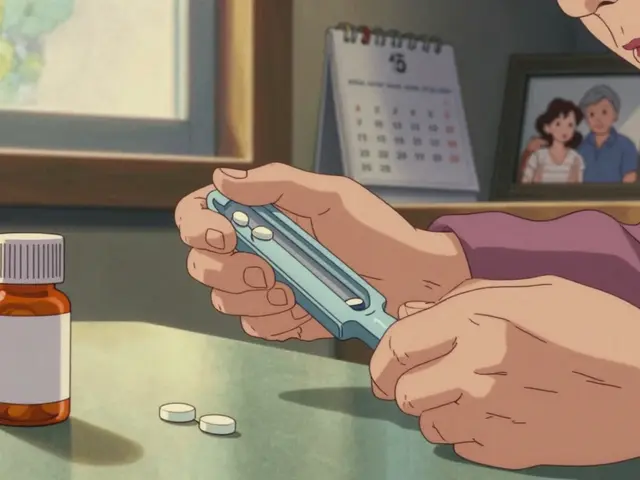
Every year, thousands of people end up in the hospital-not because of a sudden illness, but because they took the wrong pill. It happens quietly. A bottle looks similar. The label is faded. The dose feels familiar. And before you know it, you’ve swallowed something you weren’t supposed to. This isn’t rare. In the U.S., medication errors cause between 7,000 and 9,000 deaths annually. The good news? Checking labels before every dose cuts your personal risk by up to 76%. The bad news? Most people don’t do it consistently. But it’s not about being careful. It’s about building a habit. And habits can be trained.
Why Label Checking Works When Everything Else Fails
You’ve probably tried pill organizers. Maybe you use a medication app. You even set alarms. But here’s the truth: none of those tools stop you from grabbing the wrong bottle. A pill organizer doesn’t care if you put insulin in the morning slot instead of saline. An app can’t tell if the label says "20 mg" or "200 mg." Only you can do that.Label checking is the one habit that works every time because it forces you to pause. It doesn’t rely on memory. It doesn’t depend on technology. It just asks you to look-really look-at what’s in your hand. The FDA calls it your "primary defense." And studies show it’s far more effective than any other method. Pill organizers reduce errors by 42%. Apps without verification? Just 29%. But checking the label? 76%.
This matters most if you take five or more medications. Or if you’re over 65. Or if you’ve ever confused one pill for another. In fact, 67% of serious medication errors happen to older adults. Not because they’re careless. But because labels are hard to read, routines get rushed, and habits fade.
The Ten Things You Must Check Every Time
You don’t need to memorize a long list. But you do need to check these ten things every single time you take a pill:- Patient name - Is it yours? Exactly as written? No "J. Smith" if your name is "John Smith."
- Drug name - Both brand and generic. Lisinopril. Not just "blood pressure pill."
- Prescriber’s name - Who ordered this? Your doctor? A specialist?
- Dosage - 5 mg? 10 mg? 50 mg? Never guess. Read it.
- Quantity and refills - How many pills are left? Is this the last refill?
- Warnings - "Avoid alcohol." "Take on empty stomach." "May cause dizziness."
- Date filled - Is it within the last 30 days? Older than that? Ask your pharmacist.
- Expiration date - Never take expired meds. They lose potency. Or worse, turn dangerous.
- Pharmacy info - Name, phone, address. Keep this handy in case you have questions.
- Administration instructions - "Take once daily." "Swallow whole." "Do not crush."
That’s it. Ten items. Takes 3 to 5 seconds. And if you skip even one, you’re gambling.
The Three-Touch Method: Train Your Hands, Not Just Your Eyes
Looking at a label isn’t enough. Your brain can trick you. Especially in the morning. Or when you’re tired. Or if you’ve taken this pill for months.The Three-Touch Method is what healthcare professionals use to train patients. It’s simple:
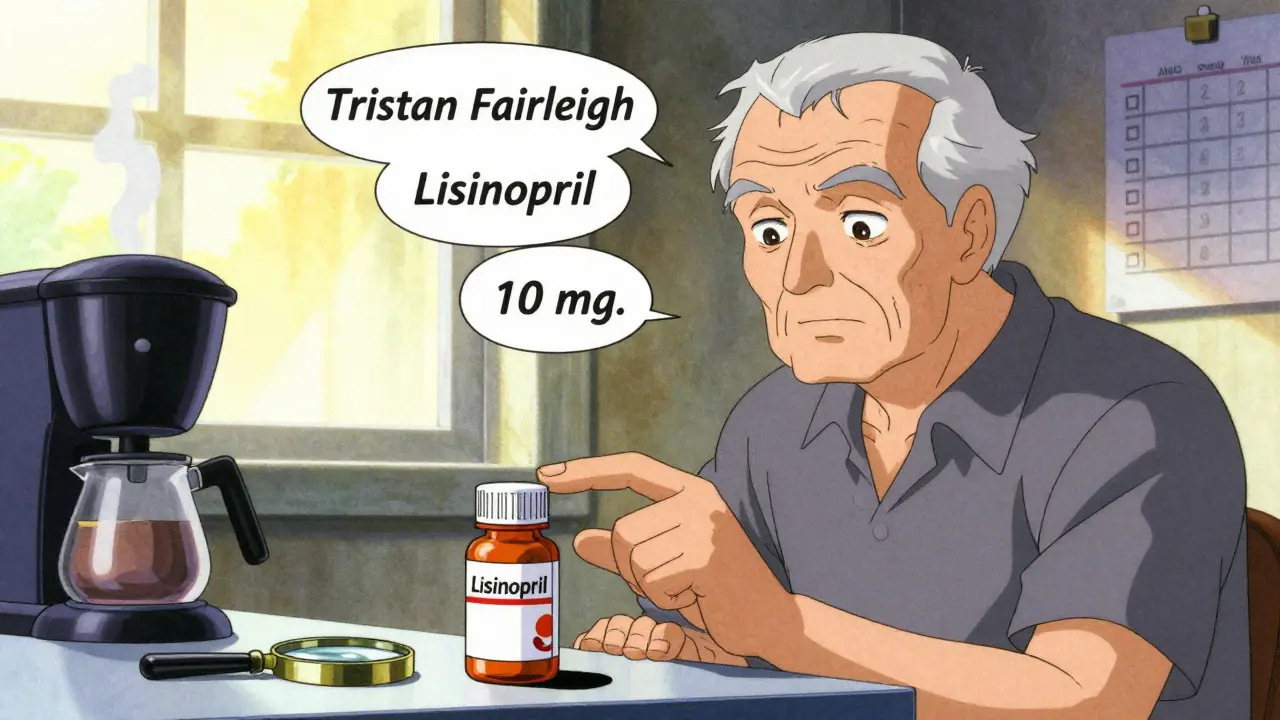
- Touch the patient’s name on the label. Say it out loud: "This is for Tristan Fairleigh."
- Touch the drug name. Say: "This is Lisinopril."
- Touch the dosage. Say: "I take 10 milligrams once a day."
That’s it. Three touches. Three spoken words. No apps. No reminders. Just you, your fingers, and the label.
Why does this work? Because you’re using three senses at once: sight, touch, and hearing. Your brain doesn’t ignore this. A clinical trial by SmithRx found that people who used this method had 92% adherence after 30 days. Those who just looked? Only 64%.
Start today. Do it with every pill. Even the ones you’ve taken for years. Even if you’re sure you know what it is. That’s exactly when mistakes happen.
Where to Place Your Medications for Maximum Safety
Habits form where routines live. If your pills are tucked away in a cabinet, you’ll forget to check. If they’re next to your toothbrush? You’ll see them. And if you see them, you’ll check them.Place your medications where you already have a daily ritual:
- Next to your coffee maker - morning meds
- By your evening snack - nighttime pills
- On the bathroom counter - if you take them after brushing
Don’t keep them in a drawer. Don’t stash them in a bag. Don’t leave them on a shelf. Put them where your hands go automatically. This simple move reduces missed checks by 53%, according to MedPak’s behavioral research.
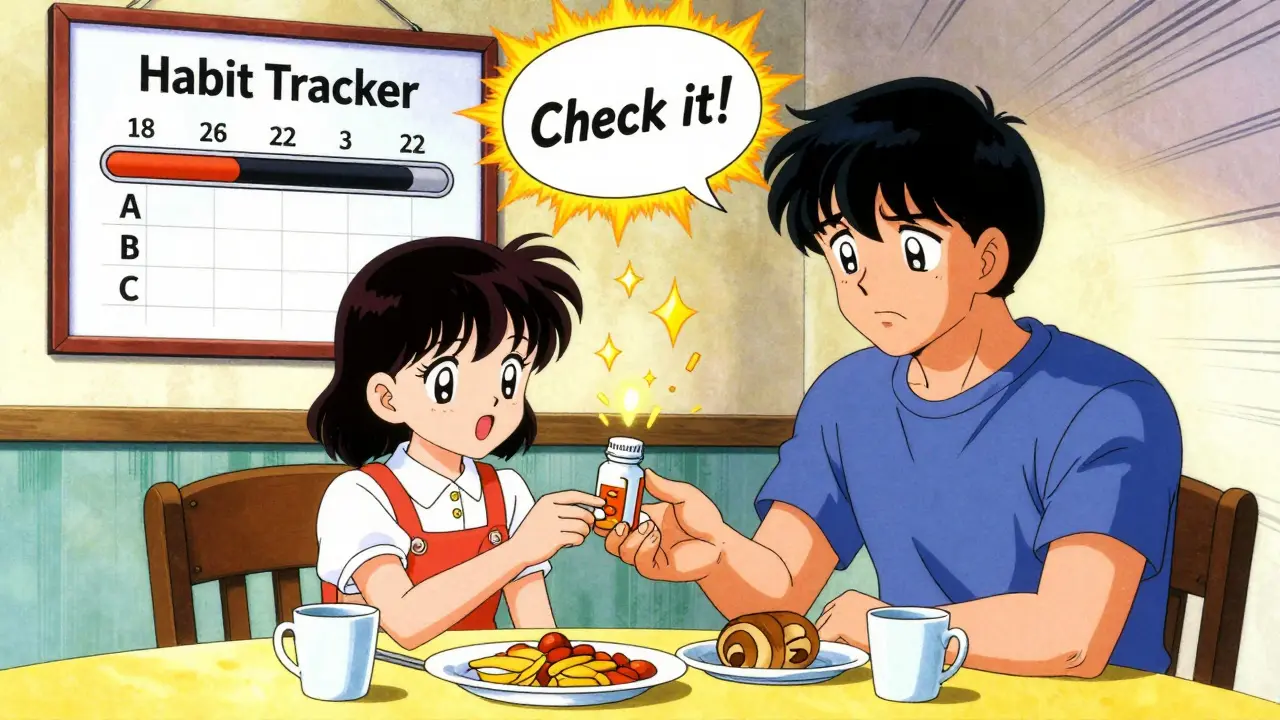
And if you live with someone? Have them place the bottle in your hand as you sit down for breakfast. Say: "Check it." It takes 3 seconds. But it builds a habit faster than any app.
What to Do If You Can’t Read the Label
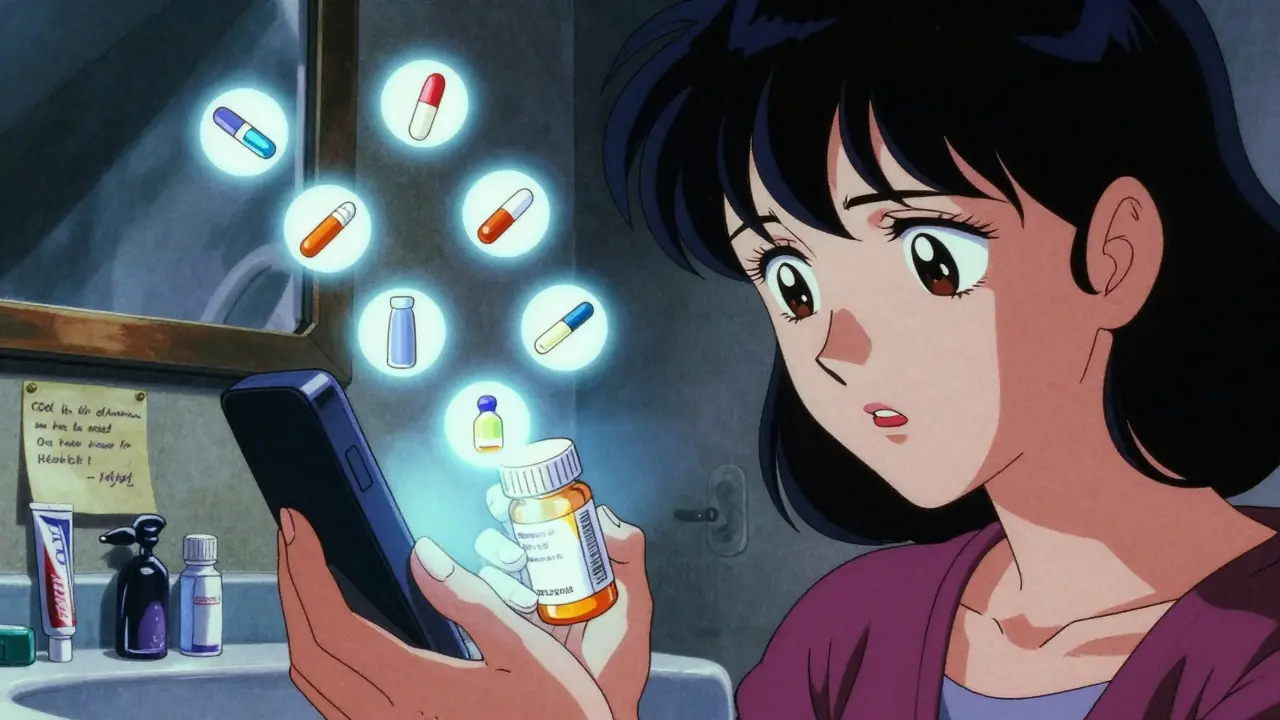
If your vision is fading, if the print is too small, if the font is blurry-don’t guess. Don’t rely on memory. Don’t take the risk.There are three fixes:
- Ask for large-print labels - Pharmacies are required to provide them. Just ask. Many now offer 8-point font or larger for warnings, as mandated since January 2025.
- Use a magnifier - A simple handheld magnifier cuts labeling errors by 38% for people with vision issues.
- Use color coding - Put a colored sticker on each bottle. Red = morning. Blue = night. Green = as needed. 82% of pharmacists recommend this. It’s cheap. It’s easy. And it works.
Also, ask your pharmacist to write the instructions on a sticky note and stick it to the bottle. Or record a voice note on your phone: "This is metformin. 500 mg. Take with breakfast."
Why Memory Alone Fails 83% of the Time
You think: "I’ve taken this pill for six months. I know what it is." That’s the trap.Dr. Angela Smith from Carolinas HealthCare System says: "Over-reliance on memory fails 83% of patients within two weeks." Why? Because your brain is lazy. It assumes patterns. It fills in gaps. It confuses similar-looking bottles. One study found that 25% of errors came from mixing up two drugs with nearly identical names.
Label checking isn’t about being paranoid. It’s about being smart. Your brain doesn’t remember every detail. But your eyes can. Your fingers can. Your voice can. Train them.
What Works Better Than Apps
Many people turn to medication apps. But most apps don’t require you to verify the label. They just remind you. Big mistake.Amazon reviews show that apps with mandatory label verification steps have 63% higher retention after 90 days. Why? Because they force you to pause. To look. To confirm.
If you use an app, choose one that:
- Requires you to photograph the label before logging a dose
- Asks you to confirm the drug name and dosage
- Has a "verify" button you must tap
And never let an app replace your own eyes. Use it as a backup. Not a replacement.
Teach-Back: The Secret Weapon for Families
If you’re caring for someone else-parent, spouse, sibling-there’s one technique that works better than any reminder system: teach-back.Here’s how:
- Hand them the bottle.
- Ask: "Can you tell me what this is for?"
- Let them explain.
- If they’re wrong, gently correct them. Then ask again.
It’s not about testing them. It’s about reinforcing the habit. CareSfield found that this method improves retention by 57%. And it builds trust. Because now, they’re not just taking pills. They’re understanding them.
Do this once a week. Even if they seem confident. Because confidence is dangerous.
How Long Until It Becomes Automatic?
You don’t need willpower. You need repetition.Most people need 18 to 22 checks before this becomes automatic. That’s about three weeks. But here’s the trick: do it every time. No exceptions. Not even once.
It’s not about being perfect. It’s about being consistent. Miss one day? That’s okay. But don’t miss two. Keep going. Your brain will start doing it without you thinking.
And when it does? You’ll feel it. You’ll reach for the bottle. Your fingers will move to the label. Your mouth will say the name before you even swallow.
Final Thought: This Isn’t About Fear. It’s About Control.
Taking medication isn’t a chore. It’s a lifeline. But you can’t let your safety depend on luck. Or memory. Or a pharmacist’s handwriting.Checking your label before every dose is the most powerful thing you can do to protect yourself. It’s simple. It’s fast. And it’s free.
You don’t need to be perfect. You just need to be consistent. One bottle. One check. One time. Then again. And again. Until it’s automatic.
Because the next time you pick up a pill-make sure you know what it is.
What if I’m confused about the label?
If you’re unsure about any part of the label-dosage, name, instructions-call your pharmacy. Don’t guess. Don’t take it. Most pharmacies offer free consultations and will walk you through it. You can also ask for a printed copy of the medication guide. Many now include pictograms to help with understanding.
Can I use a magnifying glass or phone flashlight?
Yes. The FDA recommends at least 500 lux of lighting for label reading. If natural light is poor, use a phone flashlight or a small magnifying glass. These tools reduce reading errors by up to 38% for people with vision challenges. Keep one near your medication storage area.
What should I do if I accidentally take the wrong pill?
If you realize you took the wrong pill, call your pharmacist or poison control immediately. Do not wait for symptoms. Keep the bottle and the pill you took. This helps professionals assess the risk. In South Africa, you can reach the National Poisons Information Centre at 0861 555 777. In the U.S., call 1-800-222-1222.
Is it safe to take expired medication?
No. Expired medications can lose effectiveness-or, in rare cases, break down into harmful substances. The FDA advises against using any medication past its expiration date. If your pills are expired, return them to the pharmacy. Many offer free disposal programs. Never flush them down the toilet or throw them in the trash.
Why do some labels use abbreviations like "QD" or "BID"?
These abbreviations are being phased out. Since the 2025 labeling standards, pharmacies must use full words: "once daily," "twice daily." If you still see abbreviations, ask your pharmacist to rewrite the label. They’re required to do so. Abbreviations caused 17% of labeling errors before the update.
Can I use a checklist?
Yes. Print out a simple checklist with the ten items to verify. Tape it to your medicine cabinet or keep it in your pill organizer. Many pharmacies now give these out for free. Use it until the habit sticks. Then, you won’t need it anymore.
What if I have dementia or memory problems?
If you or a loved one has cognitive decline, use a caregiver to verify labels daily. Set up a routine where the same person checks every dose. Consider smart packaging that requires a scan before opening-these are now available through major pharmacies. Also, ask your doctor about a medication review every 3 months to simplify the regimen.
Are there free tools to help me check labels?
Yes. The FDA’s "Check Before You Take" campaign offers free printable label checklists and instructional videos. Many community health centers also provide free label-reading workshops. Ask your pharmacist-they’re required to offer this service at no cost.



trudale hampton
21 March, 2026 18:30 PMI started using the three-touch method last month after my grandma almost took her neighbor's blood pressure pill. It's wild how something so simple changes everything. Now I say the name out loud every time, even if I'm half-asleep. My brain finally stopped assuming. I used to think I was careful. Turns out, I was just lucky.
Also, I put my meds next to my coffee maker. Best decision ever.
Allison Priole
21 March, 2026 21:58 PMi cant believe how many people just wing it with meds like its a game of russian roulette. i have my bottles color coded now-red for morning, blue for night, green for when i feel like crap and need to take my anxiety pill (yes, that one’s different). i even got a little sticky note from the pharmacy that says "THIS IS LAMOTRIGINE. 100MG. DO NOT CRUSH." i read it every damn time. i used to roll my eyes at this stuff. now? i’m a convert. also, my cat judges me if i don’t touch the label first. she’s a better enforcer than my alarm app.
Bryan Woody
22 March, 2026 09:25 AMyou people are making this way harder than it needs to be. the label isn’t a puzzle. it’s a sign. if you can’t read it, get glasses. if you’re too lazy to look, don’t blame the system. i’ve been on 7 meds for 12 years. never had a problem. why? because i dont let my brain do the work. i look. i touch. i say it. done. no apps. no checklists. no drama. your brain isn’t broken. you’re just not trying. also, stop using emojis as medical advice. seriously.
Paul Cuccurullo
23 March, 2026 18:50 PMThis is one of the most vital pieces of health advice I’ve ever encountered. The three-touch method isn’t just a habit-it’s a ritual of self-respect. In a world that constantly asks us to trust algorithms, to delegate our safety to apps and automation, this practice reclaims agency. It’s not about fear. It’s about reverence-for your body, for your health, for the quiet dignity of paying attention. I’ve shared this with my entire family. My 82-year-old father now says the drug name aloud every morning. He says it makes him feel like he’s still in control. And he is.
Timothy Olcott
25 March, 2026 09:59 AMI read this and immediately texted my mom. She’s 78, takes 9 pills, and still thinks "blue pill = heart" because she’s been taking it since 2010. She didn’t even know the label said "Amlodipine." I sent her a magnifier. She sent me back a selfie with the pill in one hand and the magnifier in the other. Caption: "I DID IT. I READ THE LITTLE WORDS." I cried. This isn’t about meds. It’s about dignity. 🙏❤️
Amadi Kenneth
25 March, 2026 14:47 PMI don't trust this. I think the pharmaceutical companies want you to check labels so they can track you. Why else would they make the fonts smaller? Why is the expiration date always in the corner? They’re hiding something. I read an article once-on a forum, not a government site-that said the FDA has a secret database that logs every label you check. They use it to predict when you’ll die. I don’t take anything unless I’ve checked it 3 times, in 3 different lights, and asked my neighbor to verify. He’s retired from the DEA. He says it’s real. I’m not paranoid. I’m prepared.
Shameer Ahammad
26 March, 2026 12:31 PMLet me be clear: this entire article is dangerously simplistic. You are promoting a behavioral hack while ignoring systemic failures in healthcare infrastructure. Pharmacies in the U.S. are understaffed, labels are printed on low-contrast paper, and many patients cannot afford vision correction. This is not a personal responsibility issue-it is a public policy failure. If you want to reduce medication errors, fix the system. Stop asking elderly people to squint at 6-point font while juggling five prescriptions. This is virtue signaling disguised as advice.
Kyle Young
27 March, 2026 11:30 AMThere’s a deeper philosophical layer here that I find compelling. The act of checking a label isn’t merely a safety protocol-it’s an act of phenomenological presence. In a culture obsessed with efficiency, speed, and automation, we have outsourced cognition. We no longer engage with the physical world; we delegate perception to devices. The three-touch method forces a return to embodied knowledge. It reintroduces the body as a site of verification. We are not just users of medicine-we are witnesses to it. In that witnessing, we reclaim autonomy. This isn’t about memory. It’s about consciousness.
Emily Hager
28 March, 2026 10:28 AMI find this entire premise to be alarmingly naive. The notion that a simple checklist can prevent medication errors ignores the fact that human cognition is inherently fallible. Even with perfect labeling, the brain will misinterpret, misremember, and misattribute. The real solution lies in pharmacogenomic testing, AI-assisted prescribing, and centralized electronic health records with cross-referenced drug interactions. This method is a Band-Aid on a hemorrhage. And while I appreciate the sentiment, it is ultimately a distraction from the structural reforms that are genuinely needed. One must ask: why are we asking patients to be pharmacists?
Alexander Pitt
30 March, 2026 09:29 AMI’m a pharmacist. I’ve seen this play out too many times. The three-touch method works because it interrupts automatic behavior. That’s neuroscience. The FDA data is real. The 76% reduction isn’t marketing-it’s peer-reviewed. I give out laminated checklists to every new patient. I’ve had people cry because they finally stopped having scary mistakes. I’ve had grandparents say, "I didn’t know I was supposed to do this." You don’t need an app. You don’t need a caregiver. You just need to pause. And look. And speak. It’s not complicated. It’s just not easy. But it’s worth it.