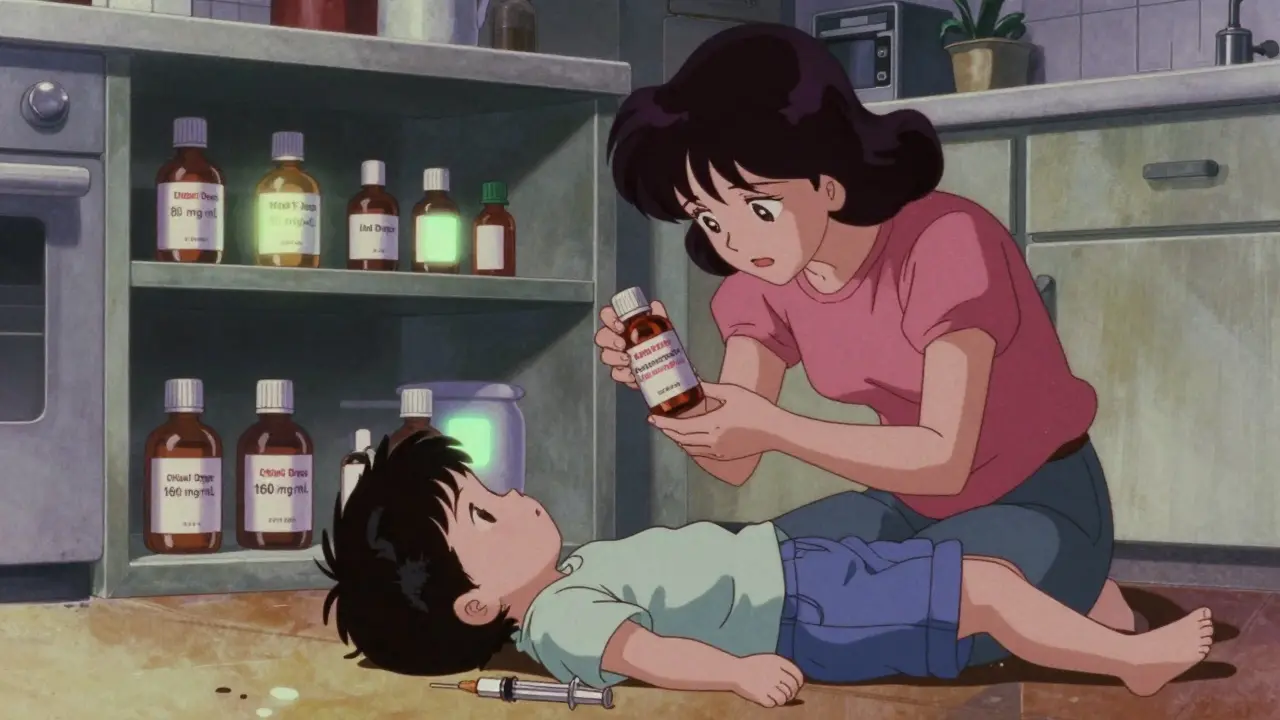
Every year, thousands of children end up in emergency rooms because of a simple mistake: the wrong dose of medicine. Not because parents are careless, but because the system is set up to fail. In pediatric emergencies, medication errors happen more than twice as often as in adults. One in three kids gets hit with a dosing mistake. And many of these errors aren’t caught until it’s too late.
Why Kids Are at Higher Risk
Adults get pills. Kids get liquids. That’s the first problem. Liquid medications come in different concentrations - infant drops, children’s syrup, generic brands - and they’re easy to mix up. A parent might grab the wrong bottle, not realize the difference between 5 mg and 5 mL, and give a full teaspoon instead of a few drops. One mother gave her 10kg child 5 mL of regular children’s acetaminophen, thinking it was the right amount. The correct dose was 1.5 mL. She gave a 10-fold overdose. Her child ended up in the ICU. Weight-based dosing is another killer. Unlike adults who get a standard 500 mg of Tylenol, kids need doses calculated by kilograms. A 5kg baby needs a totally different amount than a 25kg toddler. That calculation? Often done under pressure, with a crying child, a distracted nurse, and a clock ticking. Studies show 20-35% of errors come from simple math mistakes. Even worse - 10-31% of the time, the child’s weight isn’t even measured correctly. Someone guesses. Someone writes down 15 kg instead of 12 kg. The dose goes up. The harm follows.The Most Common Mistakes (And What They Look Like)
Here’s what actually goes wrong in real cases:- Wrong dose (13% of errors): Too much or too little. The biggest culprit. Often from misreading the label or confusing mg with mL.
- Wrong medication (4%): Giving amoxicillin instead of ibuprofen. Sounds rare, but happens when meds look similar or are stored close together.
- Wrong route (1%): Giving oral medicine through a feeding tube. Or giving a shot meant for the thigh into the arm.
- Duplicate dosing (15-25%): Mom gives Tylenol at the ER. Dad gives it again at home because he didn’t know it was already given. This happens more than you think.
- Wrong concentration (60-80% of home errors): Using infant drops (80 mg/mL) instead of children’s liquid (160 mg/mL) and thinking it’s the same. One parent on Reddit said: “I gave my 2-year-old 5 mL of children’s Tylenol instead of infant concentrate. My pediatrician called me back because the dose was triple what it should’ve been.”
And here’s the quiet truth: most of these errors never get reported. Only 10-30% of mistakes show up in official logs. The rest? They’re buried in silence - a kid feels sick, goes to the ER, gets treated, and no one connects the dots back to the medicine.
Who’s Most at Risk?
It’s not just about the hospital. Home is where most errors happen - and some families are hit harder than others.- Parents with low health literacy: 68% make dosing errors. That’s more than double the rate of those who understand medical terms.
- Non-English speakers: 45% make dosing mistakes. Labels are in English. Instructions are in English. They nod along, afraid to ask.
- Medicaid families: 27% higher error rate than privately insured kids. Why? Less access to pharmacy counseling, fewer follow-ups, more stress.
One study found that Spanish-speaking parents were 32% more likely to make a dosing error than English-speaking ones - even when they had the same education level. Language isn’t just about words. It’s about trust. It’s about feeling safe enough to say, “I don’t understand.”
What Works: Real Solutions That Save Lives
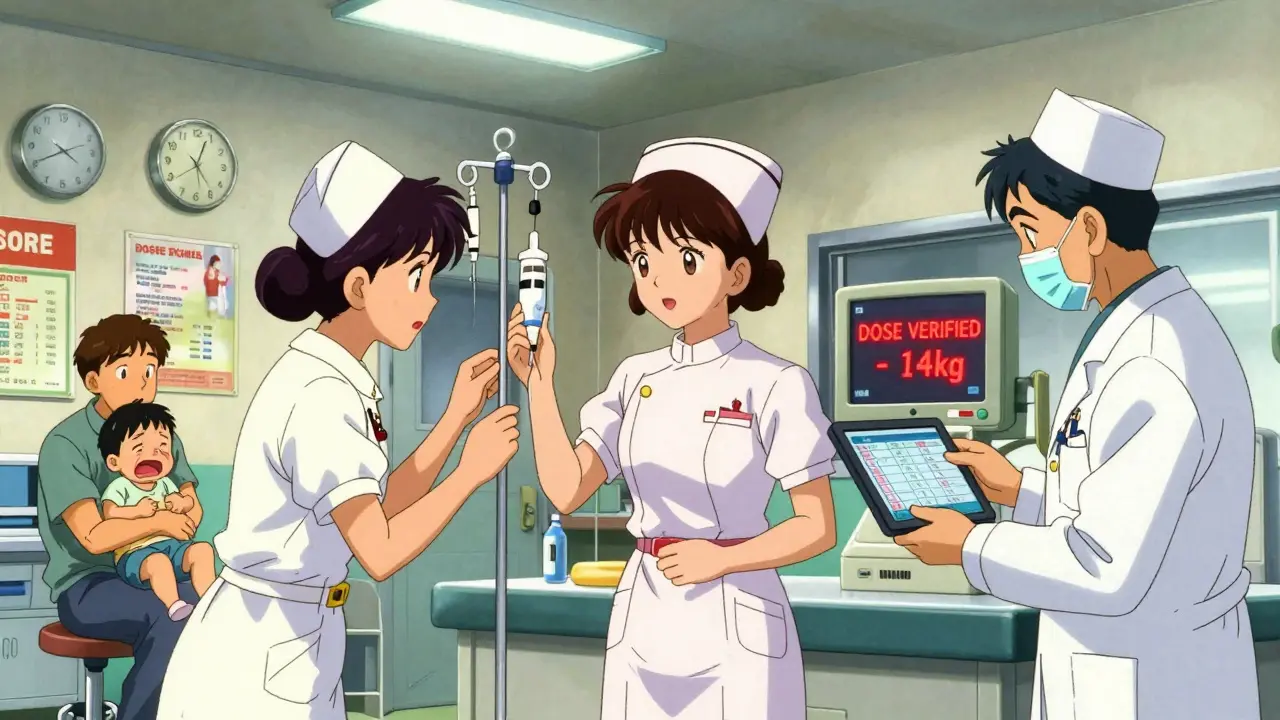
There’s good news. We know what fixes this. At Nationwide Children’s Hospital, they cut harmful medication errors by 85% in five years. How? Three things:- Double-checks for high-risk meds: Every IV antibiotic, every sedative, every insulin dose? Two people verify it. No exceptions.
- Standardized dosing protocols: No more “use your best judgment.” If the kid weighs 14 kg, the system auto-calculates the exact dose for Tylenol, Motrin, antibiotics. No math needed.
- Pharmacy verification in real time: Every order goes through a pediatric pharmacist before it’s given. No more relying on a tired nurse to remember the right number.
Outside the hospital, the MEDS intervention made a huge difference. It’s simple: when a kid is discharged, the nurse gives them a picture-based instruction sheet - no tiny print, no jargon. Then they ask the parent: “Can you show me how you’ll give this medicine?” That’s called teach-back. It takes 90 seconds. It cuts dosing errors by 15.5%. And the effect lasts. Even after the program ended, error rates stayed lower than before.
Parents who used a proper measuring device - a syringe, not a spoon - reduced errors by 40%. But here’s the catch: most hospitals still hand out plastic cups. Cups are inaccurate. Syringes are precise. Why aren’t we giving syringes to every family?
The Hidden Gap: Emergency Rooms That Aren’t Pediatric
Here’s the dirty secret: most ERs aren’t built for kids. A big city ER sees hundreds of adults and maybe 20 kids a day. They don’t have pediatric-specific EMRs. They don’t have weight-based dosing calculators built in. They don’t have pharmacists on call for kids. By 2023, 68% of children’s hospitals had automated dosing tools. But only 29% of community ERs did. That’s a safety gap. A kid with a fever goes to the nearest ER. The nurse gives them a dose based on a guess. No pharmacist. No double-check. No pictogram. That’s not negligence. It’s systemic neglect.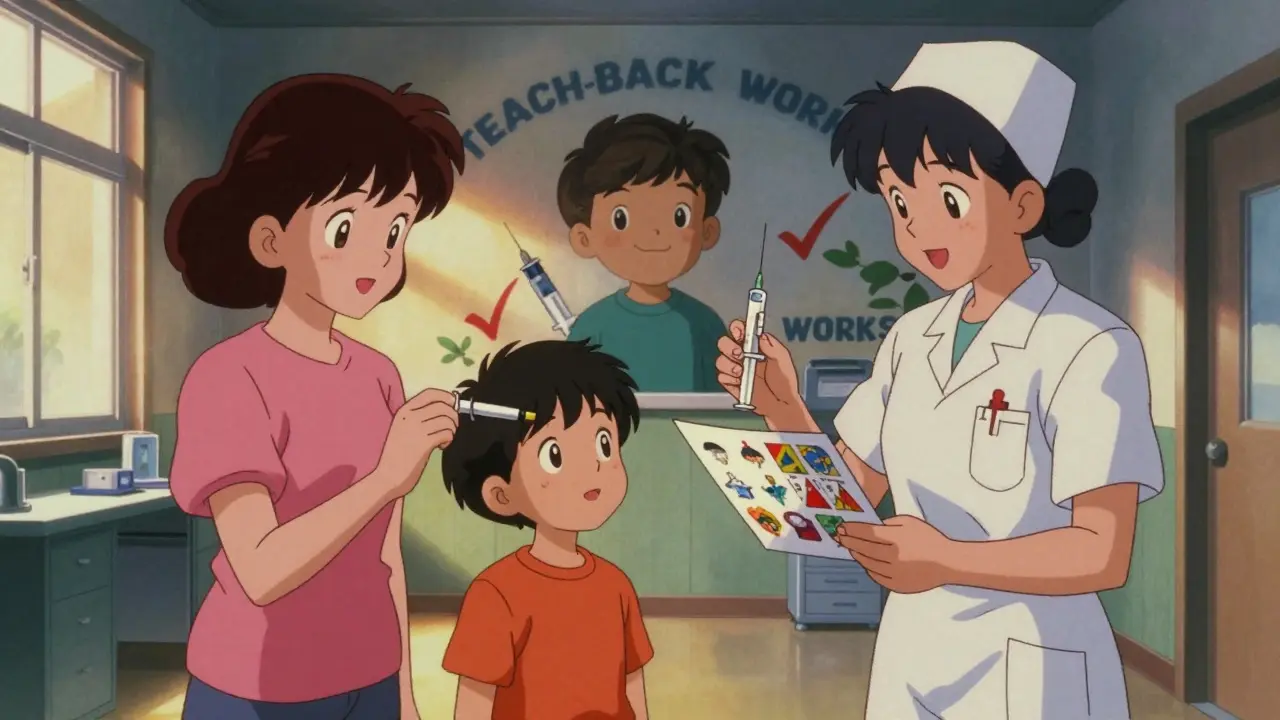
What Parents Can Do Right Now
You don’t need a medical degree to keep your child safe.- Always ask: “Is this in mg or mL?” Write it down. Don’t trust your memory.
- Use a syringe, not a cup or spoon. Get one from the pharmacy - they’re free.
- Ask the nurse: “Can you show me how to give this?” Then do it back. If they say no, ask again.
- Check the label twice. Infant drops (80 mg/mL) ≠ Children’s liquid (160 mg/mL). They look the same. They’re not.
- Keep a medicine log. Write down what was given, when, and how much. Share it with every provider.
If you’re ever unsure - don’t guess. Call your pediatrician. Call poison control. Wait. It’s better to wait than to risk a hospital stay.
The Bigger Picture: Why This Still Isn’t Fixed
We’ve known about this for 20 years. The Institute of Medicine flagged it in 1999. Pediatricians have been screaming since the 2000s. Yet here we are in 2025, and kids are still getting the wrong doses. Why? Because fixing this costs money. It takes training. It needs better technology. It requires hospitals to prioritize kids over speed. And too many systems still treat pediatric care as an afterthought. The American Academy of Pediatrics says they want standardized metrics for outpatient errors by 2025. That’s good. But metrics won’t save a child. Systems will. Training will. Syringes will. Double-checks will.This isn’t about blaming parents. It’s about fixing the system that lets mistakes happen. Every child deserves a dose that’s exact. Not close. Not “good enough.” Exact.
What’s the most common medication mistake in pediatric emergencies?
The most common mistake is giving the wrong dose - usually too much. This often happens because parents confuse milligrams (mg) with milliliters (mL), or use the wrong concentration of liquid medicine. For example, infant acetaminophen (80 mg/mL) is twice as strong as children’s liquid (160 mg/mL). Giving the same volume of the stronger version can lead to a dangerous overdose.
Why are pediatric medication errors higher than in adults?
Pediatric doses are based on weight (mg/kg), not fixed amounts. Adults usually get one standard dose; kids need individual calculations. This adds complexity, especially under pressure. Also, liquid medications are harder to measure accurately than pills. Studies show pediatric error rates are 31% versus 13% in adults. Time pressure, verbal orders, and lack of standardized tools make emergency settings especially risky.
How can I avoid giving my child the wrong dose at home?
Use a syringe, not a spoon or cup. Always check the label for concentration (mg/mL). Write down the dose and time given. Ask the provider to show you how to measure it, then do it back to them. If you’re unsure, call your pediatrician or poison control before giving anything. Never guess.
Do hospitals have systems to prevent these errors?
Some do. Children’s hospitals often use automated dosing calculators, pharmacy verification, and double-check systems. But many general emergency rooms don’t. Only 29% of community ERs have pediatric-specific EMR tools as of 2023. This creates a dangerous gap - kids in non-specialized ERs are at higher risk.
Are certain families more likely to make dosing mistakes?
Yes. Families with limited health literacy have 2.3 times higher error rates. Non-English speakers have 45% error rates compared to 28% for English speakers. Medicaid-enrolled children experience 27% more errors than those with private insurance. Language barriers, stress, lack of access to pharmacy support, and poor health literacy all play a role.
What’s being done to fix this problem?
Hospitals like Nationwide Children’s reduced harmful errors by 85% using standardized protocols, pharmacist checks, and staff training. The MEDS intervention - which uses picture instructions and teach-back - cut home dosing errors by 15.5%. The American Academy of Pediatrics is pushing for standardized error-tracking tools by 2025. But progress is slow outside children’s hospitals.
How much do these errors cost the healthcare system?
About 63,000 children visit the ER each year because of home medication errors. These visits cost an estimated $28 million annually. Many of these cases are preventable with better education, clearer instructions, and access to proper dosing tools like syringes.
Is it safe to use a kitchen spoon to measure my child’s medicine?
No. Kitchen spoons vary wildly in size. A teaspoon can hold anywhere from 3 to 7 mL. That’s a 130% difference. Always use a syringe or dosing cup marked in mL. Pharmacies give them for free. Use them.



amanda s
17 December, 2025 09:10 AMThis is why America needs to stop outsourcing healthcare to greedy corporations. Kids are dying because hospitals care more about speed than safety. I’ve seen it with my own eyes-nurses rushing, labels blurred, syringes nowhere in sight. It’s not negligence-it’s capitalism. And it’s murdering our children.
Who’s paying for this? Not the CEOs. Not the shareholders. It’s us. In grief. In hospital bills. In sleepless nights. We need to burn the system down and rebuild it with pediatric care as the priority-not an afterthought.
Stop praising ‘solutions’ that take five years. We don’t have five years. We have minutes.
And if you’re still using a spoon? You’re not a parent-you’re a liability.
Peter Ronai
17 December, 2025 12:31 PMOh please. You’re blaming the system while ignoring the fact that half these parents can’t read a label. I’ve seen moms hand their kid a bottle of NyQuil because it’s ‘the red one.’ This isn’t a systemic failure-it’s a parenting failure. Teach your kids to read. Teach yourself to ask questions. Stop expecting hospitals to be babysitters for your incompetence.
And don’t get me started on ‘language barriers.’ If you can’t understand English, maybe don’t give your kid medicine. Call someone who can. It’s not rocket science. It’s basic responsibility.
Michael Whitaker
18 December, 2025 08:30 AMIt is, without question, a matter of profound institutional dereliction that pediatric medication safety remains so inconsistently implemented across U.S. emergency departments. The variance between children’s hospitals and community ERs is not merely a statistical anomaly-it is a moral indictment.
One must interrogate the economic incentives that prioritize throughput over precision. The absence of standardized, automated, pharmacist-verified dosing protocols in 71% of community ERs is not an oversight. It is a choice. And choices have consequences.
Furthermore, the continued distribution of measuring cups-archaic, imprecise, and demonstrably dangerous-reflects a disturbing complacency. Why do we tolerate this? Because it is cheaper. And because children, statistically, are less politically visible.
Let us not mistake compassion for competence. We are failing them. Systematically. And the cost is measured not in dollars, but in liver failure, in seizures, in irreversible neurological damage.
Salome Perez
19 December, 2025 15:42 PMI’ve worked in pediatrics for 18 years. I’ve seen every single one of these errors. The syringe thing? It’s not even close to being the biggest problem.
The real issue is that nurses are still being trained to eyeball weights. No scale? Just ask the mom. ‘Oh, he’s about 30 pounds.’ Nope. He’s 22. And now he’s getting 40% too much medicine.
And don’t even get me started on the ‘double-check’ myth. Two people? One’s scrolling TikTok. The other’s on a break. They both sign off. It’s theater.
Real solution? Mandatory pediatric pharmacy consults on every weight-based med. No exceptions. No ‘it’s just Tylenol.’ It’s not just Tylenol. It’s a chemical that can kill if you get the decimal wrong.
And yes, I’m mad. I’ve held a 3-year-old who almost died because someone thought ‘infant drops’ and ‘children’s liquid’ were the same. They’re not. And neither are we.
Kent Peterson
20 December, 2025 21:29 PMStop. Just stop. You’re blaming hospitals, but you’re ignoring the fact that 80% of these errors happen at home. Parents aren’t reading labels. They’re guessing. They’re using spoons. They’re giving medicine ‘because the fever didn’t go down.’
And now you want the ER to be a 24/7 pediatric pharmacy? With pharmacists on standby? For 20 kids a day in a 300-bed ER? That’s not healthcare-that’s fantasy.
Fix the parents. Teach them. Give them free syringes. But don’t bankrupt the system because people refuse to pay attention. This isn’t a systemic crisis-it’s a cultural one. And culture doesn’t change with policy. It changes with consequences.
Meghan O'Shaughnessy
21 December, 2025 10:25 AMMy daughter had a fever last winter. We got the medicine from the pharmacy. The label had tiny print. I didn’t know if it was 160 or 80 mg/mL. I called the pharmacist. They sent me a photo of the bottle with the numbers circled. Took two minutes.
That’s all it takes. Someone to care enough to help. Not a system overhaul. Just a human being who says, ‘Here. Let me show you.’
Why don’t we do that more often?
Kaylee Esdale
22 December, 2025 07:52 AMUse the syringe. Write it down. Ask to see it measured.
That’s it.
Don’t overthink it. Don’t wait for the system to fix itself. You have power. Use it.
And if you’re scared? Call poison control. They don’t judge. They just help.
One step. One time. That’s how you save a life.
Jody Patrick
22 December, 2025 16:23 PMThey give out cups. That’s the problem. Syringes are free. Use them. Done.
Radhika M
24 December, 2025 08:49 AMIn India, we don’t have many pediatric ERs. But we have community health workers who go door to door with medicine. They show you how to use the syringe. They draw the line on the side. They say, ‘This much. Not more.’
Simple. No tech. No EMR. Just care.
Maybe we don’t need fancy systems. Maybe we just need people who show up.
Philippa Skiadopoulou
25 December, 2025 12:34 PMWhile the statistical data presented is compelling, the practical implementation of solutions remains inconsistent. The reliance on human verification in high-pressure environments is inherently flawed. Standardization, coupled with technological integration, is not merely advisable-it is imperative.
Furthermore, the disparity between children’s hospitals and general ERs reflects a broader neglect of pediatric-specific needs within emergency infrastructure. This gap must be addressed not as an ancillary concern, but as a fundamental component of clinical safety.
Pawan Chaudhary
26 December, 2025 18:41 PMI used to think my kid’s fever was nothing. Then I saw what a wrong dose did to a neighbor’s child. Now I always use the syringe. Always write it down. Always ask.
It’s not scary. It’s just smart.
And if you’re reading this? You already care. That’s half the battle.
You got this.
CAROL MUTISO
27 December, 2025 06:01 AMOh, so now we’re blaming parents for the system’s failure? How convenient.
You want to fix dosing errors? Start by making sure every ER has a pediatric pharmacist on call. Stop pretending that ‘teach-back’ is a magic fix when the system still hands out measuring cups like they’re party favors.
And don’t even get me started on the fact that Medicaid families are 27% more likely to make errors because they’re too busy working three jobs to read labels.
We don’t need more ‘tips’ for parents. We need to stop treating kids like afterthoughts. That’s the real problem. Not the parents. Not the language. The system.
And if you’re still using a spoon? You’re not just ignorant-you’re complicit.
Erik J
27 December, 2025 22:14 PMI’m curious-how many of these errors are caught before they cause harm? The post mentions only 10–30% are reported. But what about the ones where the child just seems ‘off’ for a day, then recovers? Do we know how many near-misses happen silently?
And if we’re tracking only the ER visits, are we missing the long-term neurological effects from repeated subtoxic overdoses?
Just wondering if the real scale is even bigger than the numbers suggest.