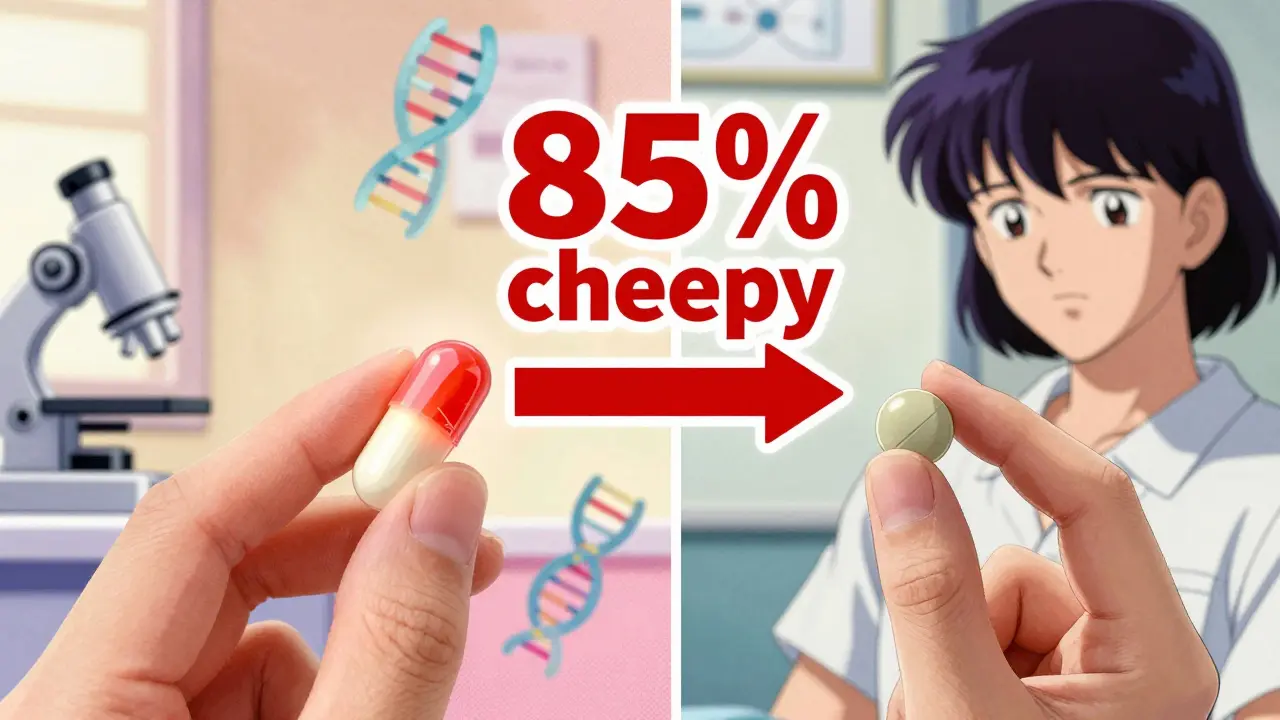
When you pick up a prescription, you might see two options: the brand-name drug you recognize from TV ads, or a cheaper generic version with a different color and shape. It’s easy to wonder - why does the generic cost 80-85% less? Is it weaker? Less safe? The answer isn’t about quality - it’s about money, rules, and timing.
Same Medicine, Different Price Tag
A generic drug isn’t a copycat. It’s the exact same medicine. The FDA requires that generics have the same active ingredient, strength, dosage form, and how it works in your body as the brand-name version. That means if you take generic atorvastatin, you’re getting the same heart medication as Lipitor. Same for omeprazole and Prilosec, or metformin and Glucophage. The pills might look different - different color, shape, or even flavor - but the part that treats your condition is identical.The FDA doesn’t just trust the manufacturer’s word. They require rigorous testing to prove bioequivalence. That means the generic must deliver the same amount of active ingredient into your bloodstream at the same speed as the brand. The acceptable range? Within 80-125% of the brand’s performance. That’s not a guess - it’s science. And if it doesn’t meet that standard, it doesn’t get approved.
The Real Cost: R&D and Patents
Here’s where the price gap opens up. Brand-name drug companies spend an average of $2.6 billion to bring one new drug to market. That includes 8 to 12 years of research, testing on animals, and multiple rounds of clinical trials with thousands of patients. Most of these trials fail. Many drugs never make it past the lab. The company has to cover all those losses while also paying for marketing, legal teams, and patent protection.Once a brand-name drug is approved, the company gets a 20-year patent from the date it was first filed. That gives them exclusive rights to sell it. No competition. That’s how they recover their investment. During those 20 years, they can charge whatever the market will bear - sometimes hundreds of dollars per pill.
Generic manufacturers don’t have to do any of that. They don’t repeat the animal studies. They don’t run new clinical trials. They don’t pay for years of failed experiments. All they need to prove is that their version works the same way as the brand. That cuts development time from over a decade down to 1-3 years. And the cost? Around $1 million to $5 million per drug - a tiny fraction of what the brand-name company spent.
The Hatch-Waxman Act: The Rule That Changed Everything
In 1984, Congress passed the Hatch-Waxman Act. It created the modern system for generic drugs. Before that, generics were rare. After? The floodgates opened.This law gave generic companies a clear path: wait until the brand’s patent expires, then file an Abbreviated New Drug Application (ANDA). The FDA reviews these applications in about 10 months on average. Once approved, the generic can hit the market immediately. The law also lets generic companies challenge weak patents - which helps speed up competition.
Without Hatch-Waxman, we wouldn’t have the 90% of prescriptions filled with generics today. It’s the reason you can get a month’s supply of generic metformin for $4 instead of $200.
Competition Drives Prices Down
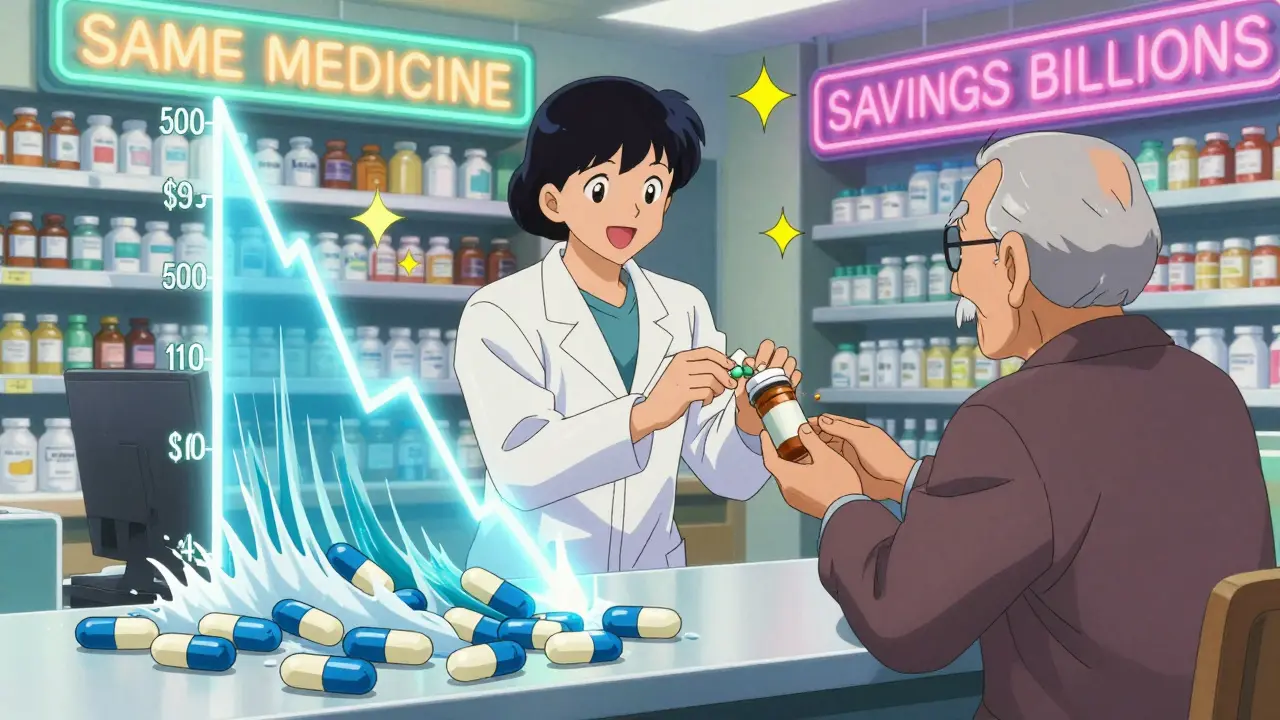
Once a patent expires, it’s not just one generic company that jumps in. It’s often 10, 15, even 20. Each one wants to sell more than the others. So they lower their prices. That’s basic economics: more sellers = lower prices.Within the first year of a generic hitting the market, prices typically drop by 80-90%. As more manufacturers enter, they drop even further. For example, when generic versions of Lipitor came out, the price fell from $500 a month to under $10. Today, you can get it for $4 at some pharmacies.
The top five generic manufacturers - Teva, Viatris, Sandoz, Amneal, and Aurobindo - control nearly half the U.S. market. But even they compete fiercely. That’s why prices keep falling.
Who’s Paying for This?
You might think drug companies are losing money. But they’re not. Brand-name companies often make their own generics once the patent expires. They sell them under a different label. That’s how they keep profits flowing.More importantly, the savings go to patients, insurers, and taxpayers. In 2022 alone, generics saved the U.S. healthcare system $293 billion. From 2007 to 2016, they saved $1.67 trillion. That’s money that didn’t go to hospitals, insurance companies, or government programs like Medicare and Medicaid.
Most insurance plans have three tiers: generics (Tier 1), brand-name drugs (Tier 2), and specialty drugs (Tier 3). Generics usually cost $0-$15 per prescription. Brand-name drugs? $25-$50. Specialty drugs? You pay a percentage of the full price - sometimes over $1,000 a month.
Why Do People Still Doubt Generics?
Despite all the evidence, 62% of Americans say they trust brand-name drugs more. Why? Because of appearances. A generic pill might look completely different. Maybe it’s blue instead of purple. Maybe it’s round instead of oval. Some people think that means it’s different.It’s not. But confusion happens. In 2022, the FDA recorded 425 adverse event reports linked to patients mixing up brand and generic pills because they looked different. That’s why they launched the “Know Your Meds” campaign - to remind people that looks don’t matter. What matters is the active ingredient.
There’s also a small group of drugs where switching between generics can cause issues. These are called narrow therapeutic index drugs - like warfarin (blood thinner) or levothyroxine (thyroid medication). A tiny change in how the drug is absorbed can make a difference. That’s why some doctors prefer to stick with one brand or generic. But even here, the FDA says all approved generics are safe. If you’re concerned, talk to your pharmacist. They can help you track which version you’re taking.
Real Stories, Real Savings
People are saving thousands every year. One Reddit user switched from brand-name Synthroid to generic levothyroxine and saved $400 a month. Another cut their monthly cost of Concerta from $350 to $15 after switching to generic methylphenidate. GoodRx data shows 92% of patients choose generics because of cost. Only 27% complain about the pill looking different.Pharmacists are trained to explain this. The American Pharmacists Association recommends spending 3-5 minutes with each patient when switching to a generic. They answer questions, show the pill, and reassure patients: “This is the same medicine. It just costs less.”
The Future: More Generics, Lower Prices
More brand-name drugs are losing patents every year. In 2023 alone, over 150 drugs with combined sales of $157 billion will go generic. The FDA is speeding up approvals for complex generics - like inhalers and ointments - cutting review times from five years to two. That means more savings soon.Even the government is pushing for change. The Biden administration directed the FDA to remove barriers to generic approval. The FTC is cracking down on “pay-for-delay” deals, where brand companies pay generics to stay off the market. Those deals cost consumers $3.5 billion a year.
By 2028, experts predict 93% of prescriptions will be filled with generics. That’s up from 90.5% today. And as more drugs go generic, prices will keep falling. The system is working - not because it’s perfect, but because competition works.
What You Can Do
If you’re on a brand-name drug and paying a lot:- Ask your doctor: “Is there a generic version?”
- Check GoodRx or SingleCare for cash prices - sometimes generics cost less than your insurance copay.
- Don’t assume your pharmacy will automatically switch you. Ask if they’re giving you the generic.
- If you notice a change in how you feel after switching, tell your doctor. It’s rare, but it can happen.
You’re not sacrificing quality. You’re choosing smart. And you’re helping the whole system save billions.
Are generic drugs as effective as brand-name drugs?
Yes. The FDA requires generics to have the same active ingredient, strength, dosage, and how they work in your body as the brand-name version. They must prove bioequivalence - meaning they deliver the same amount of medicine into your bloodstream at the same rate. Over 90% of prescriptions in the U.S. are for generics, and studies consistently show they work just as well.
Why do generic pills look different?
Trademark laws require generic manufacturers to make their pills look different from the brand-name version. That means different color, shape, size, or markings. But the active ingredient - the part that treats your condition - is identical. The FDA allows these differences to avoid confusion, but they don’t affect how the drug works.
Can switching to a generic cause side effects?
For most drugs, no. But for a small number called narrow therapeutic index drugs - like warfarin, levothyroxine, or phenytoin - even tiny differences in how the body absorbs the drug can matter. If you switch and notice changes in how you feel, tell your doctor. It’s rare, but your provider may stick with one version. Most patients switch without any issues.
Why are generics so much cheaper if they’re the same?
Brand-name drugs cost billions to develop - including 8-12 years of research and clinical trials. Generic manufacturers skip all that. They only need to prove their version works the same way, which takes months, not years. They also don’t pay for advertising. With multiple companies competing, prices drop fast. That’s why generics cost 80-85% less.
Do insurance plans prefer generics?
Yes. Most insurance plans have three tiers: generics (Tier 1), brand-name drugs (Tier 2), and specialty drugs (Tier 3). Generics usually cost $0-$15 per prescription. Brand-name drugs cost $25-$50. If you ask for the brand when a generic is available, your insurance may deny coverage unless your doctor gets prior approval.
Is it safe to buy generics made overseas?
Yes. The FDA inspects over 12,000 manufacturing facilities worldwide each year - including those in China and India - to make sure they meet the same strict standards as U.S. plants. All approved generics must follow Current Good Manufacturing Practices (CGMP). The FDA doesn’t allow drugs from unapproved facilities to enter the U.S. market.


Nicole Blain
20 March, 2026 04:54 AMi just switched to generic levothyroxine last year and saved like $500/month 😍 same pill, different color. my doctor said it’s literally identical. why do people still stress about the look??
Kathy Underhill
20 March, 2026 14:21 PMThe system works because competition forces efficiency. No magic. No conspiracy. Just market dynamics meeting regulatory rigor. We don’t need to romanticize generics. We just need to use them.
Srividhya Srinivasan
22 March, 2026 09:05 AMLet’s be real-90% of generics are made in India and China, where factories are inspected once every 5 years… IF they’re lucky. The FDA’s ‘standards’? A joke. They’re letting in substandard drugs because Big Pharma wants cheap pills for you… while they sell their own generic version for $200 a month. Wake up.
Prathamesh Ghodke
23 March, 2026 13:46 PMHonestly? I used to be scared of generics too. Then I switched to generic metformin. No side effects. No weird feelings. Just… cheaper. And my bank account thanked me. 🙌
Stephen Habegger
24 March, 2026 19:04 PMYou’re not losing anything by choosing generic. You’re gaining savings, access, and peace of mind. It’s not a compromise. It’s a smart move.
becca roberts
26 March, 2026 10:07 AMSo the FDA says they’re the same… but have you ever tried switching from one generic to another? My thyroid went haywire. Turns out, not all generics are created equal. Funny how no one talks about that.
Andrew Muchmore
28 March, 2026 05:53 AMPeople think they’re getting ripped off because the brand name has a fancy logo. The truth? You’re getting the exact same medicine. Stop paying for advertising.
Paul Ratliff
29 March, 2026 12:44 PMi got my generic zoloft for $3 at walmarts. same as the blue one. i dont even remember what the brand looked like. why are we still having this conversation??
SNEHA GUPTA
31 March, 2026 00:01 AMThe Hatch-Waxman Act was a watershed moment in public health. It shifted the paradigm from profit-driven monopolies to accessible medicine. The science is clear. The ethics are clear. The only obstacle left is perception.
Gaurav Kumar
31 March, 2026 04:07 AMIndia makes 60% of the world’s generics. That’s not a strength-it’s a vulnerability. Who’s inspecting these labs? Who’s ensuring quality? You think the FDA has time? They’re overwhelmed. And you’re the guinea pig.
David Robinson
31 March, 2026 23:31 PMI’ve been on the same generic for 8 years. Never had an issue. But every time I see someone freak out about the pill color, I think: maybe we should stop marketing drugs like they’re luxury handbags. Just because it’s blue doesn’t mean it’s better.
Jeremy Van Veelen
2 April, 2026 17:31 PMThis isn’t about medicine. It’s about capitalism. The system is designed to extract every dollar from you until the patent expires. Then-suddenly-it’s ‘oh, here’s a $4 pill.’ The real scandal? The fact that this is considered normal.
Laura Gabel
4 April, 2026 03:26 AMMy cousin switched to generic and had a panic attack because the pill was round instead of oval. She called the pharmacy crying. We laughed. Then we paid $4 for her refill. She’s fine now. No one needs to be this dramatic.
jerome Reverdy
5 April, 2026 00:05 AMThe real win here is systemic. Generics aren’t just cheaper-they’re democratizing access. For millions of people, a $4 prescription means they don’t skip doses. They don’t ration. They don’t choose between food and meds. That’s not a side effect. That’s public health in motion. And yeah, the science backs it. The data is overwhelming. Stop overthinking it. Take the pill. Save the cash.