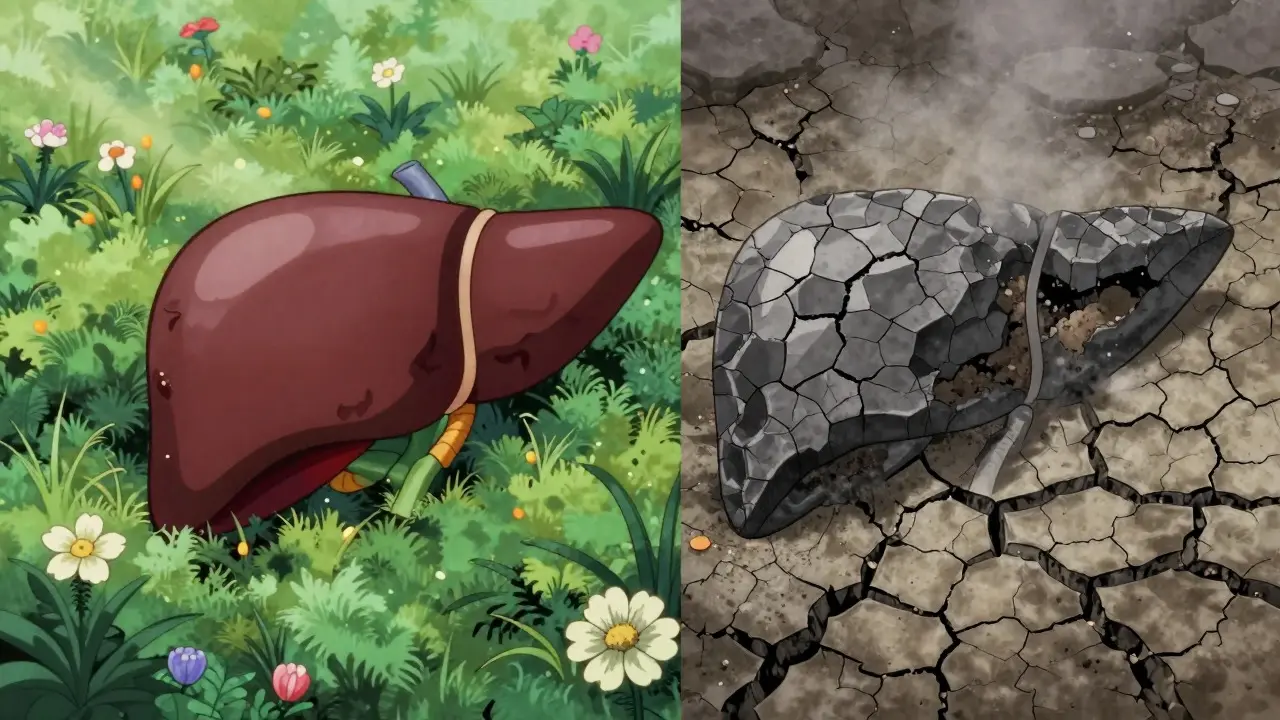
Your liver is a powerhouse. It filters toxins, produces proteins, and helps your body digest food. But when it gets damaged repeatedly over years, something irreversible happens. Healthy tissue turns into hard, useless scar tissue. This condition is called cirrhosis, which is the final stage of chronic liver disease where healthy liver cells are replaced by non-functional scar tissue. Once you reach this point, the damage is permanent. You can’t un-scar a liver. But understanding what cirrhosis is, how it progresses to failure, and when a transplant becomes necessary can save your life.
What Is Cirrhosis and How Does It Develop?
Cirrhosis isn't a sudden event. It’s the end result of long-term injury. Think of it like a garden that has been trampled on for years. The soil (your liver tissue) becomes compacted and hard. Nothing grows there anymore. In medical terms, this process starts with inflammation. When liver cells get hurt-whether from alcohol, viruses, or fat buildup-they try to heal. The body sends out fibrous tissue to patch things up. At first, this is just fibrosis, which is early-stage scarring that can sometimes be reversed if the cause is treated early.
But if the insult continues, the fibrosis spreads. It forms thick bands around clusters of regenerating liver cells. These bands block blood flow through the portal vein, which is the main vessel carrying nutrient-rich blood from the intestines to the liver. This blockage causes pressure to build up in the portal system, a condition known as portal hypertension, defined as increased blood pressure in the portal vein system, typically exceeding 10 mmHg. When this scarring becomes widespread and disrupts the liver’s architecture, we call it cirrhosis. According to the National Institute of Diabetes and Digestive and Kidney Diseases (NIDDK), this represents a major public health concern, affecting roughly 0.15% to 1.0% of the global population.
Compensated vs. Decompensated: The Critical Turning Point
Not all cirrhosis looks the same. Doctors split it into two stages because the outlook changes drastically between them. Understanding this difference is vital for anyone diagnosed with liver disease.
In compensated cirrhosis, the liver is scarred but still able to perform its essential functions without obvious symptoms. You might feel fine. Your blood tests could look slightly off, but you’re walking around, working, and living normally. Many people live for years in this stage if they address the underlying cause. However, once the scarring gets too bad, the liver can no longer keep up. It tips over into decompensated cirrhosis, where the organ fails to function adequately, leading to severe complications and overt symptoms.
This shift is dangerous. The American Liver Foundation notes that five-year survival rates drop from 80-90% in compensated cases to just 20-50% in decompensated cases. Why? Because decompensation brings complications that threaten your life directly:
- Ascites: Fluid builds up in your abdomen. It makes you feel bloated, uncomfortable, and increases infection risk.
- Hepatic Encephalopathy: Toxins your liver usually cleans out build up in your brain. This causes confusion, memory issues, and even coma.
- Variceal Bleeding: High pressure forces blood into smaller veins in the esophagus, which can burst and cause massive bleeding.
- Jaundice: Yellowing of the skin and eyes due to bilirubin buildup.
How Do We Measure Severity? MELD and Child-Pugh Scores
If you have cirrhosis, your doctor will likely calculate a score to see how sick you are. Two systems dominate clinical practice: the MELD score, which stands for Model for End-Stage Liver Disease, ranging from 6 to 40, used to prioritize patients for liver transplantation, and the Child-Pugh classification, which categorizes severity as Class A, B, or C based on bilirubin, albumin, INR, ascites, and encephalopathy levels.
| Feature | MELD Score | Child-Pugh Classification |
|---|---|---|
| Purpose | Prioritizing transplant candidates | Assessing general prognosis and surgical risk |
| Parameters Used | Bilirubin, INR, Creatinine, Sodium | Bilirubin, Albumin, INR, Ascites, Encephalopathy |
| Score Range | 6 to 40 | 5 to 15 points |
| Key Threshold | >15 indicates high mortality risk | Class C indicates poor prognosis (<45% 1-year survival) |
| Update Frequency | Updated regularly for waitlist status | Calculated periodically during care |
A MELD score above 15 means you have a significant risk of dying within three months without a transplant. This number drives who gets an organ first. The Child-Pugh score gives a broader picture of your overall health. Class A patients have well-compensated disease, while Class C patients have decompensated disease with poor short-term survival odds. Knowing these numbers helps you and your doctor decide when to start looking for a transplant.

Liver Failure and the Road to Transplantation
When cirrhosis progresses to the point where the liver simply stops working, you face acute-on-chronic liver failure or end-stage liver disease. At this stage, medication alone often isn’t enough. The only cure is a new liver. Liver transplantation is a surgical procedure replacing a diseased liver with a healthy one from a deceased or living donor.
The United Network for Organ Sharing (UNOS) reports that cirrhosis accounts for about 40% of all liver transplants globally. But here’s the hard truth: there aren’t enough organs. In 2022, only 8,780 liver transplants were performed in the U.S., while 14,300 people were actively waiting. That mismatch leads to a 12% annual mortality rate among listed patients. People die while waiting.
Getting on the transplant list is a rigorous process. You need to meet strict criteria. For example, if alcohol was the cause of your cirrhosis, many centers require six months of sobriety before listing you. If you have cancer associated with your liver disease, specific tumor size limits apply. The evaluation involves checking your heart, lungs, kidneys, and mental health to ensure you can survive the surgery and handle lifelong immunosuppression.
Diagnosis: Beyond the Biopsy
Historically, diagnosing cirrhosis required a liver biopsy, which is an invasive procedure removing a small sample of liver tissue for microscopic examination. While still considered the gold standard in some complex cases, modern medicine relies heavily on non-invasive tests. Why stick a needle in your liver when you can measure stiffness?
Transient elastography (often branded as FibroScan) is a non-invasive ultrasound-based technique measuring liver stiffness to estimate fibrosis severity. It works by sending a vibration wave through the liver. Harder, scarred livers transmit the wave faster. A stiffness value over 12.5 kPa strongly suggests cirrhosis. More recently, magnetic resonance elastography (MRE) has emerged as an even more accurate tool, achieving 90% diagnostic accuracy compared to 75% for transient elastography according to recent studies in the Journal of Hepatology.
Blood tests also play a huge role. Elevated bilirubin (>2 mg/dL), low albumin (<3.5 g/dL), prolonged INR (>1.5), and low platelet counts (<150,000/mm³) are classic red flags. Combining these lab results with imaging creates a powerful diagnostic picture without the risks of surgery.
Living With Cirrhosis: Management and Lifestyle Changes
If you have compensated cirrhosis, your goal is to stay there forever. You do this by attacking the root cause and protecting what liver tissue you have left.
- Stop Alcohol Completely: If alcohol caused your cirrhosis, every drop matters. Abstinence significantly improves survival rates.
- Treat Viral Hepatitis: Medications for Hepatitis B and C can stop viral replication and halt further damage. Direct-acting antivirals for HCV now cure over 95% of cases.
- Control Weight and Metabolic Health: For those with NAFLD-related cirrhosis, weight loss, diabetes control, and cholesterol management are critical. Non-alcoholic fatty liver disease now accounts for 24% of cirrhosis cases in the U.S., surpassing alcohol.
- Dietary Restrictions: Limit sodium to under 2,000 mg per day to prevent fluid retention. Ensure adequate protein intake unless advised otherwise by a specialist, as malnutrition worsens outcomes.
- Medication Caution: Your liver metabolizes drugs. Avoid NSAIDs like ibuprofen, which can harm kidneys and increase bleeding risk. Always check with your hepatologist before taking new prescriptions or supplements.
Regular monitoring is non-negotiable. You’ll need ultrasounds every six months to screen for hepatocellular carcinoma, a type of primary liver cancer that frequently develops in patients with advanced cirrhosis. Early detection saves lives. Catching a small tumor allows for curative treatments like ablation or resection, rather than waiting until it’s too late.
The Future of Cirrhosis Care
Science is moving fast. Researchers are developing antifibrotic therapies aimed at reversing scarring itself. Drugs targeting lysyl oxidase-like 2 (LOXL2) have shown promise in reducing fibrosis progression in clinical trials. Additionally, innovations in transplantation are expanding the donor pool. Normothermic machine perfusion keeps donor livers alive and functional outside the body, increasing usable grafts by 22%. Stem cell therapies and bioartificial livers are also entering human trials, offering hope for bridging patients to transplant or even avoiding it altogether.
Until then, awareness remains your best defense. Know your risk factors. Get tested if you’ve had hepatitis, drink heavily, or struggle with metabolic syndrome. Cirrhosis is silent until it’s loud. Don’t wait for symptoms to appear. Protect your liver today.
Can cirrhosis be reversed?
Established cirrhosis is generally considered irreversible because the scar tissue permanently replaces healthy liver cells. However, early fibrosis can sometimes be reversed if the underlying cause is treated promptly. In compensated cirrhosis, halting the progression prevents further damage and maintains function, effectively stabilizing the condition even if the scars remain.
What is the average life expectancy with cirrhosis?
Life expectancy depends heavily on whether the cirrhosis is compensated or decompensated. Patients with compensated cirrhosis may live 10-20 years or more, especially if they address the root cause. Those with decompensated cirrhosis have a significantly shorter prognosis, with a 5-year survival rate dropping to 20-50% without a liver transplant.
How is cirrhosis diagnosed?
Diagnosis involves a combination of blood tests (checking bilirubin, albumin, INR, and platelets), imaging studies like ultrasound or MRI, and specialized tests such as transient elastography (FibroScan) or magnetic resonance elastography to measure liver stiffness. Liver biopsy is rarely needed now but remains the historical gold standard.
What foods should I avoid with cirrhosis?
You should strictly limit sodium (salt) to less than 2,000 mg per day to prevent fluid buildup (ascites). Avoid raw shellfish, which can carry bacteria dangerous to compromised immune systems. Limit alcohol completely. Also, be cautious with high-protein diets if you experience hepatic encephalopathy, though most patients need adequate protein to prevent muscle wasting.
When is a liver transplant necessary?
A transplant is typically necessary when cirrhosis becomes decompensated, meaning the liver fails to function properly despite treatment. Indicators include recurrent ascites, variceal bleeding, hepatic encephalopathy, or a MELD score greater than 15, which signals a high short-term mortality risk without intervention.
What is the difference between fibrosis and cirrhosis?
Fibrosis is the initial formation of scar tissue in response to liver injury and can often be reversed if treated early. Cirrhosis is the advanced, end-stage form where scarring becomes widespread, permanent, and disrupts the liver's structure and function, leading to nodules and significant impairment.