
Packing your suitcase feels routine until you realize you're moving past borders with life-saving drugs. A traveler once spent seventy-two hours detained in Bangkok because they carried standard alprazolam without proper paperwork. Another faced permanent entry denial to Japan over common ADHD medication. These aren't isolated incidents. According to the CDC Yellow Book, twelve to fifteen percent of international travelers face medication-related issues during their trips. In 2023 alone, ninety-three million Americans traveled internationally, yet many still walk into security checkpoints unaware that the pills in their pockets could land them in jail.
Getting enough medication before international travel isn't just about filling a script; it is about understanding a complex web of international law. Since World War II, global regulations have evolved, anchored by the United Nations Single Convention on Narcotic Drugs (1961). Today, the regulatory landscape remains fragmented. As of October 2025, only eighty-seven of 193 UN member states provide specific traveler medication regulations to the International Narcotics Control Board (INCB), the body responsible for monitoring drug control globally. This gap creates significant risks for anyone relying on prescription medication for chronic conditions.
Why Your Medicine Might Be Illegal at Your Destination
You assume your doctor's prescription makes everything legal everywhere. That logic holds true in your home country, but it fails instantly once you cross a border. Laws regarding pharmaceuticals vary wildly between jurisdictions. For example, Japan prohibits over one thousand four hundred common substances. This includes everyday items like pseudoephedrine found in cold medicines and certain antibiotics. The United Arab Emirates bans eight hundred seventy-six substances, including codeine-containing products, which can lead to prison sentences of up to five years.
The U.S. Department of State regularly updates warnings based on these disparities. Dr. Jane Chen, Director of the CDC's Travelers' Health Branch, notes that even medications legal in the U.S. may be prohibited elsewhere. In 2024 alone, there were twenty-three documented cases where travelers faced legal consequences for possessing codeine products abroad. You cannot rely on a quick Google search at the last minute. You need to verify legality before you book your flight.
Regulatory divergence is accelerating. While the European Union has moved toward standardizing protocols through the 2023 Traveler Medication Directive, Asian and Middle Eastern nations have strengthened restrictions by forty-one percent since 2022. This means a trip through Asia requires more diligence than one through Europe. If you are visiting multiple countries, you must check regulations for each nation and every transit point. Transit airports sometimes have different laws than your final destination.
Calculating the Correct Quantity
Determining how much medicine to pack involves more than counting the days of your trip. Customs agencies typically allow for "no more than a 90-day supply" under U.S. Customs and Border Protection (CBP) guidelines. However, this limit changes depending on the destination. If you have a documented medical need, exceptions exist, but you need proof.
The safest strategy is to calculate your exact daily usage, multiply it by the duration of your stay, and then add a seven-day buffer. This buffer accounts for delays, missed flights, or extended stays due to illness. If your trip is three weeks, do not pack exactly twenty-one tablets. Pack thirty-five. Mobility International USA reported that in 2025, thirty-two percent of supply disruptions occurred simply because travelers brought insufficient quantities.
Liquid medications require special attention. Standard airport security usually limits liquids to 3.4 ounces. However, medically necessary liquids are permitted in larger quantities if declared. Delta Air Lines specifies that passengers must declare these at security checkpoints as per TSA Directive 1544.4, effective January 2025. Always carry liquids in your carry-on luggage. Never pack essential medicine in checked bags. If your checked bag goes missing, you lose your treatment. If it gets inspected, opening the bag might violate sealing laws in some regions.
| Metric | Standard Rule | Safety Recommendation |
|---|---|---|
| Duration Limit | 90 Days (Max) | Trip Duration + 7 Days Buffer |
| Liquids Limit | 3.4 oz (100ml) | Unlimited for Medically Necessary (Declare) |
| Container Type | Any Bottle | Original Prescription Label Required |
| Documentation | Recommended | Mandatory for Controlled Substances |
Essential Documentation Checklist
Paperwork is often the difference between walking through customs smoothly and being held in a holding cell. Five U.S. states-California, New York, Texas, Florida, and Illinois-legally require controlled substances to remain in original prescription bottles. This creates compliance conflicts for domestic connecting flights, but international standards are stricter.
Most countries require a notarized doctor's letter for all prescription medications. Thailand is particularly strict about this. The letter should be dated within six months of travel and include your generic drug names, dosages, and the prescribing doctor's contact information. Translation matters too. Forty-three percent of language barriers cited by the U.S. State Department involve document misinterpretation. If you are traveling to a non-English speaking country, get your medical certificate translated into the local language.
Contact the destination country's embassy at least sixty days pre-travel. The International Society of Travel Medicine recommends this specific timeline because seventy-eight percent of medication-related entry denials could have been prevented with proper advance planning. Ask explicitly about import permits. Saudi Arabia requires Ministry of Health import permits for specific medications. Waiting until the week before departure leaves no time to resolve bureaucratic snags.
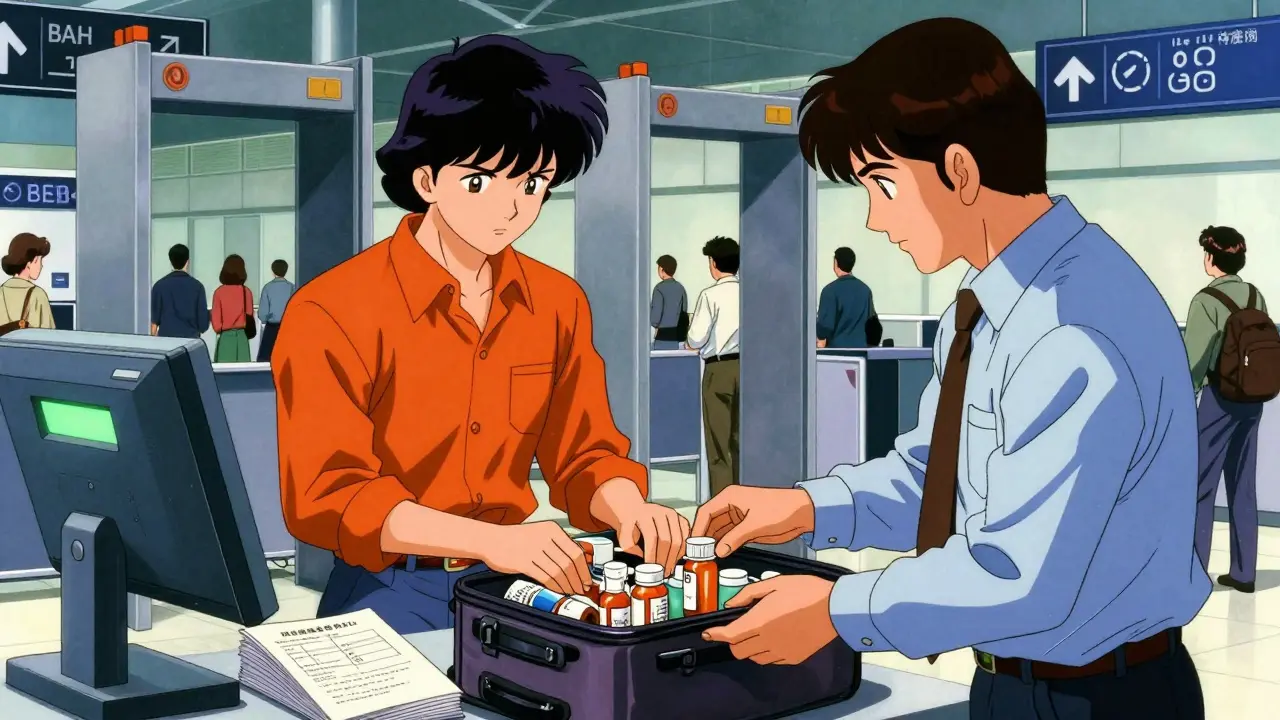
Navigating Airport Security and Airline Rules
Your journey begins at the security checkpoint. Transportation Security Administration (TSA) agents have the final say on what passes through scanners. While they consider prescription labeling "recommended but not required" for security screening, customs officials at your destination often demand it. It is safer to err on the side of caution.
Delta Air Lines' accessibility assistance line saw a thirty-seven percent increase in medication-related inquiries from early 2024 to early 2025. Most calls involved liquid medication limits or needle transport. If you require needles or syringes, such as for insulin, keep them with your medication. Some airlines require prior notification. Delta specifies these must be declared at security. The American Pharmacists Association notes that sixty-eight percent of U.S. pharmacies can provide an International Certificate for Medicinal Products (ICMP) documentation. This service averages $25-$40 per certificate and acts as a universal validation tool.
Do not mail your medications ahead of time to your hotel. It may be illegal to send prescription medications to certain countries through the mail. Carrying them personally gives you the ability to explain their purpose directly to customs officers. Keep medications in your carry-on bag so you can monitor temperature and pressure conditions throughout the flight.
Risks of Specific Drug Categories
Not all pills are created equal in the eyes of international law. Certain categories trigger immediate scrutiny. Sedatives like zolpidem and alprazolam fall under strict narcotic controls. Stimulants used for ADHD, such as amphetamine or dexamfetamine, are treated similarly to illicit drugs in many Asian and European jurisdictions. Decongestants containing pseudoephedrine are often banned entirely in places like Japan and Singapore.
Cannabis-derived medications present a growing risk. Even though U.S. federal legalization exists, nineteen countries-including South Korea and Malaysia-implemented complete bans on CBD products in 2024. Travelers carrying CBD oil often face severe penalties despite believing they are compliant with U.S. law. Always disclose any cannabis derivatives to your doctor when planning travel so they can advise on legal alternatives.
If you take multiple medications, ensure the packaging does not mix brands. Mixing drugs in a single pillbox looks suspicious to security scanners who suspect diversion. Keep distinct bottles for distinct drugs whenever possible. If space is limited, use a pill organizer only after checking if the destination allows it. Many countries prefer original blister packs to prove legitimacy.

What To Do If You Lose Your Medicine
Despite planning, things go wrong. Lost luggage happens. Theft occurs. In these scenarios, having a digital backup plan is vital. Save photos of your medication, prescriptions, and insurance cards in the cloud. Carry a printed copy of the doctor's letter separate from the actual pills. If you cannot buy medication locally, your destination country might sell generic equivalents.
The WHO predicts a sixty percent increase in medication-related travel complications by 2030 without international standardization. Until then, personal vigilance is your primary defense. Store emergency contacts prominently. The INCB maintains a 24/7 emergency assistance line (+41 22 917 92 92). Your embassy can also intervene if you are detained or denied medication access unexpectedly.
Summary of Preparation Timeline
Successful medication management starts weeks before you leave. Follow this schedule to ensure compliance:
- 12 Weeks Before: Consult your physician. Discuss travel plans and request a fresh prescription refill if needed.
- 10 Weeks Before: Verify destination laws using the INCB Country Regulations database.
- 8 Weeks Before: Contact the destination embassy for permit requirements.
- 6 Weeks Before: Obtain formal documentation, certificates, and translations.
- 1 Week Before: Pack medication in carry-on, label clearly, and declare if asked.
Taking these steps reduces anxiety and ensures your health remains stable while exploring the world. You deserve to enjoy your trip without worrying about the contents of your pocket.
How many days of medication should I bring for a trip?
You should bring the full amount needed for the duration of your trip plus a seven-day buffer. Most countries accept up to a 90-day supply as reasonable, but bringing significantly more without authorization can raise suspicions.
Can I put my medicine in my checked baggage?
No. You should always carry essential medications in your carry-on luggage. Checked bags can get lost, delayed, or stolen, leaving you without access to critical treatment during your travels.
Do I need a doctor's letter for my prescription?
Yes. While some countries recommend it, many require a notarized letter listing your generic drug names, dosages, and diagnosis. This is mandatory for controlled substances in most Asian and Middle Eastern countries.
Is CBD oil allowed for international travel?
Be extremely cautious. Nineteen countries, including South Korea and Malaysia, have implemented complete bans on CBD products in 2024, even if it is legal in the U.S. Check your specific destination's regulations carefully before packing it.
What happens if I forget to declare my meds?
Consequences vary. They can range from confiscation to arrest. For controlled substances, failure to declare can lead to detention, fines, or deportation, depending on the host country's laws.




Charles Rogers
30 March, 2026 08:01 AMThis guide outlines the critical necessity for preparation. People often overlook the legal implications of their pharmacy bottles. Customs agents hold absolute power regarding your entry status. You cannot assume domestic laws apply in foreign sovereign states. Many individuals face incarceration simply due to ignorance. The distinction between common cold medicine and banned substances blurs easily. One must contact embassies well in advance of departure dates. Documentation serves as the primary shield against aggressive screening procedures. Without original packaging, security protocols trigger unnecessary alarms. Carry-on storage ensures access even during delayed transit times. Liquids require special declaration to avoid confiscation at checkpoints. Travelers should prioritize health compliance over luggage convenience. A single buffer week protects against unexpected itinerary changes. Digital backups provide a safety net if physical documents vanish. Ultimately, personal vigilance remains the most effective tool for safety. Please share this information to protect your fellow travelers.
emma ruth rodriguez
30 March, 2026 17:16 PMIndeed! It is imperative that we consider these guidelines seriously; furthermore, one must act accordingly!!! The regulations are designed for safety reasons!
Rick Jackson
31 March, 2026 18:15 PMTrue freedom includes the responsibility to prepare adequately.
dPhanen DhrubRaaj
1 April, 2026 03:38 AMi think people ignore the embassy part too much and just fly in hope
Jonathan Sanders
2 April, 2026 01:58 AMOh wonderful, because nothing scares me more than paperwork when I already dread airports enough! The anxiety starts weeks before takeoff.
Vikash Ranjan
2 April, 2026 08:06 AMYou are worried about too much rules when sometimes you just need to survive the flight first. Many borders do not care about minor pills anyway.
Kendell Callaway Mooney
3 April, 2026 05:59 AMThe CDC recommendations align perfectly with the strategy presented here for optimal safety. Following the checklist prevents most issues completely.
Beccy Smart
5 April, 2026 02:24 AMThis is literally why nobody travels anymore 😂😭 just stay home it is safer for everyone involved 👍🚫✈️
sanatan kaushik
6 April, 2026 02:48 AMStop ignoring the embassy rules or you will get locked up like everyone else keeps complaining about. The law is strict in those regions.
Debbie Fradin
6 April, 2026 13:32 PMIt is insulting that people expect to bypass regulations without proper clearance from authorities. We live in a world with rules and consequences.
Jonathan Alexander
6 April, 2026 15:22 PMI heard of a friend who spent three days in a cell for ibuprofen which is tragic honestly. The stress ruins the entire vacation experience.