Imagine you’ve been taking a specific medication for months. It works well, and you feel fine. Then, one morning, you see a news headline or an email alert about a "serious risk" associated with that exact drug. Your heart skips a beat. Is it time to stop taking it? Do you need to call your doctor immediately? Or is this just another confusing medical alert that sounds scarier than it is?
This anxiety is common because understanding FDA Safety Communications, which are official notifications from the U.S. Food and Drug Administration regarding new safety information for approved medications, can feel like decoding a secret language. These documents are not just bureaucratic paperwork; they are critical tools for public health that bridge the gap between initial drug approval and ongoing real-world use. Since the passage of the Food and Drug Administration Amendments Act (FDAAA) in 2007, the FDA has significantly expanded its authority to monitor drug safety after marketing, leading to more frequent and detailed communications.
The goal isn’t to make you fear every pill you take. Instead, it’s to empower you with the knowledge to read these updates correctly so you can make informed decisions alongside your healthcare provider. Let’s break down exactly what these communications are, how they are structured, and how you can interpret them without getting lost in technical jargon.
Understanding the Landscape of Drug Safety Alerts
Not all safety notices from the FDA are created equal. The agency issues several types of communications, each serving a different purpose and carrying a different level of urgency. Knowing the difference helps you prioritize which ones require immediate attention and which are informational updates.
The most comprehensive type is the Drug Safety Communication. These are detailed reports that explain new safety findings, often resulting in changes to the drug’s official label. They typically address serious risks identified through post-marketing surveillance, clinical trials, or data from programs like the Sentinel Initiative, a system that uses electronic health data to monitor safety signals. According to FDA records from 2020-2023, the agency issues approximately 50-70 major Drug Safety Communications annually.
Then there are Drug Alerts. These are shorter, more urgent notices designed to convey critical information quickly, such as a recall or a life-threatening side effect that requires immediate cessation of use. For example, if a manufacturing error leads to contamination, a Drug Alert might instruct patients to stop using the product right away.
Other categories include Drug Safety-related Labeling Changes, which detail specific edits to the prescribing information, and Compounding Risk Alerts, which focus on medications prepared by pharmacies rather than mass-produced drugs.
| Type of Communication | Purpose | Urgency Level | Typical Action Required |
|---|---|---|---|
| Drug Safety Communication | Detailed analysis of new safety risks | Moderate to High | Review with doctor; may involve dosage adjustment |
| Drug Alert | Urgent notice about immediate dangers | High | Immediate attention; possibly stop use |
| Labeling Change | Updates to prescription instructions | Low to Moderate | Awareness; follow new instructions |
| Recall Notice | Removal of defective products | High | Return product; do not use |
Decoding the Structure of a Safety Communication
When you open a full Drug Safety Communication, it might look intimidating at first glance. However, these documents follow a standardized structure designed to help readers find key information quickly. If you know where to look, you can extract the relevant details for your situation without reading every single word.
Every communication begins with a section titled "What Safety Concern Is FDA Announcing?" This is the executive summary. It clearly states the problem in plain language. For instance, in a July 2025 communication regarding opioids, the FDA announced concerns about the risks of rapid discontinuation in physically dependent patients. This section tells you the "what" and the "why" before diving into the technicalities.
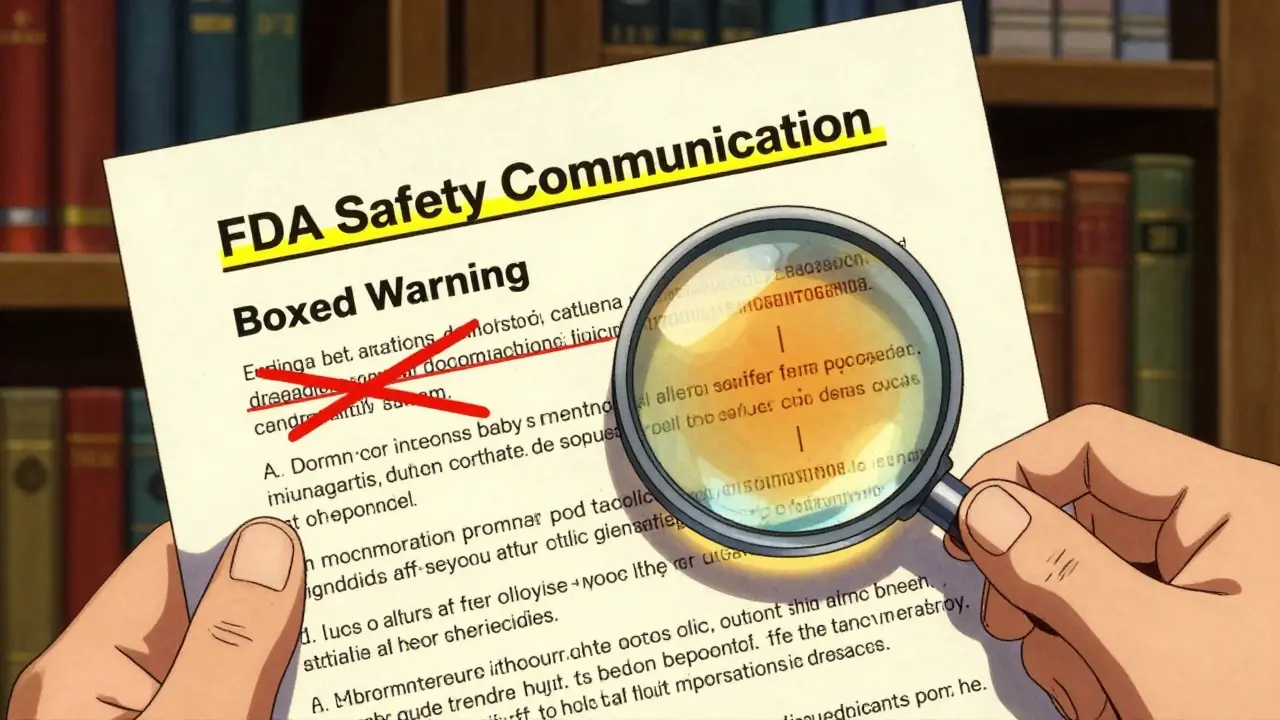
Next, you will often see a section labeled "Former Labeling Language Changes." This is crucial for understanding exactly what has changed. The FDA presents this as a before-and-after comparison. New text appears in bold underline, while deleted text shows up in ~~strikethrough~~. This visual cue makes it easy to spot additions and removals. For example, the opioid communication updated the warning from "Do not abruptly discontinue" to "Do not rapidly reduce or abruptly discontinue," reflecting a nuanced shift in clinical guidance based on new evidence.
The document also includes "Highlights of Prescribing Information." This section summarizes the most critical changes, such as updates to Boxed Warnings-the strongest safety warning the FDA can place on a label. Boxed Warnings indicate serious risks that could lead to hospitalization or death. If a communication mentions a Boxed Warning change, pay close attention.
Finally, look for the sections dedicated to specific audiences: "For Health Care Professionals" and "For Patients." The patient section offers practical advice, such as "Talk to your doctor about the risks and benefits of continuing treatment" or "Read the patient Medication Guide every time you receive a prescription." These actionable steps are designed to guide your next move.
Key Elements to Identify: Severity and Scope
Not all safety issues affect everyone equally. To understand how a communication applies to you, you need to evaluate two main factors: severity and scope.
Severity refers to how serious the risk is. The FDA categorizes warnings hierarchically. At the top is the Boxed Warning, which signifies the most severe risks. Below that are Contraindications (situations where the drug should not be used), followed by Warnings and Precautions. Understanding this hierarchy helps you gauge the potential impact. A change in the "Dosage and Administration" section might be less alarming than a new Contraindication, but both require careful review.
Scope determines who is affected. Does the issue apply to all medications in a class, or just one specific brand? In the 2025 opioid communication, the changes applied to all opioid analgesics, meaning millions of patients were potentially affected. In contrast, a communication about Copiktra (duvelisib), a cancer treatment, focused specifically on patients with certain types of leukemia. Always check if the communication specifies a particular patient population, such as pregnant women, elderly individuals, or people with kidney disease.
The FDA also indicates the evidence basis for the communication. Is it based on spontaneous post-marketing reports, new clinical trials, or meta-analyses of existing data? For example, the Copiktra safety update referenced a trial comparing duvelisib to ofatumumab, providing robust clinical evidence for the recommended changes. Knowing the source of the data can help you assess the reliability of the concern.
Challenges in Reading and Applying Safety Information
Despite their importance, FDA Safety Communications face criticism for being too technical and difficult to understand for the average person. Dr. Jerry Avorn, a Professor of Medicine at Harvard Medical School, noted in a 2019 JAMA commentary that the dense language creates barriers for non-physician healthcare providers and patients alike.
There is also the issue of timing. Critics like Dr. Donald Light of the Center for Study of Drug Development argue that serious safety risks often come to light years after initial signals emerge. His 2020 analysis showed a median lag of 4.2 years between the first safety reports and major labeling changes for high-risk medications. This delay can leave patients vulnerable during the interim period.
Furthermore, confusion exists between different types of alerts. A 2022 focus group by the National Organization for Rare Disorders found that 63% of surveyed patients mistook less urgent Drug Alerts for critical safety issues. This misinterpretation can lead to unnecessary panic or, conversely, ignoring genuine dangers.
Healthcare providers also struggle with volume. A 2021 study in the Journal of the American Medical Informatics Association found that only 37% of primary care physicians consistently read full Drug Safety Communications due to time constraints, even though 89% valued the information when applicable. This gap highlights the need for better summarization and integration of these alerts into daily practice.

Practical Strategies for Staying Informed
You don’t have to wait for a crisis to engage with drug safety information. By adopting a few proactive strategies, you can stay ahead of potential issues and ensure your treatment plan remains safe and effective.
Subscribe to Tailored Email Alerts: The FDA offers a subscription service on its Drug Safety and Availability webpage. You can filter alerts by drug class, therapeutic area, or specific medication names. This way, you only receive updates relevant to your health conditions, reducing noise and increasing relevance.
Focus on Key Sections: When reviewing a communication, prioritize the "Boxed Warning" and "Dosage and Administration" sections. These contain the most clinically significant changes. If you’re a patient, look for the "What This Means For You" section in patient-directed materials. Consult the referenced Medication Guide, which the FDA mandates to be written at an 8th-grade reading level and include a prominent discussion of serious risks.
Cross-Reference with Reliable Sources: For complex changes, such as the 2025 opioid labeling revision affecting multiple sections, cross-reference the communication with the complete prescribing information available through the Drugs@FDA database. This ensures you have the full context and aren’t missing any nuances.
Talk to Your Healthcare Provider: Never make unilateral decisions to start or stop medication based solely on an FDA communication. Share the alert with your doctor or pharmacist. They can interpret the information in the context of your medical history, current treatments, and overall health goals. As the Copiktra communication advises, "Talk to your doctor about the risks and benefits of continuing treatment."">
Use Visual Aids and Summaries: The FDA has begun piloting plain-language summaries and visual aids for high-impact communications. Look for these resources on the FDA website or ask your pharmacist if they have simplified explanations. The agency aims to increase patient comprehension rates from 54% to 75% by 2027, so expect more user-friendly content in the coming years.
The Future of Drug Safety Monitoring
The landscape of drug safety communications is evolving rapidly. The 2022 Food and Drug Omnibus Reform Act (FDORA) strengthened requirements for timely communication, mandating that the FDA issue communications within 30 days of finalizing significant safety actions, down from the previous 60-day window. This faster turnaround means patients receive critical information sooner.
Market analysis by Evaluate Pharma shows that safety communications trigger label changes in 68% of cases, with 22% leading to additional risk mitigation requirements and 10% resulting in restricted distribution programs. This demonstrates the tangible impact of these communications on how drugs are prescribed and used.
Looking ahead, the FDA plans to integrate safety alerts with digital health initiatives. By 2025, personalized safety alerts may be delivered directly through patient portals, making the information more accessible and actionable. However, challenges remain in global harmonization, as inconsistent messaging between the FDA and other regulatory bodies like the European Medicines Agency can create confusion for international patients.
As technology advances and health literacy improves, the goal is to transform safety communications from reactive warnings into proactive partnerships between regulators, healthcare providers, and patients. By understanding how to read and interpret these documents, you become an active participant in your own healthcare journey, ensuring that the benefits of your medications continue to outweigh the risks.
What is an FDA Drug Safety Communication?
An FDA Drug Safety Communication is an official notification issued by the U.S. Food and Drug Administration to inform healthcare professionals and patients about new safety information regarding medications after they have been approved and are in use. These communications address serious risks, labeling changes, or recalls based on post-marketing surveillance and clinical data.
How do I know if an FDA safety alert applies to me?
Check the "What Safety Concern Is FDA Announcing?" section for the specific drug name and condition. Look for the scope of the issue-does it affect all patients or a specific subgroup (e.g., pregnant women, elderly)? Also, review the severity level, such as Boxed Warnings, which indicate the most serious risks. Always consult your healthcare provider to determine if the alert impacts your personal treatment plan.
Should I stop taking my medication if I see a safety alert?
No, do not stop taking your medication abruptly unless explicitly instructed to do so in a Drug Alert or Recall Notice. Most safety communications recommend discussing the risks and benefits with your doctor. Abruptly stopping certain medications can cause withdrawal symptoms or worsen your condition. Contact your healthcare provider for guidance.
Where can I find FDA safety communications?
You can find all FDA Drug Safety Communications on the FDA’s Drug Safety and Availability webpage (fda.gov/drugs/drug-safety-and-availability). You can also subscribe to email alerts for specific drug classes or medications. Additionally, pharmacists and doctors often receive these alerts directly and can provide summarized information.
What is the difference between a Drug Safety Communication and a Drug Alert?
A Drug Safety Communication is a detailed report explaining new safety findings and often results in labeling changes. It is informative and may require consultation with a doctor. A Drug Alert is a shorter, more urgent notice about immediate dangers, such as a recall or life-threatening side effect, requiring quick action. Alerts are generally more time-sensitive.
How often does the FDA issue safety communications?
The FDA issues approximately 50-70 major Drug Safety Communications annually. The frequency has increased since the implementation of the FDAAA in 2007, which enhanced post-marketing surveillance capabilities. Smaller alerts and labeling changes occur more frequently throughout the year.
What does a Boxed Warning mean on a drug label?
A Boxed Warning is the strongest safety warning the FDA can place on a prescription drug label. It indicates that the drug carries a serious risk of significant adverse events, such as hospitalization or death. If a safety communication mentions a new or updated Boxed Warning, it requires careful attention and discussion with your healthcare provider.
Can patients access plain-language summaries of FDA communications?
Yes, the FDA has begun piloting plain-language summaries for high-impact communications, available in English and Spanish. These summaries aim to improve health literacy and patient comprehension. You can find these on the FDA website or ask your pharmacist for simplified explanations of complex safety updates.