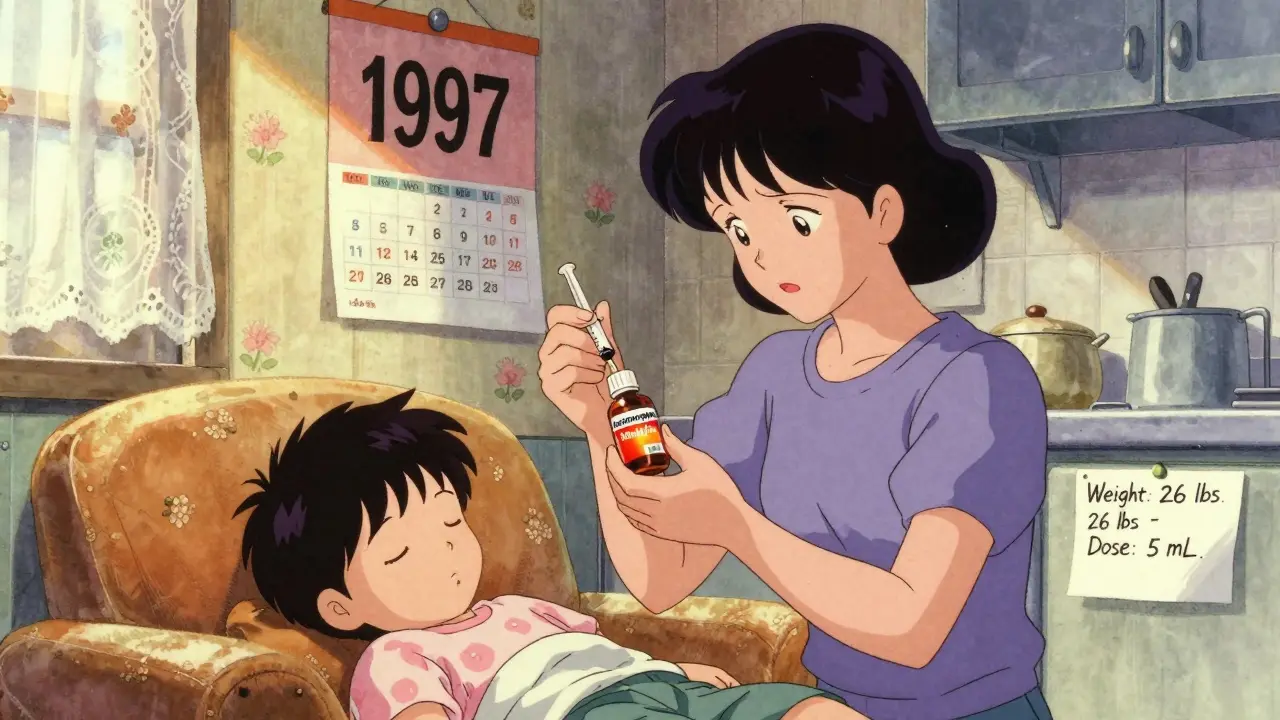
Every year, over a million children in the U.S. end up in emergency rooms because of mistakes with over-the-counter (OTC) medicines. Most of these errors happen because parents misread the label. It’s not because they’re careless-it’s because the labels are confusing. You’re not alone if you’ve stared at a tiny bottle, wondering whether to give 5 mL or 7.5 mL. The difference isn’t just a splash-it’s the difference between helping your child and harming them.
Why Weight Matters More Than Age
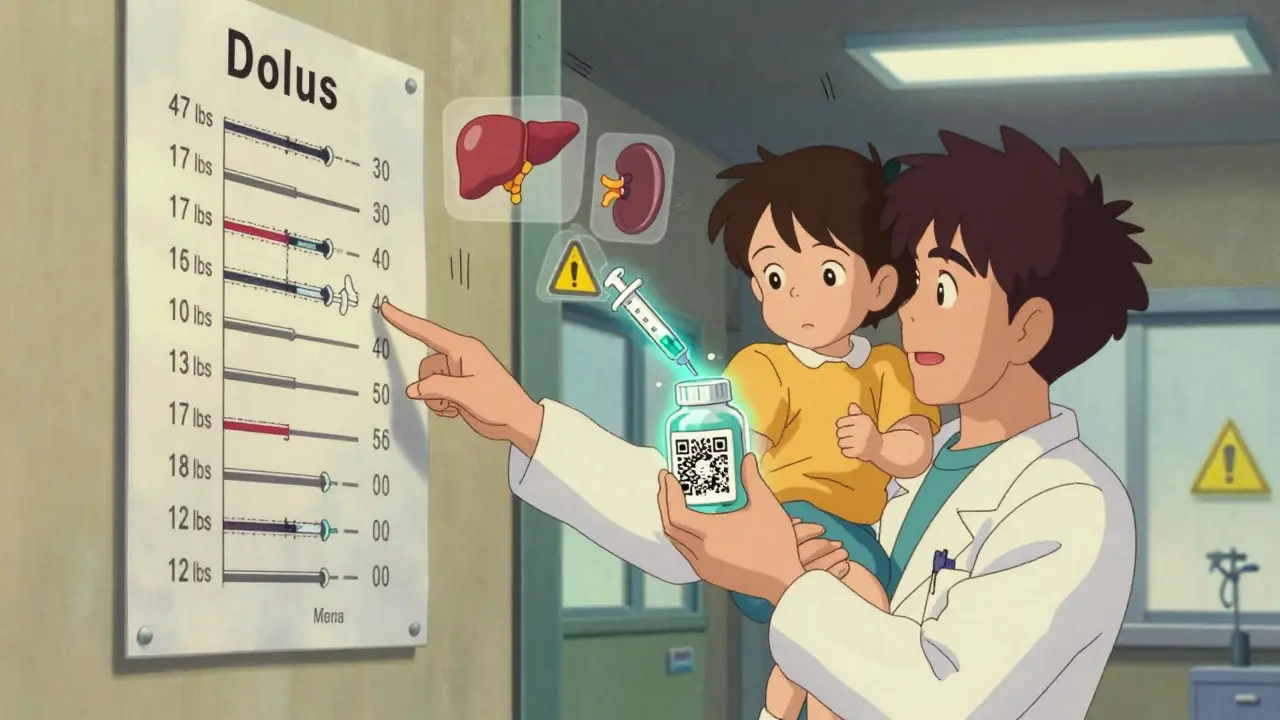
You’ve probably seen the age ranges on the label: "For children 2-3 years." But that’s just a starting point. The American Academy of Pediatrics says weight is the real key to getting the right dose. A 2-year-old who weighs 40 pounds needs more medicine than a 2-year-old who weighs 20 pounds. Using age alone leads to dosing errors in 23% of cases-15% too little, 8% too much.Acetaminophen and ibuprofen are the two most common OTC medicines for kids. Both can be dangerous if given incorrectly. Too much acetaminophen can cause liver failure. Too much ibuprofen can damage the kidneys. The FDA and pediatricians agree: if you know your child’s weight, use that. If you don’t, use age-but only as a backup.
How to Find Your Child’s Weight
You don’t need a scale at home to get an accurate weight. If you’re unsure, step on a bathroom scale holding your child, then step on it alone. Subtract the difference. Round to the nearest pound. Don’t guess. Don’t estimate. Even small mistakes add up.For example: if your child weighs 26 pounds, you look for the dosing range that covers 24-35 pounds. Never round up. If your child is 35.5 pounds, use the 36-47 pound range. Never skip a category. If your child’s weight falls between two ranges, always choose the lower one. It’s safer.
Reading the Label: The Must-Know Details
Every OTC children’s medicine label must include these five things by law:- Active ingredient-Is it acetaminophen? Ibuprofen? Diphenhydramine? Write it down.
- Concentration-This is critical. Most liquid acetaminophen is 160 mg per 5 mL. Ibuprofen is usually 100 mg per 5 mL. Some infant drops are stronger: 80 mg per 0.8 mL. Mixing them up can cause overdose.
- Dosing by weight-Look for a chart: 12-17 lbs, 18-23 lbs, 24-35 lbs, etc. Match your child’s weight to the line.
- Dosing by age-Use this only if you don’t know the weight. It’s less accurate.
- Maximum daily dose-Acetaminophen: no more than 5 doses in 24 hours. Ibuprofen: no more than 4 doses in 24 hours.
One parent told me they gave their child ibuprofen every 4 hours because they didn’t see the "6-8 hours" warning. That’s how overdoses happen.
Never Use Kitchen Spoons
A teaspoon isn’t 5 mL. A tablespoon isn’t 15 mL. Not even close. Household spoons vary by 20-30%. One parent thought her "teaspoon" held 7 mL-so her child got 40% more medicine than intended. That’s not a mistake. That’s a risk.Always use the dosing tool that comes with the medicine: a syringe, cup, or dropper. If it’s missing, go to the pharmacy and ask for one. They’ll give it to you free. Never trust a kitchen spoon-even if it’s labeled "teaspoon."
Acetaminophen vs. Ibuprofen: Key Differences
| Feature | Acetaminophen (e.g., Tylenol) | Ibuprofen (e.g., Advil, Motrin) |
|---|---|---|
| Minimum age | 2 months (with doctor’s advice) | 6 months |
| Dosing frequency | Every 4 hours | Every 6-8 hours |
| Max doses per day | 5 | 4 |
| Concentration (liquid) | 160 mg / 5 mL | 100 mg / 5 mL |
| Warning on label | "Do not use with other acetaminophen products" | "Do not give to children under 6 months" |
One of the most common mistakes? Giving two medicines at once. A cold medicine has acetaminophen. You give Tylenol on top. Now your child has double the dose. The label says "Do not combine with other medicines containing acetaminophen"-but many parents miss it. Always check the active ingredient list on every bottle.
Special Cases: Benadryl and Chewables
Benadryl (diphenhydramine) is not safe for kids under 2 unless a doctor says so. Even then, the dose depends on weight. Liquid Benadryl is 12.5 mg per 5 mL. Tablets are 25 mg each. Giving a tablet when you meant to give liquid? That’s a dangerous error.Chewable tablets are another trap. A children’s chewable acetaminophen tablet is 80 mg. A regular tablet is 160 mg. If you give two chewables thinking they’re the same as one tablet, you’ve doubled the dose. Always read the milligram amount-not the number of tablets.
What to Do When You’re Unsure
If the label doesn’t match your child’s weight, if you’re confused about concentration, or if your child is under 2 years old-call your pediatrician. Don’t guess. Don’t Google. Don’t ask a friend. Call the doctor. Even if it’s 2 a.m. Most offices have an on-call nurse.Some pharmacies now offer free dosing apps. Others have QR codes on the label that link to video instructions. Use them. If your medicine doesn’t have one, ask for a printed chart. Many clinics, like St. Louis Children’s Hospital, offer free color-coded weight charts you can print and keep by the medicine cabinet.

What’s Changing in 2026
New rules are coming. By 2026, 75% of children’s OTC medicines will have QR codes that link to video dosing guides. Labels will also start showing "syringe units"-small marks like 0.2 mL increments-to make it easier to measure. The FDA is also requiring a bold "Liver Warning" on all acetaminophen labels for kids under 12.These changes are good. But they won’t fix everything. The biggest problem isn’t the label-it’s the assumption that you know what it says. Slow down. Read it twice. Measure carefully. When in doubt, call.
Final Checklist Before Giving Medicine
- Do I know my child’s exact weight in pounds?
- Is the active ingredient listed? Is it acetaminophen, ibuprofen, or something else?
- What’s the concentration? Is it 160 mg/5 mL or 80 mg/0.8 mL?
- Am I using the dosing tool that came with the medicine?
- Is this the only medicine containing this ingredient?
- Am I giving the right number of doses in 24 hours?
- If my child is under 2, did I call the doctor first?
If you can answer "yes" to all seven, you’re doing it right. If even one is uncertain-stop. Call your pediatrician. Better safe than sorry.
Can I use the same dosing for acetaminophen and ibuprofen if they’re the same weight?
No. Even if your child weighs the same, the dosing is different. Acetaminophen is 160 mg per 5 mL and can be given every 4 hours. Ibuprofen is 100 mg per 5 mL and should be given every 6-8 hours. They are not interchangeable. Always follow the specific label instructions for each medicine.
What if my child’s weight isn’t listed on the label?
Use the closest lower weight range. For example, if your child weighs 35.5 pounds and the chart has 24-35 lbs and 36-47 lbs, use the 24-35 lbs dose. Never round up. It’s safer to give slightly less than too much. If you’re unsure, call your doctor.
Is it okay to give medicine if my child is under 2 years old?
For acetaminophen, yes-but only after talking to your pediatrician. For ibuprofen, no-do not give it to children under 6 months. For any other medicine like Benadryl, cold syrup, or cough medicine, never give it to a child under 2 without a doctor’s advice. Their bodies process medicine differently, and the risks are much higher.
Why do some labels say "infant" and others say "children"?
"Infant" formulas are more concentrated. Infant acetaminophen drops are 80 mg per 0.8 mL. Children’s liquid is 160 mg per 5 mL. They are not the same. Never swap them. Using infant drops with a children’s syringe can lead to a 10x overdose. Always check the concentration and use the right tool.
How do I know if I’m giving too much?
Signs of acetaminophen overdose include nausea, vomiting, loss of appetite, and jaundice (yellow skin or eyes). Ibuprofen overdose can cause stomach pain, drowsiness, or trouble breathing. If you think you’ve given too much, call Poison Control at 1-800-222-1222 or go to the ER immediately. Don’t wait for symptoms. Time matters.
Can I give medicine to my child if they have a fever but no other symptoms?
Fever is not always dangerous. It’s your child’s body fighting an infection. You don’t need to give medicine just because they have a fever. Only give it if they’re uncomfortable, fussy, or in pain. Always check the label for dosing by weight, even if you think the fever is mild. Never give medicine "just in case."
What to Do Next
Start today. Grab every OTC medicine in your house. Check the labels. Write down the active ingredient and concentration. Make a list of your child’s weight and the correct dose for each medicine. Keep it taped to the medicine cabinet. Use the dosing tool every time-even if you’ve given it before. Your child’s safety doesn’t depend on memory. It depends on attention.Medicine isn’t candy. It’s not a guess. It’s science. And when it comes to your child, science always wins over speed.



Tatiana Bandurina
22 January, 2026 02:48 AMEvery time I see a parent use a kitchen spoon for medicine, I want to scream. Not because they're bad parents, but because no one ever taught them this stuff. I work in ER. Saw a 14-month-old with acetaminophen toxicity last week because mom used a soup spoon thinking "it's close enough." It's not. The difference between 5 mL and 7 mL is liver failure versus a trip to the pediatrician. Read the label. Use the syringe. Save your child.
And stop trusting "pediatrician recommended" on the bottle. That's marketing, not medicine.
Philip House
22 January, 2026 12:50 PMLet me break this down like I'm explaining it to a 3-year-old, because apparently we need to: weight > age. That's it. The FDA doesn't care about your child's birthday. They care about pounds. If your kid is 2 but weighs 40, they're not a 2-year-old medically-they're a 40-pound kid. Stop using age as a crutch. It's not lazy parenting, it's dangerous ignorance.
And for the love of god, if you're giving Tylenol and a cold medicine at the same time, you're not being careful-you're playing Russian roulette with your child's liver.
Jasmine Bryant
23 January, 2026 01:19 AMJust wanted to add something real quick-some brands now have the concentration printed in bold right under the product name. Like "ACETAMINOPHEN 160MG/5ML" in huge letters. If yours doesn't, it's probably an older stock or generic. Go to CVS or Walgreens and ask for the one with the clear label. They'll point you to it. Also, if you're using drops for infants, always double-check the dropper markings. Some are calibrated for 0.8 mL, others for 1 mL. One wrong click and you're in trouble.
And yes, the 2026 QR code thing is coming. But don't wait for that. Print your own chart now. Tape it to the fridge. Your future self will thank you.
shivani acharya
23 January, 2026 06:46 AMOh great. So now we're supposed to weigh our kids every time we give them a drop of medicine? Next they'll be requiring us to submit a notarized affidavit before giving a single milliliter. Who's next? The CDC with a dosing audit? This is how they control us. First they make you paranoid about medicine, then they sell you the "safe" version at triple the price. And don't get me started on the "dosing tool"-they charge $12 for a plastic syringe you could get for 20 cents at a lab supply store. This isn't safety. It's corporate profit wrapped in a pediatrician's white coat.
My kid's fine. I've been using teaspoons since 1998. Still alive. Still breathing. Still not in the ER. Coincidence? I think not.
Neil Ellis
23 January, 2026 16:57 PMThis post? Pure gold. I'm from rural Mississippi, and I've seen grandmas give kids cough syrup from a medicine dropper they found in the back of a drawer. No idea what's in it. No idea how much. Just "it'll help." I showed my sister this guide last week. She printed it, laminated it, and stuck it on the fridge with a magnet shaped like a stethoscope. Now she's the neighborhood expert. That’s the ripple effect right there.
Medicine isn't magic. It's math. And math doesn't care how tired you are. So slow down. Measure twice. Call the doctor. You're not being overcautious-you're being a hero.
Rob Sims
24 January, 2026 22:31 PMWow. So now we're supposed to become pharmacists before we can put a Band-Aid on a scraped knee? This is the kind of over-engineered parenting that turns normal people into anxious wrecks. You know what’s worse than a dosing error? A kid who grows up terrified of medicine because mom and dad treat every fever like a nuclear threat.
My kid had a fever of 103. I gave him ibuprofen. He slept. He woke up fine. No liver failure. No kidney damage. Just a kid who got sick. Maybe we should let parents trust their instincts instead of turning every medicine cabinet into a crime scene.
arun mehta
26 January, 2026 08:08 AMThank you for this detailed and scientifically grounded guide. In India, we often rely on anecdotal advice from elders or unverified online sources. I have personally witnessed cases where children were given adult formulations due to lack of awareness. This checklist is not just helpful-it is life-saving. I have already shared it with my sister who has a 1-year-old. I have also downloaded the QR code app your mention. The emphasis on weight over age is particularly critical, as many pediatricians in rural areas still default to age-based dosing due to lack of weighing scales. May more parents read this.
🙏
Oren Prettyman
27 January, 2026 07:04 AMThe entire premise of this article is flawed. You assume that parents are the problem. But what if the problem is the pharmaceutical industry? They design labels to be confusing. They use inconsistent concentrations. They market multiple products with the same active ingredient under different brand names. They profit from overdoses because they know people will panic and buy more. This isn't about parental negligence-it's about systemic deception. The FDA has known this for decades. Yet they allow it. So now we're supposed to blame moms for not being medical physicists? The real issue is corporate malfeasance, not a mother's inability to read a tiny font.
And why is there no mention of the fact that many of these medicines are unnecessary in the first place? Fever is a defense mechanism. Most childhood fevers resolve on their own. The real epidemic isn't dosing errors-it's the over-medicalization of normal childhood illness.
Sarvesh CK
28 January, 2026 21:48 PMThere is a deeper philosophical question here: when does care become control? We are taught to fear the unknown, and so we weaponize precision. We demand exact weights, exact measurements, exact times. But children are not lab rats. They are living, breathing organisms that adapt, heal, and respond in ways no chart can predict. The real wisdom lies not in memorizing dosing tables, but in cultivating a relationship with your child's body-learning their rhythms, their cues, their silence. A child who is comfortable, hydrated, and resting is often better off than one who is medicated into stillness.
That said, I do not dispute the data. The statistics are real. The risks are real. Perhaps the solution is not more rules, but more trust-with our instincts, with our pediatricians, and with the innate resilience of our children.
Brenda King
30 January, 2026 03:29 AMJust gave my 2-year-old Tylenol this morning and I used the syringe like you said. I wrote down the weight and concentration on a sticky note and taped it to the cabinet. I didn't even know my kid weighed 26 pounds until I stepped on the scale with him. I'm so glad I read this. Thank you. I'm going to do the same with his cold medicine tonight. I'm gonna make a little chart. I'm gonna be the mom who doesn't mess up.
Also I used to use spoons. I feel like a monster now.
Lauren Wall
1 February, 2026 02:02 AMStop using spoons. That's it. That's the whole post.
Tatiana Bandurina
2 February, 2026 12:37 PMLauren Wall said it best. Stop using spoons. I've seen too many kids in the ER because someone thought "a spoon is a spoon." It's not. It's a gamble. And your kid isn't a dice.
Also-this isn't about being paranoid. It's about being responsible. You wouldn't let your kid drive without a seatbelt. Don't let them take medicine without a syringe.