
When you hear intermittent fasting, you might think of skipping breakfast or going 16 hours without food. But this isn’t just another diet trend. It’s a way of timing your meals that’s backed by real science - and it’s changing how people lose weight without counting every calorie.
What Time-Restricted Eating Actually Means
Time-restricted eating (TRE) means you eat all your food within a set window each day - usually between 8 and 12 hours. The rest of the day, you fast. The most popular version is the 16:8 method: 16 hours of fasting, 8 hours of eating. That could mean eating between 12 p.m. and 8 p.m., or 9 a.m. and 5 p.m. It doesn’t matter when you start - just that you stick to the window.
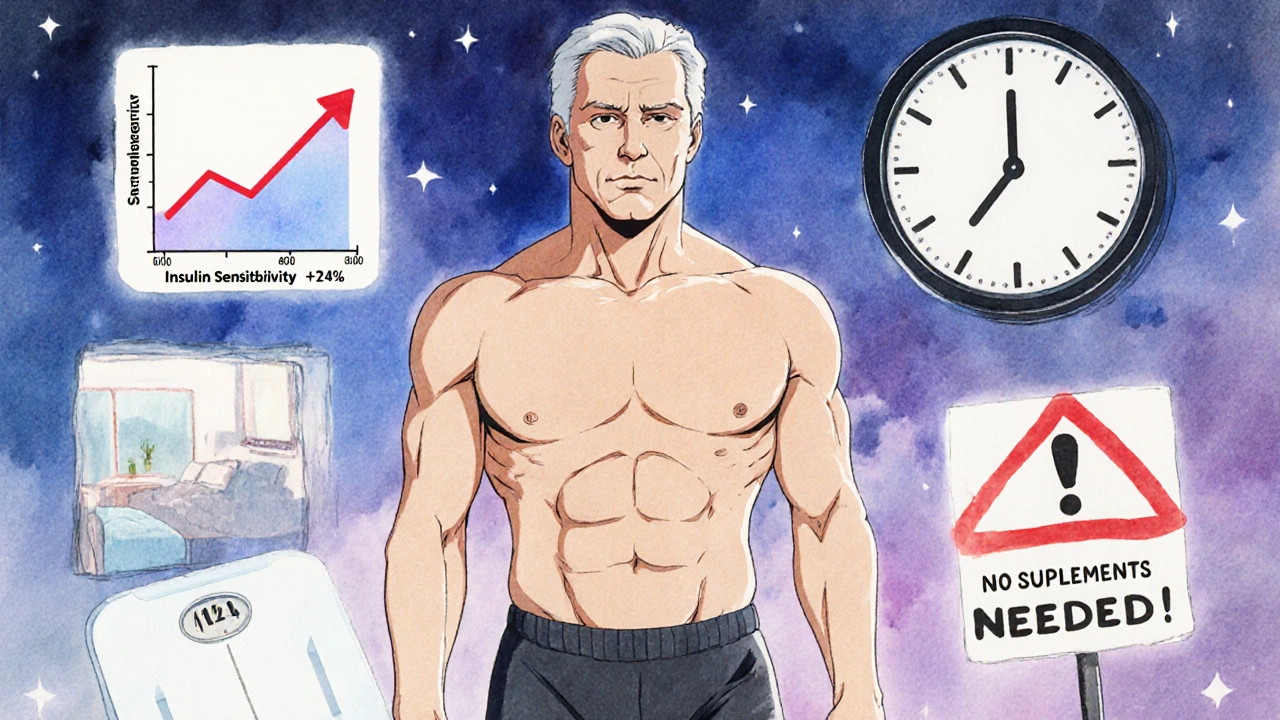
This isn’t about eating less. It’s about eating at the right times. Your body runs on a 24-hour clock - your circadian rhythm. When you eat late at night, you’re fighting that clock. Studies show that eating earlier in the day improves insulin sensitivity by up to 12.4%. That means your body handles sugar better, burns fat more efficiently, and stores less of it.
How It Compares to Traditional Dieting
Many people assume intermittent fasting works because you naturally eat fewer calories. But research says it’s more than that. A July 2025 review of 99 clinical trials involving over 6,500 people found that intermittent fasting leads to the same weight loss as traditional calorie counting - but with fewer rules.
Here’s the key difference: with calorie counting, you track grams, calories, and macros. With TRE, you just focus on when you eat. That’s why 42% of people who stick with it say it’s easier because it simplifies meal planning. You don’t need to weigh chicken breasts or log every snack. You just eat during your window and stop when it’s over.
But here’s where it gets interesting: alternate-day fasting (where you eat normally one day and cut calories to 500-600 the next) actually beats traditional diets by 1.3 kg over the same period. That’s nearly 8% more weight loss. It also shrinks waistlines by 1.5-2.2 cm and lowers bad cholesterol (LDL) by 4.8-7.2 mg/dL.
Why Some People Struggle - And How to Beat It
It’s not all smooth sailing. About 19% of people drop out of intermittent fasting programs. Why? Two big reasons: energy crashes and social pressure.
In the first week, 78% of people report feeling hungrier than usual. That’s normal. Your body is adjusting. Ghrelin - the hunger hormone - spikes at first but drops back to normal after 72 hours. Staying hydrated helps. Often, what feels like hunger is just thirst.
Then there’s the social side. One Reddit user wrote: “Dinner invitations became impossible to accept without explaining my eating schedule.” That’s real. If your window ends at 6 p.m., and your family eats at 8 p.m., you’re either eating alone or skipping out. That’s why many people find success with a 12-hour window first - say, 7 a.m. to 7 p.m. - before tightening it.
Shift workers have an advantage here. A study in the NIH meta-analysis found they stick to TRE 22.3% better than day workers. Why? Their eating window matches their work schedule. If you work nights, eating between 8 p.m. and 4 a.m. might be your best bet - and science backs it.

Who Should Avoid It - And Who Benefits Most
Intermittent fasting isn’t for everyone. The Endocrine Society’s 2025 study on 90 people with type 2 diabetes showed it improved blood sugar control - but also increased hunger. Participants on fasting diets reported hunger scores of 6.2 out of 10, compared to 4.8 for those on continuous calorie restriction.
That doesn’t mean it’s unsafe. Adverse events were similar across all groups. But if you’re prone to low blood sugar, have a history of eating disorders, or are pregnant or breastfeeding, it’s not recommended.
Who benefits most? Adults aged 35-54, especially men. According to 2025 Pew Research data, 62% of intermittent fasters are male. People with household incomes over $100,000 are also more likely to try it - likely because they have access to better nutrition resources and time to plan meals.
But the real winner? People who want flexibility. You don’t need special foods, supplements, or meal plans. Just eat real food during your window. Protein intake matters - aim for 1.2-1.6 grams per kilogram of body weight to protect muscle. That’s about 85-115 grams for a 70kg person.
What the Science Says About Long-Term Results
Here’s the catch: most studies only last 8 to 24 weeks. Only 8% of trials went beyond six months. That’s a problem. A follow-up to the DIETFITS study found that 43% of people who lost weight with intermittent fasting regained it after 12 months. That’s slightly higher than the 39% who regained weight on traditional diets.
So is it sustainable? The data says: it depends. People who get support - like weekly check-ins with a nutritionist - drop out at just 9.8%, compared to 22% without help. That’s a huge difference.
Apps like Zero, which has over 5 million downloads, help by tracking your fasting window and sending reminders. But don’t fall for miracle supplements. The FDA sent warning letters to 14 companies in early 2025 for claiming their products “boost fat burning during fasting.” There’s no pill that replaces a consistent eating window.
How to Start - Without Overwhelming Yourself
You don’t need to jump into 16:8 on day one. Start slow.
- Begin with a 12-hour eating window: eat from 7 a.m. to 7 p.m.
- After a week, shorten it to 10 hours: 9 a.m. to 7 p.m.
- Then try 8 hours: 12 p.m. to 8 p.m.
Drink water, herbal tea, or black coffee during your fast. No sugar, no cream. Stick to whole foods during your eating window - vegetables, lean proteins, healthy fats, and complex carbs. Avoid processed snacks just because you’re “in your window.”
Align your eating with daylight if you can. Eating between 8 a.m. and 4 p.m. improves insulin sensitivity 15.2% more than eating from noon to 8 p.m. That’s because your body expects food when the sun is up.
Track how you feel - not just your weight. Do you have more energy? Better sleep? Fewer cravings? Those are better markers than the scale.
The Bigger Picture: Why This Matters Now
The global intermittent fasting market hit $782 million in 2024 and is growing fast. Companies are using AI to tailor fasting schedules to your gut microbiome. But the real breakthrough isn’t technology - it’s understanding that weight loss isn’t just about calories in, calories out. It’s about when those calories enter your body.
Traditional diets fail because they’re rigid. Intermittent fasting works because it’s adaptable. It fits into busy lives, irregular schedules, and cultural routines. You can do it while working nights, traveling, or raising kids.
The science is clear: if you want to lose weight and improve your metabolic health, time-restricted eating is a powerful tool. But it’s not magic. It’s rhythm. Your body knows how to burn fat. You just have to give it the right window to do it.





Robert Bashaw
29 November, 2025 23:10 PMThis isn't fasting-it's just scheduling your hunger like a corporate meeting. I tried it for two weeks and ended up crying into a protein bar at 11:47 p.m. while my cat judged me. My body didn't adapt-it revolted. Now I eat when I'm hungry and sleep when I'm tired. Revolutionary, I know.
Also, why does everyone act like 16:8 is the holy grail? I've seen more TikTok gurus promoting this than actual scientists.
Also also: the FDA warning letters? That's the real story. Not the weight loss. The scam artists.
Also also also: I miss my midnight snacks. They were my emotional support cookies.
Steven Howell
1 December, 2025 12:03 PMWhile the data presented is methodologically sound, one must exercise caution in extrapolating population-level outcomes to individual physiological responses. The circadian alignment hypothesis, while compelling, remains confounded by socioeconomic variables-particularly dietary quality during the feeding window, which is rarely controlled in observational studies.
Furthermore, the assertion that time-restricted eating reduces caloric intake by default is empirically unsupported; multiple longitudinal cohorts demonstrate compensatory hyperphagia during the eating window, particularly in populations with elevated ghrelin sensitivity.
It is also noteworthy that the cited Pew Research data on gender distribution reflects not biological predisposition, but access to health literacy resources and leisure time, both of which are stratified by education and income. One cannot disentangle metabolic efficacy from structural privilege in this context.
Recommendation: Prioritize dietary composition over temporal patterning. A 2,000-calorie meal of processed carbohydrates at 6 p.m. remains a 2,000-calorie meal of processed carbohydrates.
Monica Lindsey
3 December, 2025 00:33 AMUgh. Of course it's 'easier'-because you're just avoiding responsibility. You don't track calories? Great. Now you're just a lazy person with a schedule.
And please. 'Align with daylight'? So now we're back to caveman logic? I eat at 8 p.m. because I work until 7. Your circadian rhythm doesn't get to dictate my life.
Also, 62% male? Shocking. Men love rules they can follow without thinking. It's like they're playing a video game called 'Fasting Simulator'.
And don't get me started on the $782 million market. This isn't science. It's capitalism with a side of wellness culture.
Bernie Terrien
4 December, 2025 18:35 PMLet’s be real-this is just calorie restriction with extra steps. The 1.3 kg edge on alternate-day? That’s statistically insignificant. The real win? People feel better because they stop snacking at 2 a.m. on chips.
And the ‘it’s not about eating less’ claim? Bullshit. You eat less because you have fewer hours to eat. It’s math, not magic.
Also, shift workers ‘stick better’? No kidding. They’re not eating with families. They’re eating alone in a break room with a vending machine. That’s not success-that’s survival.
And the apps? Zero? That’s just a glorified alarm clock with a logo. You’re not optimizing your metabolism-you’re optimizing your phone notifications.
Sohini Majumder
5 December, 2025 14:06 PMomg i tried this and my stomach was growling like a demon 😭 i thought i was gonna die at 3am... then i ate a whole pizza and cried again. why is everyone so serious about food??
also why do rich people get to do this? i work 2 jobs. i eat when i can. no window. no apps. just hunger.
and the '12 hour window' advice? lol. i eat at 1am and 7am. that's my rhythm. your science don't fit my life.
also why is everyone talking like they're in a documentary?? just let people eat. 🙃
tushar makwana
7 December, 2025 02:43 AMI get what you're saying, but for me, fasting felt like fighting my own body. I'm from India-we eat dinner late, with family. Skipping that? It felt like skipping love.
I tried 12 hours-7am to 7pm. It didn't fix my weight, but it gave me peace. No guilt. No tracking. Just eating when I was hungry and stopping when I wasn't.
Maybe the real win isn't the scale. Maybe it's not feeling like you're on a diet every day.
Also, the part about shift workers? That hit me. My cousin works nights. He eats at 2am. He's healthy. His rhythm is his own. Science should listen to lives, not the other way around.
Richard Thomas
7 December, 2025 16:48 PMThe article presents a compelling narrative, yet it fails to adequately address the confounding variable of dietary adherence in relation to macronutrient composition. The assertion that intermittent fasting confers metabolic advantages independent of caloric intake is not substantiated by the referenced clinical trials, many of which employed ad libitum feeding protocols during the eating window.
Furthermore, the citation of the 2025 Pew Research data on gender distribution lacks methodological transparency. Is this self-reported behavior? Is it stratified by age, education, or geographic region? Without this, the conclusion risks being reductionist.
Additionally, the recommendation to consume 1.2–1.6 g/kg of protein is scientifically valid, yet its integration into the broader argument is superficial. Protein timing, not merely total intake, may be the critical variable-particularly in the context of circadian metabolism.
Finally, the market valuation of $782 million is a symptom of a cultural pathology, not an indicator of physiological efficacy. The commodification of biological rhythms is a distinctly late-capitalist phenomenon.
Matthew Higgins
7 December, 2025 18:02 PMI used to be all in on this 16:8 thing. Then I realized I was just starving myself so I could feel like I was ‘doing something’ about my health.
Now I eat when I’m hungry. Sometimes that’s at 7 a.m. Sometimes it’s at 9 p.m. I don’t care.
My energy’s better. My skin’s clearer. I’m not obsessed with food anymore.
Turns out, the best diet is the one you don’t have to think about.
Also, I miss eating with my mom on Sundays. Fasting didn’t fix that. Just eating with her did.
Mary Kate Powers
7 December, 2025 18:41 PMFor anyone feeling overwhelmed by this-start small. Just push dinner back by an hour. Or skip a late-night snack. That’s it.
You don’t need to be perfect. You just need to be consistent-even if it’s only 3 days a week.
And if you’re not losing weight? That’s okay. Maybe your body doesn’t need to. Maybe you just need to feel stronger, sleep deeper, or have more energy.
That’s the real win. Not the number on the scale.
You’re doing better than you think.
Sara Shumaker
8 December, 2025 06:15 AMWhat if the real question isn’t ‘when’ we eat, but ‘why’? Why do we feel the need to control food with schedules? Why does ‘eating right’ have to mean restriction?
Maybe the rhythm we’re trying to align with isn’t just our circadian clock-it’s our relationship with hunger, with culture, with guilt.
I’ve seen people lose weight with intermittent fasting. I’ve also seen people lose their peace.
What if the answer isn’t in the window-but in the way we sit with our hunger, without fixing it?
Not every problem needs a protocol. Sometimes, it just needs presence.
Scott Collard
8 December, 2025 21:21 PMJust so we’re clear: if you’re not doing 16:8 and you’re not tracking protein intake, you’re not serious about your health.
And if you think eating at 8 p.m. is ‘fine’ because you’re ‘listening to your body,’ you’re deluding yourself.
The science is clear. Your insulin sensitivity plummets after 6 p.m.
Stop making excuses. Just do it.
Also, if you’re not using Zero or MyFitnessPal, you’re not even trying.