
Imagine you are rushing to get your child a fever reducer. It is late, the house is quiet except for their coughing, and you just want to get it over with. You grab a teaspoon from the drawer, scoop up the liquid, and give it to them. It feels like a normal, harmless action. But here is the hard truth: that simple spoon might have just given your child three times the intended dose-or dangerously little of it.
This isn't about being overly cautious; it is about physics and biology. Household spoons are kitchen utensils with highly variable capacities that are unsafe for measuring medication. They were never designed for precision. When we talk about pediatric medication dosing is the process of administering precise amounts of medicine to children based on weight or age, even a tiny error can lead to serious side effects or treatment failure. The gap between a kitchen spoon and a medical dose is wider than most parents realize.
The Hidden Danger in Your Kitchen Drawer
We all have different spoons. That fancy set you bought at the department store? The mismatched ones you picked up at a flea market? Even two spoons from the same box can hold different amounts of liquid. According to data from the Consumer Medication Safety Institute, a standard household teaspoon can hold anywhere from 3 mL to 7 mL. That is a massive range.
Think about what that means. If a doctor prescribes 5 mL of antibiotic, and you use a spoon that holds only 3 mL, your child is getting less than half the medicine they need. The infection won't clear up. It might even come back stronger. On the flip side, if you use a spoon that holds 7 mL, you are giving them 40% more than prescribed. For powerful medications like ibuprofen or acetaminophen, that extra amount can stress the liver or kidneys.
The American Academy of Pediatrics (AAP) has been warning against this since 1978. Yet, studies show that nearly 40% of parents still measure doses incorrectly when using household spoons. Why? Because we assume "teaspoon" means a specific thing. In cooking, a slight variance doesn't matter much. In medicine, it changes everything.
Why Milliliters Are the Only Standard That Matters
To fix this confusion, health organizations like the CDC and the FDA pushed for a major change: stop using teaspoons and tablespoons on medicine labels entirely. Instead, use milliliters (mL). This shift wasn't just bureaucratic; it was a safety necessity.
A medical teaspoon is exactly 5 mL. A medical tablespoon is exactly 15 mL. These numbers don't change. When you see "5 mL" on a bottle, it means precisely that amount. The CDC’s "Spoons are for Soup" campaign drives this home clearly: "Milliliters (mL) are for Medicine."
Here is how the units break down:
- 1 Teaspoon (medical) = 5 mL
- 1 Tablespoon (medical) = 15 mL
- 1 Fluid Ounce = 30 mL
If a label says "give 10 mL," do not guess with two spoons. Use a tool marked in milliliters. This eliminates the guesswork. It removes the ambiguity of whether your spoon is "big" or "small." It relies on a universal standard that every pharmacy and hospital uses.
The Right Tools for the Job
So, if you can't use the spoons in your drawer, what should you use? Not all measuring tools are created equal. Some are better than others, especially when dealing with small doses.
| Tool | Accuracy Level | Best For | Common Pitfalls |
|---|---|---|---|
| Oral Syringe | Highest | Doses under 5 mL and precise measurements | Forgetting to depress the plunger fully |
| Dosing Cup | Moderate | Larger doses (10-15 mL+) | Reading the meniscus incorrectly; poor visibility for small amounts |
| Medicine Spoon | Low | Rarely recommended now | Confusing with kitchen spoons; spillage |
| Household Spoon | Unsafe | Soup and cereal only | Variable capacity (3-7 mL); high error rate |
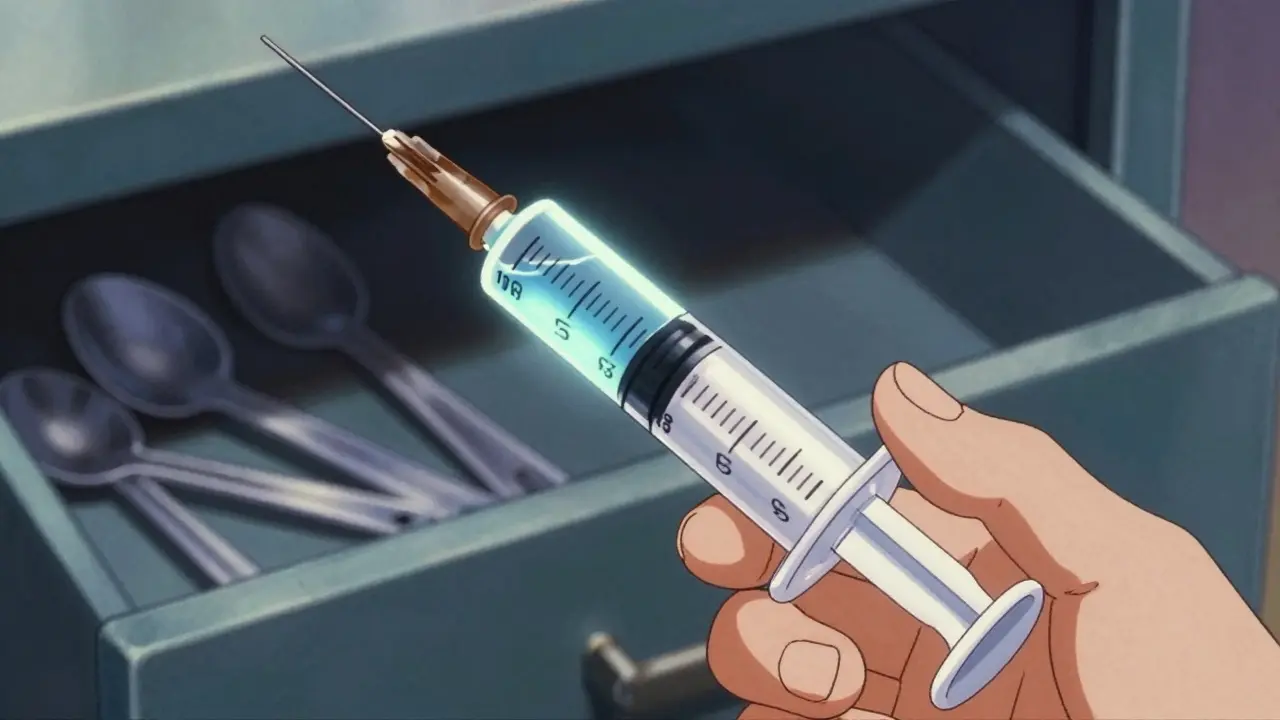
The oral syringe is a plastic device with a plunger used to draw and administer precise liquid medication doses. is widely considered the gold standard by experts. Research published in *Frontiers in Public Health* in 2023 confirmed that oral syringes result in the least percentage of imprecise dosing. They have markings every 0.1 mL or 0.5 mL, allowing you to measure 3.5 mL or 0.5 mL accurately-something a cup or spoon simply cannot do.
Dosing cups are okay for larger amounts, like 10 mL or 15 mL, but they struggle with precision. If you need 4 mL, trying to estimate that in a wide cup is nearly impossible. The liquid level looks different depending on where you stand. Always choose the syringe for anything under 5 mL.
How to Measure Like a Pro
Having the right tool is only half the battle. How you use it matters just as much. Many parents make simple mistakes that throw off the dose.
- Measure at Eye Level: This is the number one rule. Hold the syringe or cup so the measurement line is directly in front of your eyes. If you look down from above, the liquid looks higher than it is. If you look up from below, it looks lower. Get down on your knees if you have to.
- Check the Meniscus: Liquid curves slightly in the tube or cup. Read the measurement at the bottom of that curve, not the top edges where the liquid sticks to the sides.
- Prime the Syringe: If you are drawing medicine into a syringe, make sure there are no air bubbles. Air takes up space that medicine should occupy. Tap the syringe gently to move bubbles up, then push the plunger slightly until a drop appears at the tip.
- Use What Comes with the Bottle: Most pharmacies now provide an oral syringe specifically calibrated for that medication. Use that one. It is matched to the concentration of the drug.
If you don't have a proper device, do not improvise. Go to the pharmacy. Pharmacists are trained to help with this. Ask them, "Do I have the right tool for this dose?" They will often give you a fresh syringe for free.
Administering the Medicine Without the Struggle
Getting the medicine into your child is another challenge. You don't want them choking or spitting it out, which would mean they didn't get the full dose.
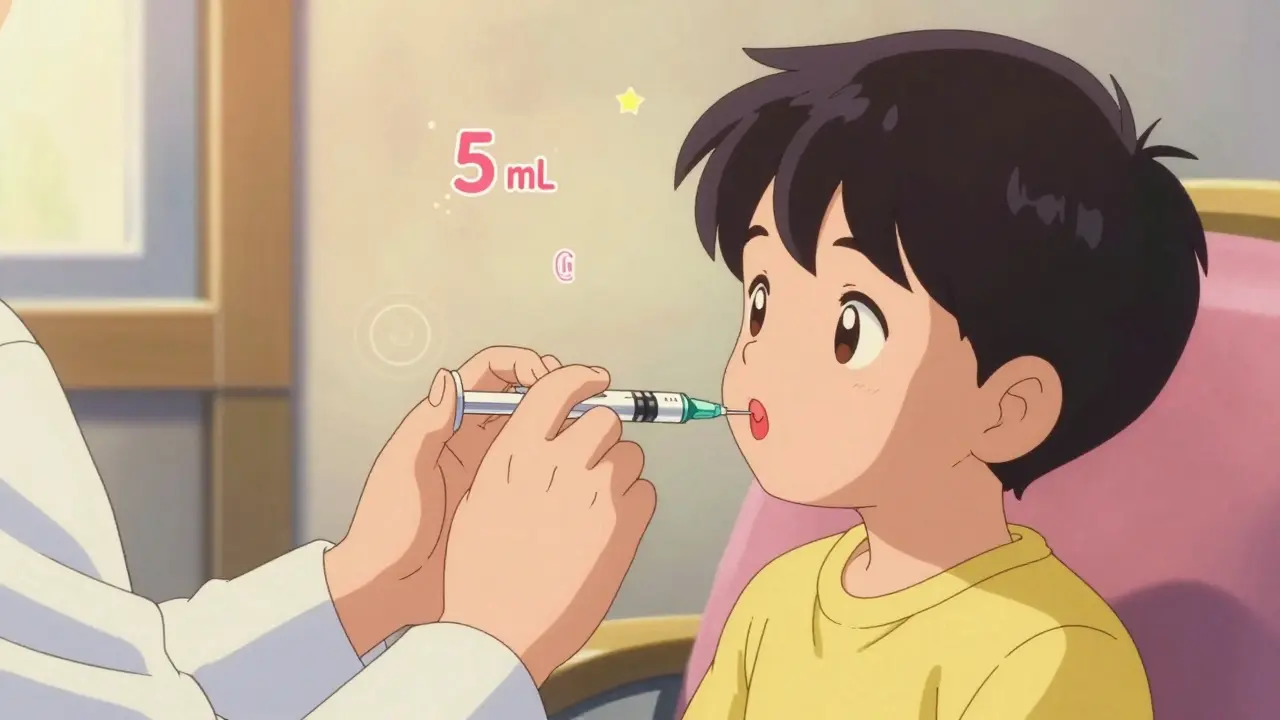
Safe Kids Worldwide recommends aiming for the side of the mouth. Squirt the medicine gently between your child's tongue and their cheek. Do not aim for the back of the throat. Hitting the back triggers the gag reflex, causing them to choke or spit out the liquid. By placing it on the side, they can swallow naturally without panic.
For infants, go slow. Let them swallow between small pushes of the plunger. Rushing causes overflow. If they spit some out, do not automatically give another full dose. Estimate how much came out. If it was a tiny bit, you might be fine. If it was half, consult your doctor or pharmacist before redosing. Giving double the dose because you think they missed it is dangerous.
What If the Label Says "Teaspoon"?
You might encounter older bottles or generic brands that still say "1 tsp" on the label. This is confusing, and unfortunately, still happens despite regulatory pushes. Here is how to handle it:
Treat "1 tsp" as "5 mL." Ignore the word teaspoon. Look for the metric equivalent on the bottle. Most modern labels include both, but the mL number is the legal standard. If the bottle only says "teaspoon," call the pharmacist. Ask them, "Is this 5 mL per teaspoon?" Get confirmation. Then, use your oral syringe to measure 5 mL. Never use a kitchen spoon, even if the label uses the word.
Studies show that when labels use "tsp" or "teaspoon," parents are three times more likely to grab a kitchen spoon. When labels use "mL," that risk drops significantly. This is why the FDA and AAP advocate for milliliter-only labeling. It forces us to use the right tools.
The Cost of Getting It Wrong
It is easy to dismiss this advice as unnecessary fussiness. "My kid is tough," you might think. "A little extra won't hurt." But the data tells a different story.
Poison control centers receive more than 10,000 calls every year related to incorrect dosing of liquid medications for children. These aren't just minor issues. Overdoses of common drugs like acetaminophen can cause acute liver failure. Underdoses of antibiotics can lead to resistant infections that are harder to treat later.
Children metabolize drugs differently than adults. Their organs are smaller, their bodies are growing, and their tolerance for error is much lower. A dose that is safe for you could be toxic for them. Precision isn't optional; it is essential for their safety.
Building a Safe Routine
Make medication time a calm, deliberate process. Don't rush. Set up your station. Have the medicine, the correct syringe, and a tissue ready. Read the label twice. Check the expiration date. Measure carefully. Administer slowly.
If you are traveling, pack your dosing tools separately. Don't rely on finding a spoon at a hotel or restaurant. Keep the syringe in its case. If you lose it, buy a new one at any local pharmacy. They are inexpensive and widely available.
Finally, educate everyone who helps care for your child. Grandparents, babysitters, and teachers need to know the rule: No kitchen spoons. Show them how to read the syringe. Leave written instructions with the medicine. Consistency across all caregivers ensures your child gets the right dose every time.
Safety starts with the tools you choose. Put the household spoons back in the drawer. Keep them for soup. For medicine, trust the milliliter. Trust the syringe. Trust the science. Your child's health depends on that precision.
Can I use a coffee spoon for medicine?
No. Coffee spoons are even smaller and more variable than standard teaspoons. They typically hold 1-2 mL, making it impossible to measure standard pediatric doses accurately. Always use a calibrated oral syringe or dosing cup marked in milliliters.
What if I don't have an oral syringe?
Do not use a kitchen spoon. Visit a pharmacy to purchase a digital scale or a dedicated oral syringe. Most pharmacies will also provide a free syringe when you pick up a prescription. If you are in an emergency, call your pharmacist for immediate guidance on alternative measuring methods, though this should be rare.
Why are household spoons so inaccurate?
Household spoons are manufactured for eating, not measuring. Their sizes vary by brand, design, and wear. A "teaspoon" from one manufacturer might hold 3 mL, while another holds 7 mL. This 40% variance is too large for safe medication dosing, where precision within 1-2 mL is often critical.
How do I read the meniscus on a syringe?
Hold the syringe at eye level. Look at the curved surface of the liquid inside the barrel. The bottom of that curve is the true volume. Align your eye with the measurement mark that touches the lowest point of the curve. Reading from above or below will result in an incorrect dose.
Is it safe to reuse oral syringes?
Yes, if they are cleaned properly. Rinse the syringe with warm water after each use. Allow it to air dry completely. Store it in a clean place. However, replace the syringe if it becomes cloudy, cracked, or if the markings fade. Most pharmacies recommend replacing them every few months or if hygiene cannot be guaranteed.
What should I do if my child spits out the medicine?
Do not immediately give another full dose. Assess how much was lost. If it was a small amount, you may not need to redose. If a significant portion was lost, contact your pharmacist or doctor for advice. Redosing blindly can lead to accidental overdose. Prevention is key: aim for the side of the mouth and administer slowly to reduce spitting.