
Imagine walking into your pharmacy with a prescription for a life-saving medication, only to be hit with a bill that looks like a mortgage payment. You check your insurance card, see the logo you pay premiums for, and assume you’re covered. But the pharmacist shakes their head. "It’s not on your formulary," they say. Suddenly, you’re stuck in a maze of phone calls, paperwork, and financial panic.
This scenario is more common than you might think. If you have health insurance in the United States, whether through an employer, Medicare, or Medicaid, you are almost certainly subject to a drug formulary. It sounds like dry administrative jargon, but this list dictates what medications you can afford, which ones require permission from your doctor, and how much you will actually pay at the counter. Understanding it isn’t just about saving money; it’s about ensuring you stay healthy without going broke.
What Exactly Is a Drug Formulary?
At its core, a drug formulary-also known as a Preferred Drug List (PDL)-is simply a catalog of prescription drugs that your specific health insurance plan agrees to cover. Think of it as a menu. Your insurance company has negotiated prices with pharmaceutical manufacturers and Pharmacy Benefit Managers (PBMs). The drugs on this menu are the ones they have agreed to help pay for, either partially or fully.
If a medication is not on this list, it is considered "non-formulary." In most cases, this means you pay the full retail price out of pocket, which can be thousands of dollars for specialty drugs. Formularies aren't static documents; they are living lists managed by Pharmacy and Therapeutics (P&T) committees made up of doctors and pharmacists. These experts review new clinical data, safety reports, and cost-effectiveness studies regularly to update the list. Their goal, according to guidelines from the National Institutes of Health, is to balance clinical effectiveness with financial sustainability.
Why do these lists exist? It boils down to two things: quality and cost. Insurance companies want to ensure patients are taking medications that have strong evidence supporting their safety and efficacy. Simultaneously, they need to manage costs so that premiums don’t skyrocket for everyone. By steering patients toward generic versions or equally effective but cheaper brand-name alternatives, they keep the system running. However, for the individual patient, this often feels like a restriction on choice rather than a benefit.
Decoding the Tiers: How Your Out-of-Pocket Costs Are Calculated
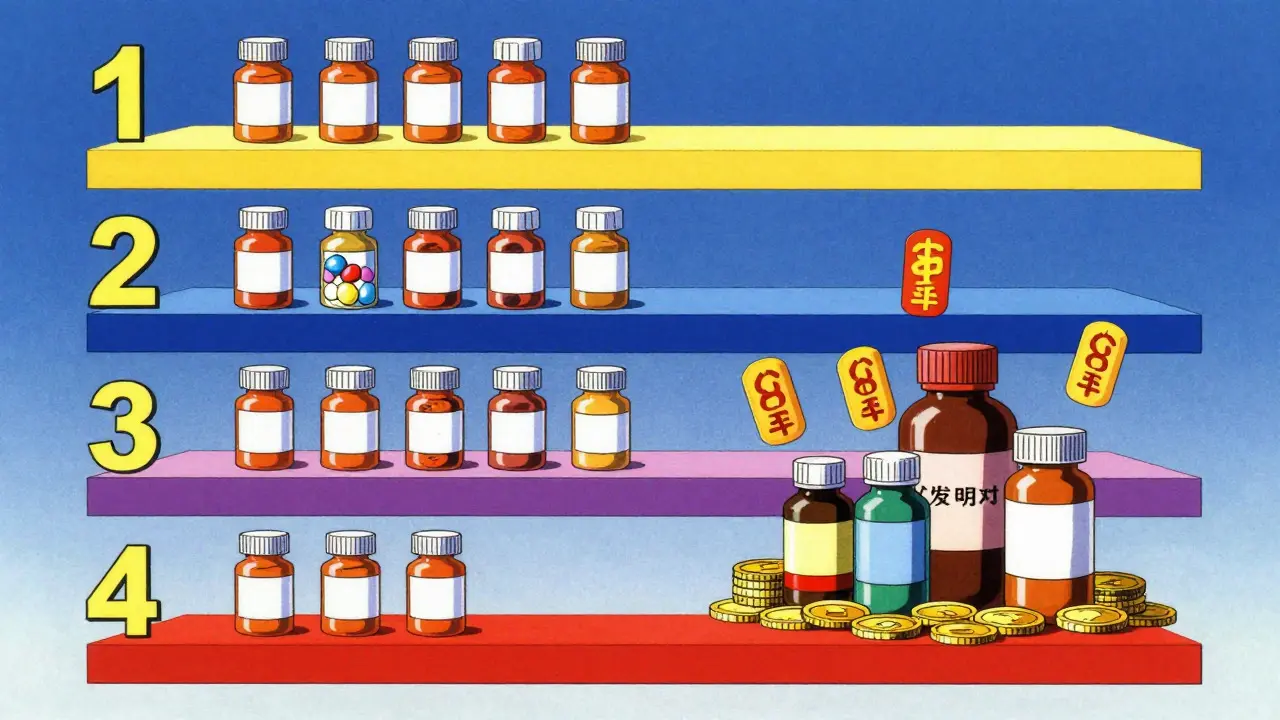
The most critical part of understanding your formulary is grasping the concept of "tiers." Almost all modern formularies organize drugs into categories based on cost and type. Your copay-the amount you pay at the pharmacy-is directly tied to which tier your medication falls into. While every insurance plan is slightly different, the structure generally follows this pattern:
| Tier | Type of Medication | Typical Patient Cost |
|---|---|---|
| Tier 1 | Generic Drugs | $0 - $15 (Lowest cost) |
| Tier 2 | Preferred Brand-Name | $25 - $50 or 15-25% coinsurance |
| Tier 3 | Non-Preferred Brand-Name | $50 - $100 or 25-35% coinsurance |
| Tier 4 | Specialty Drugs | $100+ or 30-50% coinsurance |
Tier 1 is where you want your prescriptions to live. These are generic medications. The FDA requires generics to be identical to brand-name drugs in dosage, strength, and intended use. Because there is no marketing overhead or patent protection, they are incredibly cheap for insurers to buy, passing those savings to you.
Tier 2 usually includes preferred brand-name drugs. These are medications where the insurance plan has negotiated a good deal with the manufacturer. You pay more here than for generics, but significantly less than for non-preferred brands.
Tier 3 contains non-preferred brand-name drugs. This might be a newer medication that hasn’t had time to prove its long-term value, or one where the insurer hasn’t secured a low price. Your share of the cost jumps noticeably here.
Tier 4 is reserved for specialty medications. These are complex drugs used for serious conditions like cancer, rheumatoid arthritis, or multiple sclerosis. They often require special handling or administration. The costs here are high, and while insurance covers a portion, your out-of-pocket expenses can still be substantial unless you hit your plan’s annual out-of-pocket maximum.
The Hidden Hurdles: Prior Authorization and Step Therapy
Being on the formulary doesn’t always mean you can just walk in and fill the script. Insurers use tools called "utilization management" to control usage. Two of the most frustrating for patients are prior authorization and step therapy.
Prior Authorization (PA) is a gatekeeping process. Before the pharmacy can dispense the drug, your doctor must send documentation to the insurance company proving that you specifically need this medication. Maybe you’ve tried others, or maybe your condition is unique. If the PA is denied, you don’t get the drug unless you appeal. This adds days or weeks to getting treatment and creates administrative headaches for your healthcare provider.
Step Therapy, often called "fail first," is even more intrusive. It mandates that you try a lower-tier, cheaper medication first. Only if that drug fails to work or causes severe side effects will the insurance approve the next step up the ladder. For example, if you need a specific biologic for psoriasis, your insurer might force you to try three different generic creams or oral pills first. While this saves money for the insurer, it can delay effective treatment for patients who know exactly what works for them.
Why Formularies Change and What It Means for You
A common mistake patients make is assuming their formulary stays the same year after year. It rarely does. Formularies are updated annually, usually effective January 1st. During this refresh, drugs can move between tiers. A medication that was Tier 2 last year might jump to Tier 3, doubling your copay overnight. Or worse, it might be removed entirely.
These changes happen because patents expire (allowing cheaper generics to enter the market), new clinical guidelines emerge, or negotiations with drug manufacturers break down. According to data from the Patient Advocate Foundation, nearly 30% of formulary changes occur outside the main annual enrollment period, meaning surprises can happen mid-year if the insurer provides proper notice.
This volatility is why checking your formulary is an active job, not a passive one. Relying on last year’s experience is a recipe for sticker shock. When you switch jobs or change plans during Open Enrollment, never assume your current medications are covered under the new plan. You must verify each one individually.
How to Navigate Your Formulary Like a Pro
You don’t have to accept bad coverage or high costs. There are concrete steps you can take to manage your formulary effectively.
- Check Online Before You Prescribe: Most insurance providers have a searchable formulary tool on their website. Use it. Enter your medication name before you even talk to your doctor. If it’s non-formulary or Tier 4, ask your doctor if there is a therapeutic alternative that is Tier 1 or 2.
- Understand Your Plan’s Specifics: Look for the "Summary of Benefits" document. It will tell you exactly how many tiers your plan has and what the specific copays are. Some plans use percentage-based coinsurance instead of flat fees, which matters greatly for expensive drugs.
- Request a Formulary Exception: If your doctor prescribes a non-formulary drug and insists it is medically necessary, they can file a formulary exception. This is an appeal process where they argue why the covered alternatives won’t work for you. For Medicare Part D plans, the approval rate for these exceptions is around 67%. It takes effort, but it often pays off.
- Leverage Manufacturer Coupons: For brand-name drugs, especially those on higher tiers, pharmaceutical companies often offer savings cards. These can sometimes lower your cost below what your insurance copay would be. Always check the manufacturer’s website.
- Review Annually: Mark your calendar for October (for Medicare) or your employer’s open enrollment period. Pull up your current medication list and cross-reference it with the new year’s formulary. If a drug has moved up a tier, start the conversation with your doctor early.

Special Considerations for Medicare Part D
If you are on Medicare, the rules are slightly different but equally important. Medicare Part D plans are offered by private insurance companies, and each one has its own unique formulary. The government requires that these plans cover at least two drugs in every therapeutic category, but beyond that, the choices vary wildly.
Recent changes due to the Inflation Reduction Act have brought some relief. As of 2023, insulin is capped at $35 per month for most Part D beneficiaries. Starting in 2025, there will be a hard cap of $2,000 on total out-of-pocket prescription costs for the year. However, until you hit that cap, tier placement still dictates your monthly bills. Using the official Medicare Plan Finder tool is essential. It allows you to input your specific medications and compare plans side-by-side to see which one offers the lowest total cost for your personal drug regimen.
Frequently Asked Questions
What happens if my medication is not on the formulary?
If your medication is non-formulary, your insurance may deny coverage entirely, leaving you to pay the full retail price. Alternatively, your doctor may need to file a formulary exception or prior authorization request to justify medical necessity. You can also ask your doctor to prescribe a different, covered alternative that treats the same condition.
Can I switch from a brand-name drug to a generic to save money?
Yes, in most cases. Generics are chemically equivalent to brand-name drugs but cost significantly less. Ask your doctor if a generic version is available. Switching to a generic typically moves your medication to Tier 1, drastically reducing your copay. Note that for some narrow-therapeutic-index drugs, switching requires careful monitoring by your physician.
How long does a prior authorization take?
Prior authorization timelines vary by insurer. Standard requests often take 3 to 7 business days, though some expedited processes can resolve in 24 to 72 hours for urgent needs. Delays can occur if additional medical records are required. It is best to submit the request as soon as the prescription is written.
Do formularies change every year?
Yes, formularies are reviewed and updated annually, usually effective January 1st. Drugs may be added, removed, or moved between tiers based on new clinical data, patent expirations, or contract negotiations. Mid-year changes can also occur, but insurers are required to provide advance notice (typically 60 days) for significant changes.
What is the difference between a copay and coinsurance?
A copay is a fixed dollar amount you pay for a medication (e.g., $15 for generics). Coinsurance is a percentage of the drug’s cost that you pay (e.g., 20% of the price). Copays are predictable, while coinsurance costs fluctuate based on the drug's price. Specialty drugs often use coinsurance, which can result in higher out-of-pocket costs.
How do I find my insurance formulary online?
Log in to your insurance provider’s member portal or visit their public website. Look for sections labeled "Drug Formulary," "Prescription Drug List," or "PDL." Most sites allow you to search by drug name. For Medicare Part D users, the official Medicare.gov Plan Finder tool is the most reliable resource for comparing formularies across different plans.
What is step therapy and can I opt out?
Step therapy requires you to try cheaper, covered medications before your insurer approves a more expensive option. You cannot simply opt out, but your doctor can request a waiver if they can demonstrate that the step-therapy drugs would be ineffective or harmful for your specific condition. This is done through a prior authorization appeal.
Are biosimilars covered on formularies?
Increasingly, yes. Biosimilars are highly similar versions of biologic drugs and are often placed on lower tiers (Tier 2 or 3) to encourage their use over reference biologics. As more biosimilars gain FDA approval, insurance plans are adding them to formularies to reduce costs for complex treatments like cancer and autoimmune diseases.