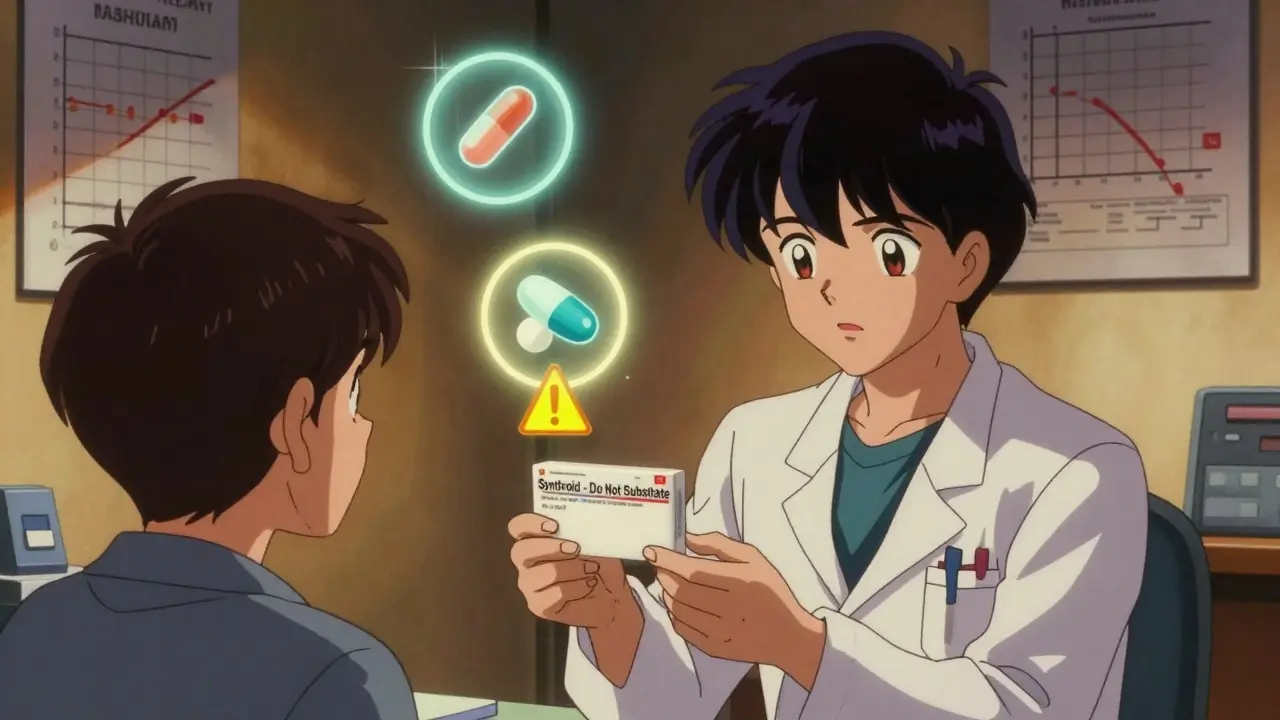
Most people assume that when a doctor writes a prescription, the pharmacy can swap in a cheaper generic version. But that’s not always true. Sometimes, your doctor insists on the brand-name drug-no substitutions allowed. And while it might seem like just a way to spend more money, there are real medical reasons behind it. Understanding when and why this happens can help you make smarter choices about your health-and your wallet.
Why Doctors Sometimes Skip Generics
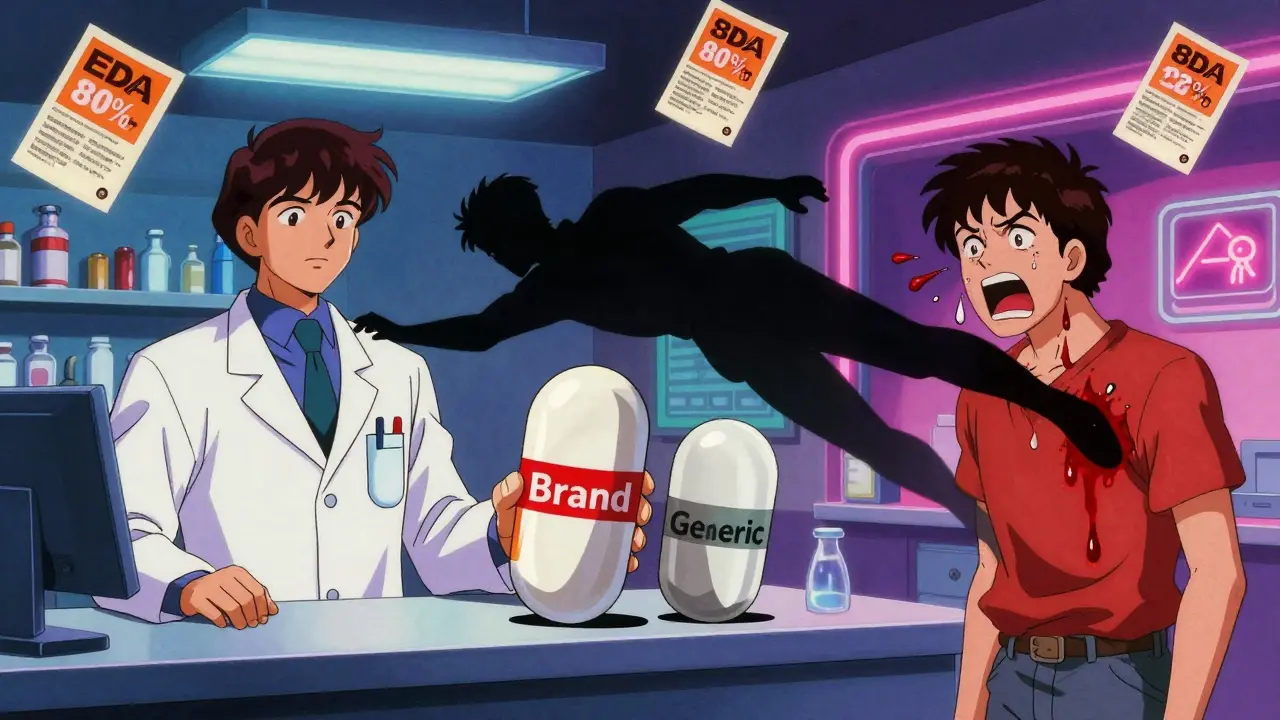
Generic drugs are chemically identical to brand-name versions. They contain the same active ingredient, in the same dose, and work the same way in your body. The FDA requires them to be bioequivalent, meaning they deliver the same amount of medicine into your bloodstream within an 80% to 125% range of the brand. For most drugs, that’s more than enough. But not all drugs are created equal.Some medications have what’s called a narrow therapeutic index. That means the difference between a dose that works and one that causes harm is tiny. Even a small change in how much of the drug enters your system can lead to serious problems. For these drugs, the 20% variability allowed by the FDA isn’t just a number-it’s a risk.
Examples include:
- Levothyroxine (Synthroid): Used for thyroid conditions. A slight drop in hormone levels can trigger fatigue, weight gain, or even heart problems.
- Warfarin (Coumadin): A blood thinner. Too little, and you risk clots. Too much, and you could bleed internally.
- Levetiracetam (Keppra): An anti-seizure medication. Switching to a generic has been linked to breakthrough seizures in 12.7% of patients, compared to just 4.3% who stayed on the brand.
The American Thyroid Association and the American Academy of Neurology both recommend sticking with the same brand for these drugs-not because generics are unsafe, but because consistency matters. Your body adapts to a specific formulation. Switching between different generic manufacturers-even ones approved by the FDA-can cause fluctuations that affect how you feel.
When Brand-Name Prescriptions Are Unnecessary
For most medications, generics are just as effective. Studies involving over 112,000 patients found no difference in outcomes between brand and generic versions of common drugs like:- Lisinopril (for high blood pressure)
- Atorvastatin (for cholesterol)
- Metformin (for diabetes)
A 2020 JAMA Network Open review of 47 clinical trials confirmed this. Patients on generics had the same success rates, side effects, and hospitalization rates as those on brand-name versions. So why do some doctors still write for brand?
One reason is habit. Many physicians learned to prescribe using brand names during medical training. Even when they know generics are fine, saying “Lipitor” instead of “atorvastatin” can lead them to prescribe the more expensive version-sometimes without realizing it. Research from Stanford shows that doctors who use brand names in notes are more likely to prescribe the brand, even if they intend to save money.
Another reason is patient pressure. Some people believe brand-name drugs are stronger or safer. A 2022 GoodRx survey found that 68% of patients who switched from Synthroid to a generic reported worse symptoms-even though studies show no clinical difference. Placebo effect? Maybe. But it’s real enough to affect how people feel.
The Real Cost Difference
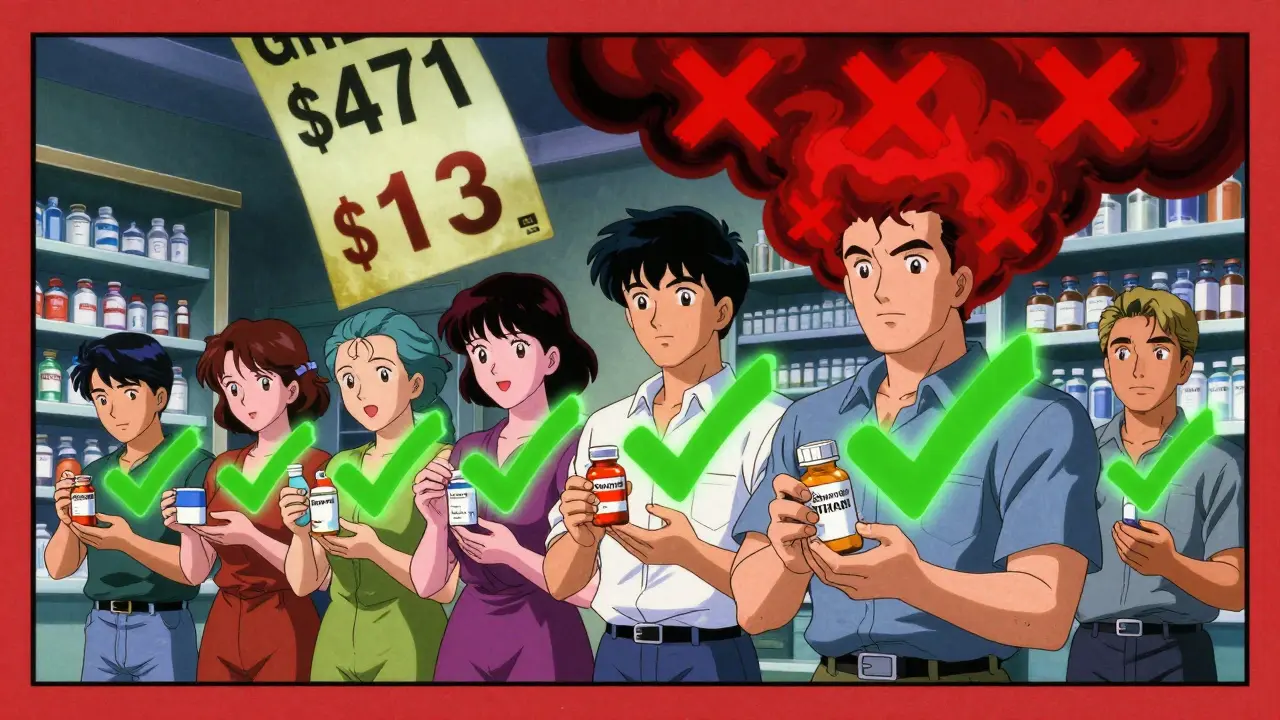
The price gap between brand and generic is staggering. In 2022, the average cost of a brand-name prescription was $471.67. The same medicine as a generic? Just $13.76. That’s an 85% drop.For someone on multiple medications, that adds up fast. One patient in a Consumer Reports survey saved $1,200 a year just by switching from brand to generic statins. But when doctors prescribe brand-name only without medical justification, patients pay more. Insurance companies often require prior authorization for brand-only prescriptions, which can delay treatment. And if your insurance doesn’t cover the brand, you might end up paying the full price out of pocket.
Here’s the twist: generics make up 90% of all prescriptions filled in the U.S., but only 23% of total drug spending. That means brand-name drugs-despite being used far less-cost the system far more. And when they’re prescribed unnecessarily, it’s not just your wallet that suffers. It’s the entire healthcare system.
What Doctors Look for Before Prescribing Brand-Name Only
Doctors don’t just pick brand-name drugs randomly. There are three evidence-based reasons they’ll write “do not substitute”:- Narrow therapeutic index drugs-as mentioned above. These are the clearest cases.
- Inactive ingredient reactions. Generics use different fillers, dyes, or preservatives. Some people are sensitive to these. For example, one patient reported severe stomach cramps after switching from one generic ciprofloxacin to another. The issue wasn’t the antibiotic-it was the coating.
- Documented failure. If you’ve tried two or three different generics and had side effects or reduced effectiveness, your doctor may decide the brand is your best option.
Some states have strict rules about how this is documented. In California, doctors must check a box labeled “Medical Necessity” on electronic prescriptions. In New York, they need to write out why. Pharmacists can’t just assume-there has to be a paper trail.
What You Can Do
If your doctor prescribes a brand-name drug, ask:- Is this because of a medical reason-or just habit?
- Is this a narrow therapeutic index drug?
- Have I had problems with generics before?
You can also check the FDA’s Orange Book, which lists therapeutic equivalence ratings. If a generic is rated “AB,” it’s considered interchangeable. If it’s “BX,” that means there’s not enough data to confirm equivalence-usually because it’s a new generic or has unique delivery systems.
Also, don’t be afraid to ask your pharmacist. They know which generics are made by which companies and can tell you if your prescription has switched manufacturers recently. If you notice a change in how you feel after a refill, speak up.
What’s Changing
The FDA is pushing for more consistency. In 2023, they released new guidance requiring generic manufacturers to match the shape and color of brand-name pills. Why? Because confusion over appearance is a leading cause of medication errors-especially in older adults.There’s also a rise in “authorized generics”-drugs made by the original brand company but sold under a generic label. These avoid the variability between different generic makers. They’re still cheaper than the brand, but closer in quality.
And while biosimilars (similar to generics but for biologic drugs) are starting to hit the market, they won’t replace all brand-name drugs. Companies like AbbVie still hold strong market positions, even after patents expire, thanks to contracts with insurers and patient loyalty.
But the trend is clear: when there’s no medical reason, generics should be the default. The data doesn’t lie. For most people, they’re just as safe and effective. And they save billions every year.
Can my pharmacist switch my brand-name drug to a generic without telling me?
In 49 U.S. states and Washington D.C., pharmacists can substitute generics unless the doctor writes "do not substitute" or "dispense as written." Texas has stricter rules for certain drugs. Even if substitution is allowed, many pharmacies will still notify you if a change is made, especially if the pill looks different. Always check your prescription label and ask if you’re unsure.
Why do some generics cause side effects if they’re supposed to be the same?
Generics must match the active ingredient, but they can use different fillers, dyes, or coatings. These inactive ingredients can affect how the drug is absorbed or how your body reacts. For example, one person might tolerate a generic ciprofloxacin with a certain coating, but develop nausea with another version. This is especially common with antibiotics and thyroid medications. If you notice new side effects after switching, talk to your doctor.
Is it true that brand-name drugs are more reliable?
For most drugs, no. The FDA holds generics to the same manufacturing standards as brands. But for drugs with a narrow therapeutic index, consistency matters. If you’ve been on Synthroid for years and feel stable, switching to a generic-even one approved by the FDA-can cause hormonal shifts. In those cases, the brand may be more reliable simply because your body is used to it.
How can I find out if my drug has a generic version?
Check the FDA’s Orange Book online. It lists all approved drugs and their generic equivalents, along with therapeutic equivalence ratings. You can also ask your pharmacist or use apps like GoodRx to compare prices. If a generic exists and is rated "AB," it’s considered interchangeable.
Will insurance cover a brand-name drug if my doctor says it’s necessary?
Maybe. Insurance companies often require prior authorization for brand-only prescriptions. They’ll review your medical history and may ask for documentation from your doctor. Approval rates vary: 89% for anti-seizure drugs, but only 45% for acid reflux medications. If denied, you can appeal-or ask if a different generic or authorized generic might work.



John Watts
7 February, 2026 13:25 PMMan, I never realized how much of a gamble switching generics could be until my mom went from Synthroid to a generic and started having heart palpitations. She thought it was just stress, but turns out her TSH went haywire. We switched back and she’s been stable for two years now. Don’t let anyone tell you it’s all the same-your body remembers the formula.
Also, props to the doc who actually asked about her history before prescribing. Too many just copy-paste prescriptions these days.
Ritteka Goyal
8 February, 2026 22:33 PMOMG I totally agree!! In India we have this problem too where generics are sold everywhere but sometimes they’re made in factories with no quality control!! I had a friend who took a generic for epilepsy and had 3 seizures in one week-doctor said it was because the bioequivalence was off by like 30%!! FDA standards are good but not everyone follows them!!
Also, why do you think pharma companies in US still push brand names? It’s because they’re greedy!! They don’t care about patients, only profits!! I’m so angry about this!!
Tricia O'Sullivan
9 February, 2026 18:43 PMThank you for this thoughtful and meticulously researched piece. It is refreshing to encounter a discussion on pharmaceutical policy that is grounded in empirical evidence rather than anecdotal fear-mongering or corporate lobbying.
The point regarding inactive ingredients as potential triggers for adverse reactions is particularly well-articulated. I have observed in clinical practice that patients with autoimmune conditions or multiple chemical sensitivities often respond poorly to variations in excipients, even when the active moiety remains unchanged. This is not a flaw in generics per se, but rather a recognition of individual biological variability.
It is also worth noting that the FDA’s recent guidance on pill appearance aligns with cognitive ergonomics research, which demonstrates that visual consistency significantly reduces medication errors in elderly populations. A small, thoughtful regulatory change with outsized public health benefits.
Alex Ogle
10 February, 2026 16:21 PMI’ve been on warfarin for 12 years. Switched to generic once. Felt like I was turning into a human leak. Bruised from a sneeze. Went back to Coumadin. My INR stayed stable. My wife said I stopped looking like I was about to collapse.
And yeah, the docs don’t always know what they’re doing. Mine kept prescribing brand until I showed him the JAMA study. Then he just shrugged and said, ‘Well, you’re my patient. You’re not going to die on my watch.’
That’s the thing-this isn’t about science. It’s about trust. Your body trusts the pill you’ve been taking for years. Don’t mess with that unless you have to.
Brandon Osborne
12 February, 2026 01:14 AMTHIS IS WHY AMERICA IS BROKE. Pharmacies are giving out fake medicine and doctors are too lazy to check. You think it’s okay to risk someone’s life because you want to save $10? What’s next-giving people fake insulin? You’re not saving money, you’re gambling with lives.
I had a cousin who had a stroke because they switched his levetiracetam. He’s in a nursing home now. And guess what? The pharmacy didn’t even tell his family they switched brands. That’s fraud. Someone needs to go to jail for this.
Lyle Whyatt
12 February, 2026 10:43 AMAs someone who’s been on metformin for over a decade, I can say this: generics are 99% fine. But here’s the kicker-I switched from one generic to another last year because my insurance changed. Suddenly I was bloated, dizzy, and my blood sugar spiked. I thought I was just eating too much carbs.
Turns out, the new version had a different coating. Took me three months and three different generics to find one that didn’t make me feel like a zombie. My pharmacist finally said, ‘You’re one of those people who’s sensitive to the filler.’
So yeah, for most people, generics are fine. But for some of us? We’re not lab rats. We’re humans with real bodies that react to invisible stuff. Don’t assume uniformity. Ask questions. Keep a log. And don’t be ashamed to say ‘this one doesn’t work for me.’
Sam Dickison
12 February, 2026 14:55 PMTherapeutic equivalence ≠ bioequivalence. FDA’s AB rating means the active ingredient is the same, but dissolution curves, particle size, and excipient interactions can vary. That’s why some people crash after switching-especially with narrow TI drugs.
Also, authorized generics are the real win. Same factory, same batch, just cheaper label. If your doc says ‘brand only,’ ask if there’s an authorized generic. Saves cash without risking stability.
Brett Pouser
13 February, 2026 00:02 AMMy grandma’s on levothyroxine. Switched to generic because her Medicare plan changed. She got so tired she stopped walking. Took three months to get back to normal after switching back. I get why people want to save money-but sometimes, stability isn’t a luxury. It’s survival.
Also, props to the pharmacist who noticed the switch and called my mom. That’s the kind of care we need more of.