
When you notice bright red blood in your stool or on the toilet paper, it’s natural to panic. But not all GI bleeding is the same. Lower GI bleeding - bleeding from the colon or rectum - is more common than most people think, especially in older adults. Two of the most frequent causes? Diverticula and angiodysplasia. Both can cause serious bleeding, but they work very differently, and knowing how to tell them apart changes everything about your treatment.
What Exactly Is Lower GI Bleeding?
Lower GI bleeding means blood is coming from anywhere past the ligament of Treitz - that’s the anchor point where your small intestine meets your large intestine. The most obvious sign? hematochezia: bright red or maroon blood in your stool. Sometimes it’s just a streak. Other times, it’s a full-blown gush. Unlike upper GI bleeding (which gives you black, tarry stools), lower GI bleeding usually doesn’t hurt. That’s part of why it’s tricky.
About 1 in 5 people who go to the ER with GI bleeding have it coming from below the belly button. And in people over 60, it’s even more common. The good news? Most cases stop on their own. The bad news? If it doesn’t, you need to find out why - fast.
Diverticula: The Silent Vessels That Burst
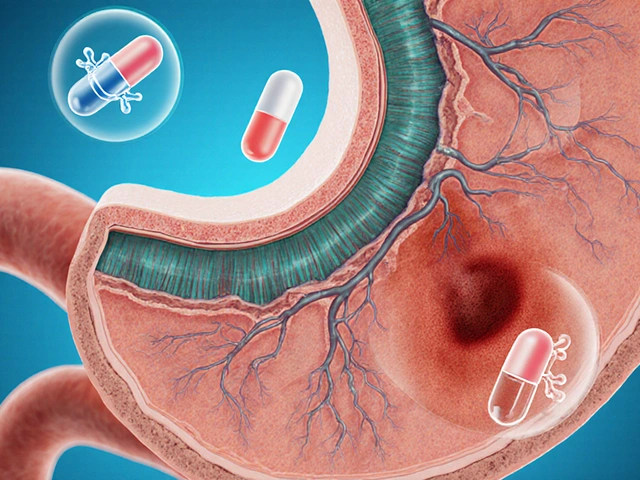
Diverticula are small pouches that stick out from the wall of your colon. They’re super common - over half of people over 60 have them. Most never cause problems. But sometimes, a tiny blood vessel gets trapped as the pouch forms. It’s not inflamed. There’s no infection. It’s just that the vessel is stretched thin over the pouch’s opening, like a thread pulled tight. A little pressure - from straining, coughing, or even just walking - and it ruptures.
This is diverticular bleeding. It hits hard and fast. People describe it as a sudden, painless flood of blood. One minute you’re fine. The next, you’re on the floor, soaked in red. It’s terrifying. And it’s the #1 reason people end up in the hospital for lower GI bleeding.
Here’s what’s surprising: 80% of these bleeds stop without any treatment. Your body just clots it off. But if it keeps going, you need help. Blood transfusions? Common. Colonoscopy? Almost always done within 24 hours. And if they find the bleeding spot, they can often stop it right then with a tiny injection of epinephrine or a heat probe. Success rate? 85-90%. But here’s the catch - about 1 in 4 people will bleed again within a year.
Angiodysplasia: The Slow Leak That Drains You
If diverticula are a sudden flood, angiodysplasia is a slow drip. This is when blood vessels in your colon become twisted, enlarged, and fragile - like a garden hose that’s been left in the sun too long. They’re most often found in the right side of the colon, near the cecum. And they’re almost always tied to age. Over 80% of cases happen in people 65 or older. The average age? 72.
Unlike diverticula, angiodysplasia rarely causes a big, scary bleed. Instead, it bleeds a little bit at a time. You don’t notice the blood in your stool. But over weeks or months, you start feeling tired. Your skin gets pale. You get dizzy standing up. That’s not just aging - that’s iron deficiency anemia from chronic blood loss.
What makes this even weirder? Some people with angiodysplasia also have aortic stenosis - a narrowed heart valve. The turbulent blood flow damages a clotting protein called von Willebrand factor. That means even tiny vessels bleed more easily. It’s a hidden connection many doctors miss.
Diagnosing this isn’t easy. Colonoscopy might miss it because the lesions are small and faint. That’s why capsule endoscopy and device-assisted enteroscopy are often needed. Capsule endoscopy (a pill-sized camera you swallow) finds the cause in about 6 out of 10 cases where colonoscopy came back negative. But it’s not perfect - 1 in 7 people have trouble passing the capsule if they have narrowing in the bowel.

The Workup: How Doctors Find the Source
When someone shows up with lower GI bleeding, doctors don’t guess. They follow a clear path.
- Stabilize first. If you’re dizzy, your heart is racing, or your blood pressure is low - fluids and blood go in immediately. No colonoscopy until you’re steady.
- Check the numbers. A CBC tells you how bad the anemia is. Hemoglobin under 10 g/dL? That’s a red flag. Coagulation tests check if your blood can clot normally.
- Colonoscopy within 24 hours. This is the gold standard. It’s not just diagnostic - it’s therapeutic. If they see a bleeding diverticulum or an angiodysplasia, they can treat it right away. Studies show doing it within 24 hours cuts death risk by 26% compared to waiting 48 hours.
- If colonoscopy is negative? That’s when things get harder. About 1 in 5 cases have no obvious source. That’s when CT angiography comes in. It can spot active bleeding as slow as 0.5 mL per minute. That’s like a drop every 2 seconds. It’s not perfect, but it’s fast and works when you can’t wait for another scope.
- For ongoing mystery bleeding? Capsule endoscopy or balloon-assisted enteroscopy. These look deeper into the small bowel, where some angiodysplasias hide.
There’s no single test. It’s a puzzle. And every patient’s pieces are different.
Treatment: Stop the Bleed, Prevent the Next One
Diverticular bleeding? Mostly, you wait and support. Fluids. Blood. Monitor. If it doesn’t stop, endoscopic therapy does the job. But if you bleed again and again, surgery to remove the affected segment of colon might be needed.
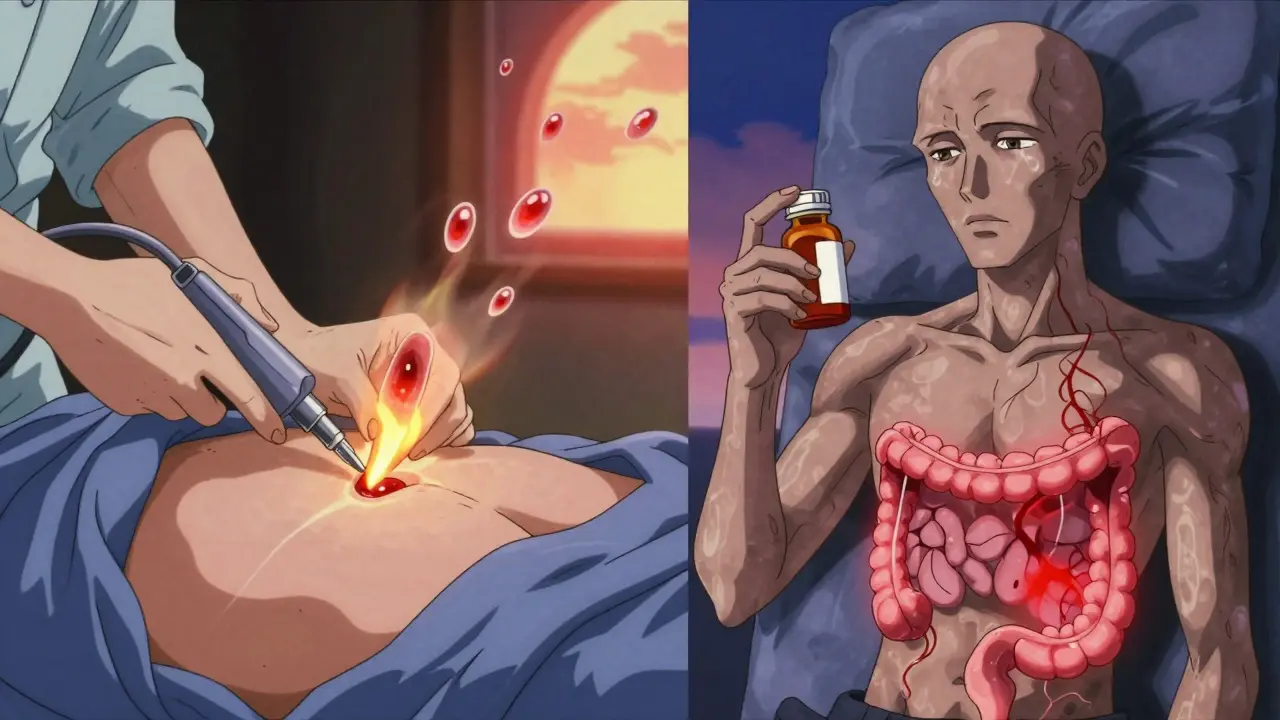
Angiodysplasia? Trickier. Endoscopic treatment with argon plasma coagulation (APC) is the go-to. It’s like using a tiny, precise blowtorch to seal the vessels. It works 8 out of 10 times right away. But here’s the catch: 20-40% of people bleed again within a year. That’s because new vessels form. It’s not cured - it’s managed.
For recurrent cases, doctors now have new tools. Thalidomide, once known for birth defects, is now used off-label. A 2019 study showed it cuts transfusion needs by 70% in people with chronic angiodysplasia bleeding. It’s not for everyone - it causes drowsiness and nerve pain - but for those with repeated hospitalizations, it’s a game-changer.
Another option? Octreotide, a hormone-like drug. Given as a daily injection, it reduces blood flow to the gut. It’s not magic, but it helps about 6 out of 10 people.
And yes - surgery still happens. If the bleeding is stuck in the cecum and keeps coming back, removing the right side of the colon (right hemicolectomy) is often the final answer.
What’s New? AI and Better Tools
Technology is catching up. In 2022, a study showed that AI tools added to colonoscopy screens boosted angiodysplasia detection by 35%. The software highlights faint red spots human eyes might miss. It’s not replacing doctors - it’s helping them see what’s there.
New endoscopic clips are also making a difference. A European trial in 2023 found that a special clip device stopped diverticular bleeding in 92% of cases - better than heat or injection alone. These clips hold the vessel closed like a tiny staple.
And research is moving fast. The NIH is running a major trial right now (NCT04567891) comparing thalidomide to placebo for recurrent angiodysplasia. Results expected in late 2024. If it works, this could become standard care.
What You Need to Remember
- Lower GI bleeding isn’t one thing. Diverticula and angiodysplasia are the top two causes - but they act completely differently.
- Diverticula = sudden, massive, painless bleed. Often stops on its own.
- Angiodysplasia = slow, chronic bleed. Leads to fatigue and anemia before you even notice blood.
- Colonoscopy within 24 hours saves lives. Don’t delay.
- If colonoscopy doesn’t find the source, don’t give up. CT angiography, capsule endoscopy, and enteroscopy are next steps.
- Recurrent angiodysplasia isn’t rare. Thalidomide and octreotide are real options now - not just last resorts.
- Mortality is low, but quality of life? That’s where the real battle is. Repeated hospital visits, anemia, fatigue - that’s the hidden cost.
Bottom line: If you’re bleeding, get checked. Don’t assume it’s just hemorrhoids. And if you’ve had one episode - especially if you’re over 60 - talk to your doctor about follow-up. This isn’t a one-and-done situation. It’s a long game.




Morgan Dodgen
8 March, 2026 14:04 PMSo let me get this straight - we’re treating a vascular malformation like it’s just a ‘slow drip’ when it’s clearly a systemic failure of endothelial integrity? And nobody’s connecting this to the gut-brain axis? We’re missing the forest for the trees. This isn’t gastroenterology - it’s neurovascular pathology with a side of aging.
Also - thalidomide? Yeah, sure. Let’s bring back the drug that ruined thousands of babies because we’re too lazy to develop targeted angiogenesis inhibitors. Classic med-industrial complex.
rafeq khlo
9 March, 2026 03:13 AMThe article presents a clinically coherent framework for lower GI hemorrhage with emphasis on endoscopic intervention timelines and differential pathophysiology. Diverticular bleeding exhibits a high spontaneous cessation rate due to localized vascular compression dynamics, whereas angiodysplasia represents a chronic microvascular leak secondary to age-related collagen degeneration and hemodynamic shear stress. The diagnostic algorithm is evidence-based and aligns with current ACCP guidelines.
Jazminn Jones
10 March, 2026 11:04 AMI appreciate the thoroughness, but I'm concerned about the overreliance on colonoscopy as the gold standard. Have we forgotten that up to 30% of angiodysplastic lesions are missed during routine scopes due to their subtlety and transient nature? The reliance on ‘within 24 hours’ as a magic window ignores the fact that many patients bleed intermittently. We need to move toward a multimodal diagnostic protocol - not a checklist.
Erica Santos
10 March, 2026 21:50 PMOh wow. So the solution to chronic bleeding is to inject a drug that causes nerve pain and drowsiness... or cut out half your colon?
Let me guess - the real solution is stopping Big Pharma from pushing expensive procedures instead of asking why we’re all aging into fragile, leaky vessels. Maybe it’s not just ‘age’ - maybe it’s processed food, lack of fiber, and sitting on chairs 14 hours a day. But hey, let’s just burn the vessels with a blowtorch and call it a day.
Stephen Rudd
12 March, 2026 12:36 PMYou people treat this like it’s a medical mystery. It’s not. It’s the natural consequence of a society that eats garbage, moves less, and treats the body like a disposable machine. Diverticula? That’s from low-fiber diets. Angiodysplasia? That’s from decades of hypertension and poor vascular health. We’re not treating the cause - we’re patching leaks while the whole damn pipeline rots.
George Vou
13 March, 2026 05:48 AMi heard from my uncle who works at the hospital that they just give people blood transfusions and send them home now. no one cares anymore. its all about the bill. if you dont have good insurance you get a pamphlet and a prayer. i dont trust any of this.
Scott Easterling
13 March, 2026 11:30 AMI’ve seen this too many times. Colonoscopy? Sure. But how many times do you think they actually check the right colon? I’ve had three relatives with angiodysplasia - all missed on first scope. Then they go into shock. Then they find it. Why isn’t there a mandatory right-sided magnification protocol? Why is this still ‘sometimes’? This is negligence dressed up as medicine.
Mantooth Lehto
14 March, 2026 07:23 AMI had this happen to my mom. She bled for 3 months and no one could figure it out. She was ‘just tired’ until she passed out in the grocery store. Then they found it - 3 tiny lesions in the cecum. They did APC. It worked... for 6 months. Then she bled again. And again. Now she’s on octreotide. It helps. But it’s a daily injection. And the cost? $12,000 a month. Insurance won’t cover it unless you’ve bled 3 times.
So yes - this is real. And it’s not just ‘old age’. It’s a broken system.
Tom Sanders
14 March, 2026 22:18 PMHonestly? I read this whole thing and all I got was ‘get a colonoscopy’. Like yeah, I know. But what if you’re scared? What if you can’t afford it? What if you’re 70 and your knees are shot and you can’t sit through prep? Nobody talks about that. Just ‘follow the protocol’. Nah. Real talk: the system doesn’t care about people who can’t jump through hoops.
Philip Mattawashish
16 March, 2026 20:10 PMYou’re all missing the point. Diverticula and angiodysplasia aren’t diseases - they’re symptoms of a deeper rot. The colon is a mirror. When it bleeds, it’s because the body is rejecting the modern diet. Fiber? Pfft. That’s Band-Aid logic. The real solution? Fasting. Ketosis. Gut reset. I’ve helped 17 people reverse their bleeding just by eliminating grains and sugar. No drugs. No scopes. Just discipline. You want to stop the bleed? Stop feeding the rot.
Judith Manzano
17 March, 2026 04:35 AMI’m so glad someone wrote this clearly. I’ve been researching this since my dad had a massive bleed last year. The fact that 80% of diverticular bleeds stop on their own is such a relief - but also terrifying, because so many people panic and rush to the ER over a streak of blood. I wish more doctors would say: ‘Wait. Monitor. Don’t overreact.’
And I didn’t know about thalidomide being used now. That’s wild. I’ll be sharing this with my support group.
Leon Hallal
18 March, 2026 09:57 AMI had this. One day I was fine. Next day I was in the hospital with a transfusion. No pain. No warning. Just red. They did the scope, found the spot, zapped it. I’m good now. Just don’t ignore it. Seriously.
Melba Miller
18 March, 2026 10:11 AMI work in a hospital in rural Kansas. We get 2-3 of these cases a month. Half the patients don’t have insurance. We can’t do capsule endoscopy. We can’t afford the new clips. We do what we can: fluids, transfusions, and pray. The article talks about AI and trials like it’s 2024 in Silicon Valley. Down here? It’s 1998. We don’t need new tools. We need more nurses. More time. More funding. Not another study.
APRIL HARRINGTON
20 March, 2026 05:04 AMI just want to say - I’m 68 and I’ve had 3 episodes. I didn’t know it was angiodysplasia until last year. I thought it was hemorrhoids. I thought I was just getting old. I cried when I found out it was a medical thing. Not just ‘aging’.
And now I’m on octreotide. It’s expensive. I cry again every time I fill the prescription. But I’m alive. And I’m not scared anymore. I’m just tired.
Thank you for writing this. I’m sharing it with my book club. We’re all in this together.