
Walking out of a hospital can feel like a victory, but for many patients, the real work begins at home. You leave with a new list of pills, instructions that might contradict what you were taking before, and a follow-up appointment scheduled for two weeks later. In that gap, confusion sets in. Did the doctor stop your blood thinner? Is this new antibiotic okay to take with your heart medication? These aren't just minor details; they are critical safety checks. Medication reconciliation is the process designed to close this gap, ensuring your outpatient doctor knows exactly what changed during your stay.
It’s not just about having a piece of paper. It’s about active communication between the hospital team, your primary care provider (PCP), and any specialists involved. Without this coordination, you risk adverse drug events, unnecessary readmissions, or simply stopping essential medications by accident. Here is how to make sure nothing falls through the cracks.
What Actually Happens During Medication Reconciliation?
Medication reconciliation is a standardized healthcare process that compares a patient's discharge medication list with their current outpatient list within 30 days of leaving the hospital. The goal is simple: identify discrepancies. A discrepancy isn't just a typo; it’s a missed dose, a duplicate prescription, a dangerous interaction, or a forgotten restart of a chronic med like an anticoagulant.
This process is formally recognized by major health bodies. The National Quality Forum designates it as measure NQF 0097, and CMS (Centers for Medicare & Medicaid Services) uses it to track quality. But for you, the patient, it translates to one thing: someone has to verify that your home routine matches your new reality. If your hospital stopped your statin because of liver issues found during surgery, but your PCP doesn’t know, you might keep taking it unnecessarily-or worse, miss a critical change entirely.
The 30-Day Window: Why Timing Matters
You have a specific window to get this right. The standard requirement is that reconciliation happens within 30 days of discharge. This timeframe isn't arbitrary; it aligns with when most post-discharge complications arise. Studies show that 30-70% of hospital transitions involve some form of medication error. If you wait longer than 30 days, the trail of who made which change gets cold.
There are two main ways this reconciliation gets documented:
- Standalone Documentation: Your provider reviews your lists and notes "no changes" or "reconciled" in your chart without necessarily seeing you in person. This can happen via phone or virtual visit.
- Transitions of Care (TRC) Visit: An in-person appointment specifically focused on coordinating your care. This is billable under CPT codes 99495 or 99496, but only one provider can bill for it per discharge episode.
If you’re paying out-of-pocket or navigating insurance, ask your office which method they use. A TRC visit often allows for deeper conversation, but the standalone documentation is faster and less disruptive if your schedule is tight.
Your Role: Don't Just Hand Over the Bag
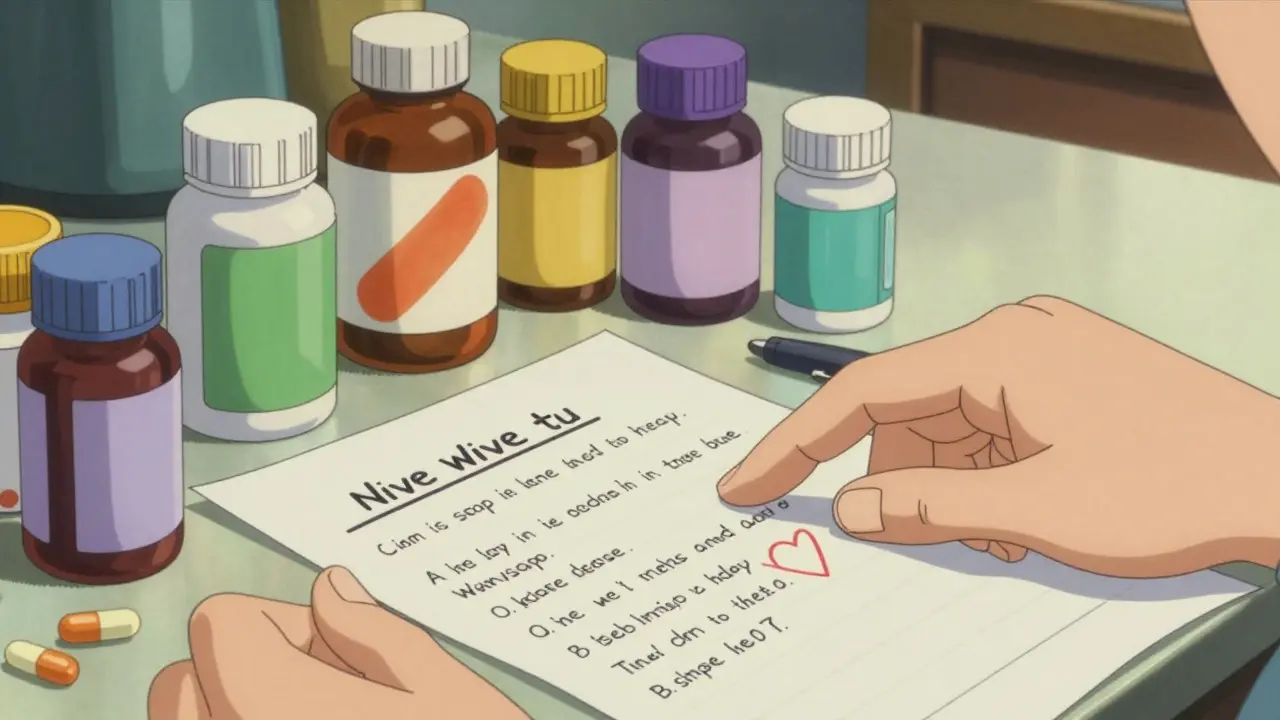
Hospitals rely on providers, but providers rely on patients. The single biggest source of accurate data is you. Before you go to your follow-up, do this:
- Gather everything: Bring all pill bottles, including over-the-counter meds, vitamins, supplements, eye drops, and creams. The ASHP MATCH Toolkit emphasizes that "prescription and over-the-counter medications-including vitamins, supplements, eye drops, creams, ointments, and herbals" must be included.
- Make a simple list: Write down what you were taking *before* the hospital and what they gave you *at discharge*. Highlight anything that looks different.
- Note your adherence: Be honest. If you forgot doses, took them at weird times, or ran out early, tell your provider. PipelineRx data shows that direct patient verification increases accuracy by 41% compared to relying solely on electronic records.
Why does this matter? Because EHRs (Electronic Health Records) are often fragmented. A 2022 AHRQ survey found that 68% of hospitals report fragmented records between settings. Your pharmacist might not see what your cardiologist prescribed last month. You are the bridge.

Provider Communication: Breaking Down Silos
The biggest hurdle isn't the drugs; it's the people. Specialists focus on their organ system. Your cardiologist cares about your heart, not your kidney function or your diabetes meds. This "siloed





Amy Zalkin
28 August, 2026 15:48 PMok so i read this and felt a bit of relief tbh because my mom just got out of the hospital last week and we were totally lost. she has like 14 pills now and half of them are new which is super scary when you dont know if they clash with each other. the part about bringing ALL the bottles including the eye drops and vitamins made me realize we almost left her blood pressure med at home because it was in a different bag. who knew that little detail could be so crucial? also the 30 day thing feels like a tight squeeze but makes sense if you think about how fast things change after surgery. i guess we are going to make a big list on the fridge so nobody forgets what is what. it feels like a lot of work but better than guessing right?
Alex Brown
29 August, 2026 00:38 AMThis is a fascinating look at the administrative machinery behind patient safety. We often view healthcare as a series of clinical interventions, but the true value lies in the continuity of information flow. The concept of medication reconciliation is essentially an audit of reality versus documentation. If the record does not match the physical intake, one of them is wrong, and until verified, the system is fragile. It reminds us that technology, while powerful, is only as good as the data input by humans who are often stressed or rushed.
Kaylyn Mello
29 August, 2026 14:09 PMi agree completely with the point about being honest about adherence. its so easy to just say yes i take them all because you feel guilty for forgetting one dose here and there but the doctor needs the truth to adjust the plan properly. my sister had a bad reaction last year because she thought she was taking her meds but actually ran out three days before and no one knew. its such a simple fix if people just talk
joyce Hogewoning
30 August, 2026 12:10 PMOh my god this post is basically screaming at us to pay attention which is exactly why i am here reading it at 2am because i have been so stressed about my dad's discharge papers and he keeps losing the little envelopes from the nurses so i am trying to figure out if we need to go back to the specialist or just wait for the primary care appointment in two weeks which feels like an eternity when you are worried about whether he should be taking that new heart pill with his old diabetes stuff or if they conflict and cause some kind of weird interaction that nobody warned us about because apparently the hospital team thinks they told us everything but honestly the instructions were a blur and now i am paranoid that we missed something huge like maybe they stopped his anticoagulant and we are still taking it and that would be terrible and i really hope someone can confirm if we should call the office tomorrow morning or just wait and see if anything happens because waiting is the hardest part and i just want to feel like we are doing the right thing for him since he is getting older and more confused and i don't want him to end up back in that bed again so any advice on how to phrase the question to the pharmacist without sounding like a total novice would be amazing because i feel like i am learning all these medical terms on the fly and it is exhausting but necessary i guess
Thhomas Fox
30 August, 2026 18:25 PMGreat breakdown. The 'bridge' metaphor is spot on. Patients are the only constant variable in a fragmented system. Keep your records organized and you keep control.
Owen John
31 August, 2026 04:55 AMTypical US overreach. They invent complex billing codes like 99495 just to monetize basic communication. In the UK, the GP simply asks the hospital what changed. No drama, no 'reconciliation process', just facts. But sure, let's turn a phone call into a billable service. The real issue is that our doctors are too busy filling out forms to actually talk to you. The EHR is a prison for clinicians, not a tool for patients. Don't trust the 'system', trust your own notes. The state wants you dependent on their fragmented records so they can control the narrative. Wake up.
Lilian Binda
1 September, 2026 08:06 AMthis is very important info for everyone especially those of us who have to manage multiple conditions at once. in my country we struggle with this even more because sometimes the hospitals dont even have a proper system to send the list to the community clinics so the patient has to carry everything around. it is so frustrating when you get home and realize the doctor at the clinic doesnt know what the surgeon prescribed. we need better tech and better training for nurses to explain things clearly not just hand you a paper and wish you luck. also the cost of these follow ups can be high if insurance doesnt cover it properly so people just skip appointments and then get sick again. we must push for free access to these coordination visits because health is a right not a privilege. let us fix this broken system before more people suffer from preventable errors. its time for action not just reading articles
Fabian Saldana
3 September, 2026 05:22 AMExcellent guide. This level of preparation transforms a stressful transition into a manageable routine. Proactive communication is the key to long-term health stability. Take charge of your medical journey today.
Colin Finch
3 September, 2026 16:05 PMWhat a vital topic! I cannot stress enough how much peace of mind comes from just having that one list in front of you. It changes the whole dynamic of the conversation. You stop feeling like a passenger and start feeling like a partner in your own care. So empowering, really. Thank you for sharing this practical advice!